Monday, August 4, 2025

A Young Couple Moved into a New House on Lowell Avenue in 1912

      On Wednesday evening, May 15, 1912, dozens of guests arrived at the Goe family home on South Ritter Avenue to witness the marriage of Theodore Kingsbury to Cornelia Goe. Their union brought together two very prominent Irvington families. Theodore was the seventh son of James G. Kingsbury, the publisher of the Indiana Farmer. Theodore hardly knew his biological mother as she died when he was two years old. His stepmother, Kate Gunckel Kingsbury, helped to raise him in homes on Lowell and Layman Avenues along with his stepsister, Edna Gunckel. At the time of his marriage, he worked for his father at the Indiana Farmer.

     Cornelia Goe was the daughter of Hezekiah and Cornelia Farnsworth Goe of 128 South Ritter Avenue. She had two brothers and two sisters. She graduated from Emmerich Manual High School and later attended Butler University. Her father earned a comfortable income running a popular grocery store in Moore's Hall at 130 South Audubon Road. Since her family attended the Irvington Methodist Church, the Reverend John Bickel officiated the wedding that night. We do not know if the couple went on a honeymoon, but we do know that on June 12, 1912, James G. Kingsbury hosted a dinner for the couple at his home at 71 North Ritter Avenue.

     Three days later, the newlyweds moved into a new house at 5515 Lowell Avenue. Theodore would have known the location of the house quite well as it was built in the backyard of a previous home belonging to his father at 98 Layman Avenue. William Babbitt took out a building permit in the spring of 1912 and erected the Dutch Colonial Revival residence for $1600. Babbitt used concrete blocks to clad the first floor and wood shake for the second floor. The elderly Kingsburys lived just around the corner at 71 North Ritter Avenue--also in a concrete-block home. 

     The Kingsburys lived here for five years before moving to Washington D.C. Cornelia appears to have adopted the Irvington Presbyterian Church and attended services with her husband's family. Various Presbyterian groups met at their home including the group seen below in the photographs. She was also very involved in a women's group called the Irvington Coterie Club. They met on Thursdays and newspaper accounts reveal that she hosted the ladies numerous times in this house. The club focused on historical topics as well as current events. Theodore spent much of his time during the warmer months on various golf courses. He was quite good at the sport and frequently made the sport pages for his low scores. 

     Within one year of moving into the residence, Theodore Kingsbury suffered the loss of his father in the spring 1913. The burden for operating the Indiana Farmer fell upon both he and his brother, James L. Kingsbury. Joy found a way into the home in 1915, with the birth of the couple's first child, Cornelia. If you are keeping track, that is the third Cornelia mentioned in this article. 

      In 1917, the Kingsburys relocated to the nation's capital where he found employment with the U.S. Department of Agriculture. They didn't stay there long, however, and by 1919, the couple found their way back to Irvington. 


Cornelia Goe Kingsbury sat on the steps of her new house at 5515 Lowell Avenue c1912 (photo courtesy of the Kingsbury family)

Theodore Kingsbury sat on his porch at 5515 Lowell Avenue c1912. Behind him you can see the residences at 5506 and 5510 Lowell Avenue. (photo courtesy of the Kingsbury family)

Cornelia Goe Kingsbury sat on the front porch at 5515 Lowell Avenue. If you look closely, you can see a horse in the alley next to the residence. (photo courtesy of the Kingsbury family)

A group from the Irvington Presbyterian Church met in the home of Theodore and Cornelia Kingsbury in either 1912 or early 1913. James G. Kingsbury was a founder of the church and considered an elder at this point in his life. Pictured: Front row left to right--James L. Kingsbury, Charlie Davis, Theodore Kingsbury, Cornelia Kingsbury (above Theodore), Reverend John S. Martin, Merrill Woods; Second Row--Grace Goe, Anna Kingsbury, James G. Kingsbury, Edna Boyle, Mary Martin, ?, Maude Martin Davis, ?, ?, Clara Goe; Top row--listed in order on photo although some names have been left off by the original documenter: Mrs. Martin, Gertrude Meisenhelder, Bonnie Major, ?, Mr. and Mrs. Layman?, Edith Schowe, Hermine Reller, and ? (photo courtesy of the Kingsbury family)

     I wish to thank Kathy and Dick Meyer for their stories and photographs. I also wish to thank Alyssa Stewart and Steve Barnett for their help with research on this house. 

Sources:  Kingsbury-Goe wedding: "Kingsbury-Goe Wedding," Indianapolis News, May 16, 1912, p. 7; "Irvington," Indianapolis Star, June 16, 1912, p. 26; House construction: "Building Permits," Indianapolis News, May 21, 1912, p. 15; Irvington Coterie Club: "Affairs of Clubs," Indianapolis Star, May 20, 1014, p. 13; "Clubs," Indianapolis Star, December 12, 1915, p. 37; Irvington Presbyterian Church involvement: "News of Churches," Indianapolis Star, August 29, 1914, p. 3.

Saturday, July 26, 2025

Phi Delta Theta--First Fraternity House Built in Irvington

      Theodore Kingsbury, the youngest son of James G. Kingsbury, graduated from the Winona Agricultural Institute in 1907. One year later, he enrolled at Butler University in Irvington where he played football. He also seems to have been involved with Phi Delta Theta Fraternity along with his nephew, Layman Kingsbury. His association with the fraternity came at an important time for the organization as the men had just built their first chapter house near the campus on the northwestern corner of Emerson Avenue and East Washington Street. 

     Architect, Frank B. Hunter, designed the two-story residence as a bungalow in the spring of 1908. On the first floor he placed the chapter hall and study room. He located the dining room and kitchen in the basement, and he situated the sleeping rooms on the third floor. Lt. Governor Hugh T. Miller, a legacy of the fraternity, helped to dedicate the new house on November 19, 1908. The structure cost $3500 and was the first fraternity house ever built in the neighborhood. Other fraternities generally rented existing homes. 

     With the arrival of the new Pleasant Run Parkway, the fraternity relocated west of the stream at 5020 East Pleasant Run Parkway North Drive in 1915. The site of the former home became a small park dedicated to the memory of Hilton U. Brown, Jr., who died in World War One. To see many more photos of the Phi Delta Theta home, including interior shots, click on the "Phi Delta Theta" link below. 


The Phi Delta Theta Fraternity House, c1908 used to be located on the northwestern corner of Emerson Avenue and East Washington Street.  It was moved in 1915 to its current location on the northwestern corner of Pleasant Run Parkway and East Washington Street. The home barely visible in the background belonged to cartoonist, Kin Hubbard, who lived at 5070 East Pleasant Run Parkway North Drive. (photo courtesy of the Kingsbury family)

Frank B. Hunter designed the Phi Delta Theta Fraternity House in 1908. (Indianapolis Star, May 2, 1908, p. 4)

Up Next: A Young Couple Moved to Lowell Avenue in 1912     

     I wish to thank Kathy and Dick Meyer for the use of the Kingsbury family photo collection. 

Sources:  Construction and design of house: "Building Permit," Indianapolis News, April 17, 1908, p. 20; "Butler Phi Delta Theta House Now Under Construction," Indianapolis News, May 2, 1908, p. 4; "Phi Delta Theta House," Indianapolis News, November 20, 1908, p. 7; Moving of house: "Building Permits," Indianapolis Star, August 24, 1915, p. 12. 

Saturday, July 19, 2025

A Concrete-Block House in Irvington

      Friends and family were likely surprised to learn that 76-year-old James G. Kingsbury and 68-year-old Kate Kingsbury decided to move from their Layman Avenue home into a new residence at 71 North Ritter Avenue in 1907. They were not just moving into any home, but one that had been clad in concrete blocks. Local businesses mass produced concrete blocks for construction lowering the costs for such a residence. Another nearby home at 65 North Ritter Avenue also had a first story built of concrete block. Mr. Kingsbury's scrapbook noted that his home was the first concrete block house in the neighborhood. While he took out a building permit for the residence in 1905, the family did not move in right away. 

     James G. Kingsbury still served as the publisher of the Indiana Farmer although his sons, James L. and Theodore, took on more responsibility for the publication.  Only his young son, Theodore, still lived at home. On November 17, 1907, all seven of Mr. Kingsbury's sons gathered at the new house to celebrate Theodore's 21st birthday. Sadness, however, soon gripped the family as Kate Kingsbury, the third wife of James G. Kingsbury, faced a dire cancer diagnosis. She penned a column in the Indiana Farmer called "Aunt Kate" where she discussed domestic issues. In her final column, she wrote:

          For over a year I have been an invalid, and during that time there has not been a day that I have not had reason to thank God for neighbors. Fruits, flowers, and dainties, have been almost daily offerings. And how good things taste that come to you unexpectedly...And flowers! From the time of the early spring crocuses awaken from their wintry slumbers, until the frosts cut short the chrysanthemum blooms, I have not been a day without flowers...

     Mrs. Kingsbury died on April 1, 1908, leaving James G. Kingsbury a widower for a third time. Mr. Kingsbury continued to go to his office at the Indiana Farmer. On January 18, 1910, his family held a surprise birthday party for him after he returned from work. An Indianapolis News article noted that the entire house at 71 North Ritter Avenue was illuminated to celebrate his 78th birthday. A few weeks later, he surprised his friends and family by announcing that he had taken out a marriage license to wed a 62-year-old widow named Anna Risk. On February 10, 1910, the couple gathered at the Somerset Apartments to be married by the Reverend Frank O. Ballard of the Memorial Presbyterian Church. Only a few witnessed the moment, and then the couple honeymooned in Washington D.C. and New York City before returning to their Ritter Avenue home. 

     At some point before 3:30 AM on the morning of May 5, 1910, Mr. Kingsbury went to the window of his second-story bedroom on Ritter Avenue and looked to the east. There in the quiet of the night, he witnessed Halley's Comet racing over Irvington. Ever the journalist, he recorded the moment and the Indianapolis News reported that he was the first in the city to see the comet. 

     Mr. Kingsbury's death on June 11, 1913, was widely reported around the state of Indiana. His efforts to write about Hoosier agriculture had been impactful. He left behind his fourth wife, seven sons, one step daughter, and numerous grandchildren. Some of those descendants have been very generous with their time, stories, and photographs. I am very grateful to them. 

Up Next:  A Butler Fraternity House on Pleasant Run Parkway


"The First Concrete Block House in Irvington," as reported from the scrapbook belonging to the Kingsbury family, c1907. The photo is also important because it shows the side of 75 North Ritter Avenue, a house destroyed by fire in 1920. A double later replaced that home.  (photo courtesy of the Kingsbury family)

This c1913 photo in front of 71 North Ritter Avenue is remarkable as it shows a very young John K. Kingsbury (seated and holding a hat). He later became a beloved local doctor and a witness in the infamous trial involving D.C. Stephenson, the Grand Dragon of the Ku Klux Klan, and murderer of Madge Oberholtzer. His testimony helped to convict the man. Seated (left to right) James G. Kingsbury, John K. Kingsbury, Anna Risk Kingsbury, Kate Kingsbury holding Frank Kingsbury, and Charles Kingsbury; Standing (left to right): Florine Kingsbury, Hannah Kingsbury, Pearl Kingsbury, Edna Gunckel, Cornelia Goe Kingsbury, Nathan Howard Kingsbury, Theodore Kingsbury, Franklin Kingsbury (photo courtesy of the Kingsbury family)

Nathan Howard ("Punk") Kingsbury, James G. Kingsbury, and Theodore Kingsbury after a big snowstorm at 71 North Ritter Avenue c1910. You can also see the south side of the Clancy home at 75 North Ritter Avenue. That home burned in 1920. (photo courtesy of the Kingsbury family)

Charles Kingsbury, Kate Kingsbury, Hannah Kingsbury, and Nathan Howard Kingsbury c1910 on the steps of 71 North Ritter Avenue. (photo courtesy of the Kingsbury family)

Theodore Kingsbury, Sylvia Ewan (Lil), and the Marsh sisters standing at the rear of 71 North Ritter Avenue c1910 (photo courtesy of the Kingsbury family)

Edna Gunckel was the daughter of Kate Gunckel Kingsbury, the third wife of James G. Kingsbury. Letters in the Kingsbury family collection reveal that she remained close to the family for years. This photo was likely snapped c1910 in front of 71 North Ritter Avenue. After Mr. Kingsbury died in 1913, he left his stepdaughter some of his money. (photo courtesy of the Kingsbury family)

Always the farmer, Mr. Kingsbury worked in the backyard of his home at 71 North Ritter Avenue c1910. Behind him you can see the rear of 76 and 98 North Layman Avenue. (photo courtesy of the Kingsbury family)

Theodore Kingsbury and Sylvia Ewan c1910 behind 71 North Ritter Avenue. (photo courtesy of the Kingsbury family)

71 North Ritter Avenue after a snowstorm c1910 (photo courtesy of the Kingsbury family)

71 North Ritter Avenue on July 16, 2025

     I wish to thank Kathy and Dick Meyer for their wonderful help with this article. I also wish to thank Marion County historian, Steve Barnett, who helped me pin down a date on the house. 

Sources:  The 1910 Federal Census; Polks's Indianapolis City Directories, 1906-1914; Birthday party for Theodore Kingsbury: Indianapolis News, November 18, 1907, p. 7; Obituaries for Kate Kingsbury: "Mrs. Kingsbury Dead," Indianapolis News, April 2, 1908, p. 7; "Death of Mrs. Kingsbury," Indiana Farmer, April 11, 1908, p. 10;  J.G. Kingsbury Surprise Birthday Party: "Birthday-Anniversary," Indianapolis News, January 19, 1910, p. 7; J.G. Kingsbury and Halley's Comet: "Arise Early, Look East And You Will See It," Indianapolis News, May 5,1910, p. 1; J.G. Kingsbury to Anna Risk: "Will Marry Fourth Wife," Indianapolis Star, February 10, 1910, p. 1; "Society," Indianapolis News, February 10, 1910, p. 7; Obituary for James G. Kingsbury: "James G. Kingsbury, of Indiana Farmer, Dead," Indianapolis News, June 12, 1913, p. 7. James G. Kingsbury's Will:  "Kingsbury Will Probated," Indianapolis Star, July 8, 1913, p. 3. 


Wednesday, July 9, 2025

Layman and Lowell Avenues in the Early 20th Century


     Between 1903 and 1907, James G. and Kate Kingsbury resided in the two-story home located at 98 North Layman Avenue. Almost as soon as he moved in, Mr. Kingsbury took out a building permit for an addition on to the home in the autumn of 1903. He also applied for a building permit in the following year to repair a barn on the property. 

     The Kingsburys were not the first to reside in the house. The Hannas lived at 98 North Layman in the late 1890s and the Williams family resided in the house in the early 1900s. Thomas Hanna (1841-1901) had been the Lt. Governor for the state of Indiana from 1881-1885. 

     For reasons unknown, 74-year-old James G. Kingsbury and 67-year-old Kate Kingsbury moved to a new house located nearby at 71 North Ritter Avenue. Photos from the Kingsbury family show the homes that existed at the intersection of Lowell and Layman Avenues between 1903 and 1915. 

James G. Kingsbury posed with his son, Theodore Kingsbury, at 98 North Layman Avenue c1903 (photo courtesy of the Kingsbury family)

James G. Kingsbury posed in front of his home at 98 N. Layman Avenue c1903. Behind him, you will note that no houses had yet been built on the south side of the 5600 block of Lowell Avenue. If you look closely, you can see the side of 5716 Lowell Avenue. (photo courtesy of the Kingsbury family)


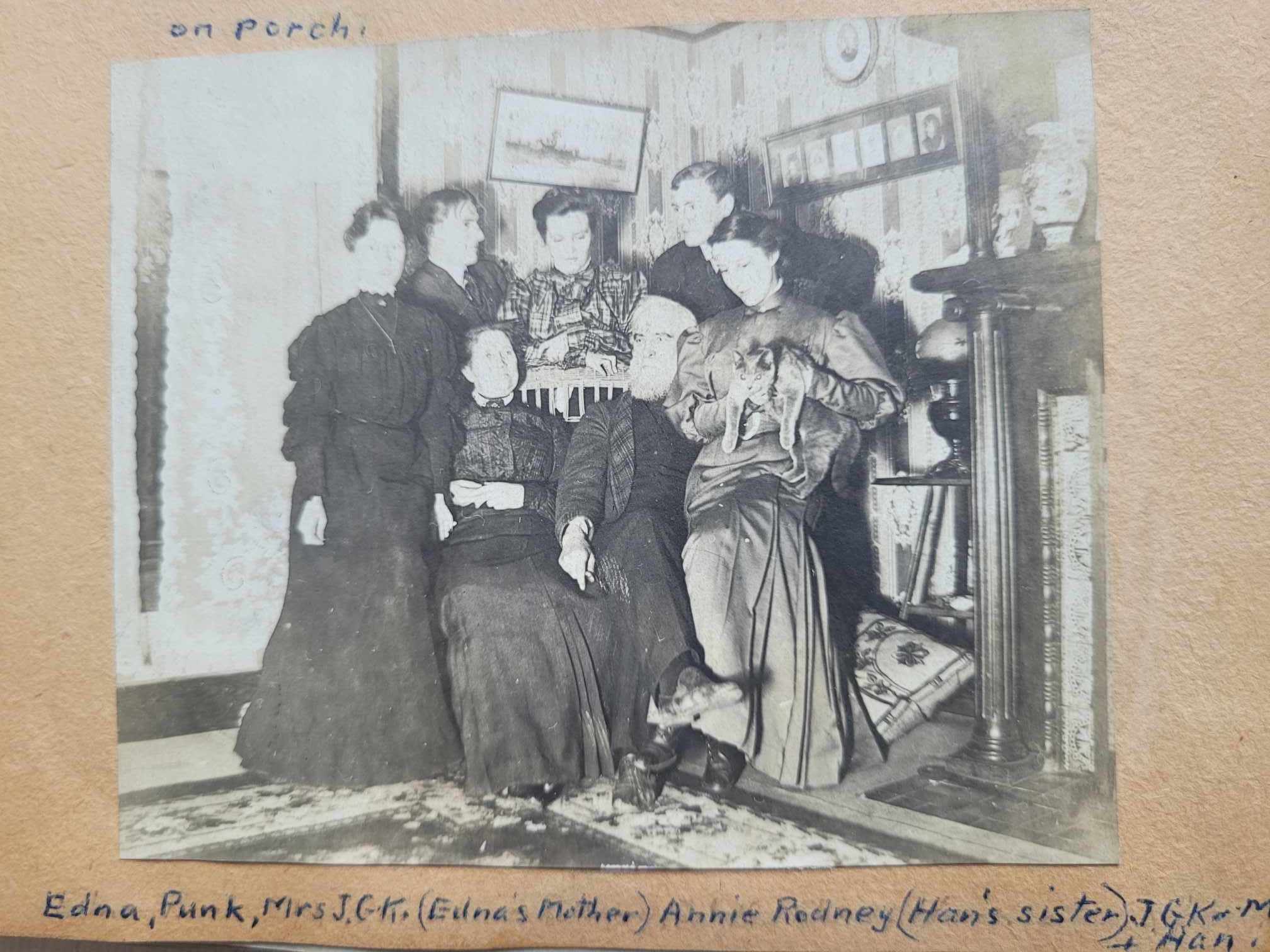
Friends and family of the Kingsburys gathered in the dining room of their home at 98 North Layman Avenue c1903. Seated (left to right): Kate Gunckel Kingsbury, James G. Kingsbury, Hannah Rodney Kingsbury (holding a cat); Standing (left to right): Edna Gunckel, Nathan Howard ("Punk") Kingsbury, Annie Rodney (sister to Hannah), and  Theodore Kingsbury (photo courtesy of the Kingsbury family)

308 North Layman Avenue

     Frederick M. and Alice Dickerman resided in the newly-constructed home at 308 North Layman Avenue in 1906. If they had looked out their dining room window, they would have seen James G. Kingsbury mowing his yard at 98 North Layman. Mr. Dickerman worked as a postal clerk for a railroad. The Dickermans lived in a variety of Irvington homes before moving to Los Angeles, California. 

James G. Kingsbury mowed his yard at 98 North Layman Avenue. Behind him you can see 308 North Layman Avenue c1906. (photo courtesy of the Kingsbury family)


5602 Lowell Avenue

     Cornelia Kingsbury, the daughter of Theodore and Cornelia Goe Kingsbury, was the subject of this photograph in the winter of 1915. The Kingsburys resided at 5515 Lowell Avenue at the time. Behind the baby, you can see several houses in the 5600 block of Lowell Avenue. The most visible home is 5602 Lowell Avenue (on the left). Wellington and Anne Downing had resided in that home since 1905. Mr. Downing was a contractor and built many homes in that section of Irvington. 

Cornelia Kingsbury in front of her home at 5515 Lowell Avenue in 1915. Behind her, you can see the intersection of Lowell and Layman Avenues. (photo courtesy of the Kingsbury family)


Up Next:  The First Concrete Block House in Irvington? 

     I wish to thank Kathy and Dick Meyer for their stories and photos of Irvington. I also wish to thank Katherine Meadows who assisted me with research on 98 North Layman Avenue. 

Sources: Interview with Kathy and Dick Meyer, June 9, 2025; 1910 Federal Census; Polk's Indianapolis City Directory, 1903-1915; Frame addition to 98 North Layman Avenue: "Building Permits," Indianapolis Journal, November 14, 1903, p. 8; Repairs to Barn: "Building Permits," Indianapolis Journal, April 9, 1904, p. 10.

Wednesday, July 2, 2025

Lost Irvington: The Kingsbury Home on Lowell Avenue

      The home belonging to James and Mary Kingsbury has been missing since 1917. In fact, it has been gone longer than it ever stood on what is today the northeast corner of Lowell and Bolton Avenues. James G. Kingsbury, the editor and publisher of the Indiana Farmer, a publication for Hoosiers involved in the agricultural and horticultural business, moved his large family into 5860 Lowell Avenue in 1886 or 1887. We do not know if they were the first owners of the grand Italianate home, but they lived in the residence until 1903. The family also owned a 28-acre farm behind the house on what is today North Bolton and Campbell Avenues. 

     Long before he moved to Irvington, James G. Kingsbury had likely known about the community as he was very involved in the Prohibition Party along with one of the founders of Irvington, Sylvester Johnson. Many of his children also attended Butler University. One of his sons, James L. Kingsbury moved to the area one year before his father and settled along Layman Avenue. Irvington's "dry" laws likely appealed to Mr. Kingsbury as well. 

     In total, James G. Kingsbury had four wives. His first wife, Mary Layman Kingsbury died before he moved to Irvington. Not long after relocating, Mary Taylor Kingsbury, his second wife, died at the young age of 43 on August 5, 1888. A year later, James G. Kingsbury married Kate Gunckel of Cincinnati on September 4, 1889. She lived long enough to move with him from his lovely home on Lowell Avenue to another residence on Layman Avenue. Only his fourth and final wife, Anna Graham Risk Kingsbury, outlived him. 

      When a census taker arrived at 5860 Lowell Avenue in 1900, he found a very full house. Besides 68-year-old James G. Kingsbury and 61-year-old Kate Gunckel Kingsbury, the enumerator also noted 25-year-old Charles Kingsbury, a son, who worked with the telephone company; 21-year-old Howard Kingsbury, who worked as a railroad clerk; 20-year-old John Fletcher Kingsbury, who served as a mechanic; and 13-year-old Theodore Kingsbury, who was still in school. Mr. Kingsbury also welcomed his former mother-in-law, 84-year-old Jane B. Taylor and his 22-year-old step daughter, Edna Gunckel into the home. Miss Gunckel worked as a proofreader. A 20-year-old servant named Lena Funke and her 2-year-old son, Edgar Funke also boarded in the house. 

     In an interview with a reporter for the Indianapolis News in 1903, Mr. Kingsbury noted that he had created a model farm and had hoped that one of his seven sons would take over the business; however, none of them were interested so he sold the house and the land to Willis Wright of Terre Haute, Indiana. The Kingsburys held one final reunion in the residence on July 3, 1903. After their departure, many people moved in and out of the house until W.H. Cooper applied for a permit to demolish the structures in 1917. Fascinatingly, Josephine Hyde Woodbury, pioneering female developer, purchased the farm and created a new subdivision called "Edgehill." A beautiful brick American Foursquare home was built for the Lewis family on the site of the former Kingsbury home in 1920. 


The Kingsbury home at 5860 Lowell Avenue c1895 (photo courtesy of the Kingsbury family)

Kingsbury home at 5860 Lowell Avenue c1895 (photo courtesy of the Kingsbury family)

5860 Lowell Avenue c1900 (courtesy of the Kingsbury family)

The Kingsbury home at 5860 Lowell Avenue can be seen on this 1889 map of Irvington. The residence and barn are located just next to "89" on this map. You will note that Bolton Avenue north of Lowell Avenue did not exist yet. Pleasant street, denoted in a dotted line, was never built. . (Irvington Historical Society)

James G. Kingsbury created a model farm behind his house at 5860 Lowell Avenue. He can be seen here c1895. The farm stretched up to Pleasant Run stream and over to Arlington Avenue. (photo courtesy of the Kingsbury family)


"Kendall," a farm hand, (far left) stood near Nathan Howard (Punk) Kingsbury, Theodore Kingsbury, and John Fletcher (Butch) Kingsbury. Charles Kingsbury stood next to Billy the horse c1892. (photo courtesy of the Kingsbury Family)

James G. Kingsbury, the Secretary of the Indiana Farmer, kept an office for the publication on the grounds of the Indiana State Fair. (photo courtesy of the Kingsbury family)

Site of former Kingsbury home on June 23, 2025

 Up Next:  The Intersection of Lowell and Layman Avenues in the Early 20th Century

     I wish to thank Kathy and Dick Meyer for the stories and use of the photographs from the Kingsbury family. Kathy is a descendant of James G. and Mary Taylor Kingsbury. 

Sources:  Polk's Indianapolis City Directories, 1886-1918; US Federal Census Records, 1880, 1900, 1910; Interview with Kathy and Dick Meyer, June 9, 2025; Kingsbury family in the 1880s: "Personal Mention," Indianapolis Journal, May 27, 1884, p. 3; "Death of Mrs. Kingsbury," Indianapolis Journal, August 7, 1888; "Personal and Society," Indianapolis Journal, September 5, 1889, p. 7;  Prohibition Work: "Articles of Association," Indianapolis Journal, January 17, 1885, p. 7; "The City in Brief," Indianapolis Journal, November 10, 1885, p. 8; "Prohibitionist Satisfied," Indianapolis Journal, December 21, 1889, p. 1; Agricultural work:  Indiana Farmer and agricultural work: "The Agricultural Board," Indianapolis Journal, January 8, 1885, ; "In Brief," Indianapolis Journal, June 10, 1887, p. 8; Buying and selling house:  "Personal," Indianapolis News, June 11, 1887, p. 2; "Movement in Real Estate," Indianapolis Journal, May 27, 1888, p. 5; "Real Estate Transfers," Indianapolis Journal, October 31, 1889, p. 7; "Model Fruit Farm Sold," Indianapolis News, July 4, 1903, p. 24; "Twenty-Seven Transfers Made Matter of Record Yesterday," Indianapolis Journal, August 4, 1903, p. 8; Demolition--"Building Permits," Indianapolis Star, November 7, 1917; Edgehill--"Edghill in Irvington," Indianapolis News, June 21, 1919, p. 3.

Thursday, May 29, 2025

Historic Glass Negatives See the Light


     In 1965, Richard and Colleen Wilson moved into 68 North Ritter Avenue. Under the basement stairs the couple discovered a soap crate filled with several hundred historic glass negatives. The family kept the artifacts for years and then donated the collection to the Irvington Historical Society in 2012.

     After receiving a grant, members of the Irvington Historical Society scanned all 338 images.  Director, Steve Barnett, determined that the photos belonged to Osbert Sumner, who lived at the Ritter Avenue home from 1904 until his death in 1932. Over the next decade researchers thoroughly examined each photograph. A major breakthrough occurred in 2022, when local researcher Deedee Davis discovered a Sumner family diary at the Oakville, Ontario Historical Society. Osbert Sumner originally lived in that town before moving to Indianapolis. The diary provided key entries that helped unlock many of the mysteries of the collection.

     Mr. Sumner's photographs contains incredible documentation of life in Canada and Indianapolis from 1899 to 1903. His subjects included family members and friends, canoe outings, parades, a convention, and even the funeral of President Benjamin Harrison. Some of the photos had been developed, but many will now be seen for the first time in over 125 years.

     To see these incredible photos in person, visit the Bona Thompson Center at 5350 University Avenue in Indianapolis. The collection will be on display from May 31 until November 16, 2025. We are open on the weekends from 1-4PM.  I have included a small sample below. 


Osbert Sumner photographed an unidentified girl on the steps leading to the Benton Home at 312 South Downey Avenue in Irvington. He most likely took the photo on July 4, 1901. He attended a celebration there. 


George Sumner, the father of Osbert Sumner, kept a diary. From one of his entries, we know that this photo was likely taken on October 10, 1900 in downtown Indianapolis. The elder Sumner, who lived in Oakville, Ontario, was visiting his family here. The city hosted a "Fall Carnival" complete with temporary ornamental arches leading into Monument Circle. 

Osbert Sumner captured a fallen cyclist in the Morton Place neighborhood of Indianapolis near the intersection of East 19th and North Delaware Streets. Note the beautiful esplanade that used to be in the middle of the street c1900. 

Osbert Sumner (1872-1932) received a camera as a gift from his fellow co-workers in 1898. For the next several years, he documented life in Indianapolis and back in his hometown of Oakville, Ontario. He loved the outdoors and many of his photos show excursions in canoes on various waterways in central Indiana. 

Tuesday, April 15, 2025

The Teeguardens Moved Into Newly-Built Home in Christian Park

Teeguarden family at 4621 Young Avenue: Joseph and Miriam (top) along with Bethanyanne and Linda, June, 1945 (photo courtesy of Dan Carlson)


     In January of 1942 both the Indianapolis Star and the Indianapolis News advertised that a newly-built home at 4621 Young Avenue in the recently-developed Christian Park Heights neighborhood was on the market for $4400. Beginning in 1941, the Grinslade Company built dozens of two and three-bedroom homes in the Christian Park neighborhood just west of Irvington. They had already sold 45 homes by the time they completed their newest property at 4621 Young Avenue. 

     Joseph R. and Miriam Teeguarden had been renting homes on Keystone and Kealing Avenues since their marriage in 1935. Mr. Teeguarden worked as a pressman for the Indianapolis News when the ad appeared.  The couple had been saving their money thanks in large part to Miriam Teeguarden, who was very adept at managing money with few resources. Shortly after the ad appeared, the Teeguardens along with their daughters, Bethanyanne and Linda, moved into the cottage in 1942.

     The Teeguardens represented the typical family who moved into the new addition as they were young and had children. In fact, there were so many young residents in the neighborhood that school officials struggled to accommodate the influx at nearby Christian Park Elementary School. (School #82) 

     As the United States joined the fight during World War II, Mr. Teeguarden worked stateside for the Lukas Harold Company manufacturing the Norden Bombsight. Once the war ended, he resumed his employment with the local newspapers. He was an avid tennis player and belonged to several organizations like the Jaycees. Mrs. Teeguarden stayed home and raised their two daughters. Her grandson notes that she kept a beautiful house and garden. Sometime in 1945 the couple painted their white house gray. Newspaper accounts indicate that Mrs. Teeguarden was highly involved with the Central Christian Church north of downtown Indianapolis. The couple also attended many plays and discussions at the Civic Theater. 

     The Teeguardens placed their home on the market in the fall of 1948 for $9400. They sold their home to another young family, the Tolers, and moved to the north side of the city. Photos from the Teeguarden family scrapbook show typical domestic scenes from the era. 

Indianapolis Star, January 25, 1942, p. 28


Bethanyanne, Joseph, and Linda Teeguarden at 4621 Young Avenue, September, 1943 (photo courtesy of Dan Carlson)

Linda and Bethanyanne Teeguarden, Christmas, 1943 at 4621 Young Avenue (photo courtesy of Dan Carlson) 

Linda and Bethanyanne Teeguarden posed in front of their home at 4621 Young Avenue in February of 1944. In the following year, the family painted the house gray. (photo courtesy of Dan Carlson)

Miriam Giddens Teeguarden (1917-1967) posed inside of her home at 4621 Young Avenue in 1944. Note the incredible radio next to her. (photo courtesy of Dan Carlson) 

Linda and Bethanyanne Teeguarden posed in their home at 4621 Young Avenue in 1944. (photo courtesy of Dan Carlson)

Linda and Bethanyanne Teeguarden on their front stoop at 4621 Young Avenue in 1944 (photo courtesy of Dan Carlson)

Easter portrait of Linda and Bethanyanne Teeguarden at 4621 Young Avenue in 1944 (photo courtesy of Dan Carlson)

The Teeguarden sisters posed next to 4621 Young Avenue on their first day of school in 1945. (photo courtesy of Dan Carlson)

The Teeguarden family sat for this portrait in the living room at their home of 4621 Young Avenue in 1945. Pictured: Miriam, Linda, Bethanyanne, and Joseph Teeguarden (photo courtesy of Dan Carlson)

Miriam Teeguarden posed with her daughter, Linda, along the front walk leading to their house at 4621 Young Avenue. Behind the women, you can see 4617 and 4613 Young Avenue. (photo courtesy of Dan Carlson) 

Linda and Bethanyanne Teeguarden in front of 4621 Young Avenue in 1947 (photo courtesy of Dan Carlson)

Bethanyanne Teeguarden on her front yard at 4621 Young Avenue in 1948 (photo courtesy of Dan Carlson)

Linda Teeguarden posed in front of her home at 4621 Young Avenue in the summer of 1948. If you look closely, you can see neighbors on their front stoop next door at 4625 Young Avenue. Vassel and Maxine Flinn lived in that home. (photo courtesy of Dan Carlson)


     I wish to thank Dan Carlson, the grandson of Joseph and Miriam Teeguarden and the son of Linda Teeguarden, for his stories and photographs. 

Sources:  Emails from Dan Carlson, 2025; Indianapolis City Directories 1940-1950; For Sale Ad--Indianapolis Star, November 4, 1948. p. 35; Patrons of Civic Theater--Indianapolis Star, March 8, 1946, p. 6; Obituary Miriam Teeguarden--"Mrs. Teeguarden Dies; Funeral to be Today," Indianapolis Star, January 12, 1967, p. 50.