Showing posts with label Benton Family. Show all posts

Monday, September 22, 2025

The Goes of South Ritter Avenue

      Hezekiah and Cornelia Goe arrived in Irvington in 1884. He was 47 and she was 36. They left their comfortable home and business in Indianapolis for a new chapter in the small town located in eastern Marion County. Few people lived in Irvington when they arrived, but Butler University had been in the community for nine years so the Goes speculated that the area was ripe for a new grocery store. Their gamble paid off. After renting a home for a few years, they moved into their own home designed by Louis Gibson at 128 South Ritter Avenue in 1890. They had five children who lived into adulthood and three of them lived in Irvington for most of their lives. In this post, you will get the opportunity to meet some of the earliest residents of Irvington.


Hezekiah and Cornelia Goe posed for this photograph in 1911. Behind the couple, you can see their neighboring houses at 127, 129, and 128 South Ritter Avenue. (photo courtesy of the Kingsbury family)

Hezekiah Noble Goe (1837-1919)

     Hezekiah Goe hailed from Madison County, Indiana and married a local woman named Winifred A. Mauzy in 1864. They lived in Indianapolis as Mr. Goe started his various jobs as a clerk. Tragedy struck within one year as both his wife and newborn baby died in 1865. At some point, he met Margaretta "Cornelia" Farnsworth. They married in 1872 and started a family and a life together. 

     Besides running the family grocery store at 130 South Audubon Road, he also managed at least one rental property. In 1891, the Goes built a second home just south of the Pennsylvania Railroad at 220 South Ritter Avenue as an investment. An ad in the Indianapolis News on November 7, 1898, promoted an eight-room cottage for $15 a month. The house was within easy walking distance of their own home nearby. 

     We know from family records that Mr. Goe was active in the Methodist Church and that he loved to garden. Family photographs reveal that besides growing fruit and vegetables, he also raised chickens. The house had a large barn for his horses and later his automobiles. 

     He lived to be 82 years old. At his funeral, Professor Allen R. Benton, read the eulogy composed by Cornelia Goe, his wife of 47 years. 

     He loved the out-of-doors, the flowers, plant life, the work in his garden. Watching the growth of his planting was a source of great pleasure to him. He enjoyed sharing the results of his work with friends and neighbors, and possessed a fund of information which was often sought from him. So he was happy in his nature, liking people, and possessing a forgiving spirit. He did not cherish resentment. Sabbath, the last day of his life, he was very happy with his family, reading and enjoying his home in all that it afforded...When the even-tide came, a messenger hovered near--that unseen power called "death," the reaper, which spares neither young nor old, claimed its victim, after four brief hours...

Hezekiah Goe on December 12, 1912 (photo courtesy of the Kingsbury family)

One of the final photographs taken of Hezekiah Goe was snapped in 1919. Behind him, you can see a neighbor's home located at 5427 Julian Avenue. (photo courtesy of the Kingsbury family)

  Margaretta "Cornelia" Farnsworth Goe (1848-1940)

     In an age when most women in Indiana could only dream of a college education, Cornelia Farnsworth of Liberty, Indiana received her diploma from the Western College for Women in Oxford, Ohio in 1869. Education remained the hallmark of her life. Newspaper articles reveal that after she married Hezekiah Goe in 1872 she joined numerous clubs for women. In Irvington she belonged to dozens of organizations and frequently hosted book talks, discussions, and lectures. 

     Her crowning professional achievement came when she served on the Irvington School Board in the late 1880s and early 1890s. The State of Indiana allowed women to serve on school boards after 1881, but few did. In fact, she became one of the earliest females to serve on a school board in the state. Many women believed that capable public servants like Cornelia Goe demonstrated to the public that women could hold office and deserved the right to vote in elections. It took a while for the men to catch on, but Cornelia Goe likely cast her first vote in 1920 at the age of 72. 

      She helped to raise her five children into adulthood. All of them received coursework or degrees past high school. She loved to travel and the society pages noted her excursions throughout the United States and to Europe. She lived a long life. Sadly, she had to endure the deaths of her beloved husband and three of her adult children. 

Margaretta "Cornelia" Farnsworth Goe in her later years. She was a pioneer female public servant serving on the Irvington School Board in the late nineteenth century. (photo courtesy of the Kingsbury family)

Cornelia Farnsworth Goe posed with her daughter Cornelia Goe Kingsbury on May 30, 1920. After her daughter's death in 1923, Mrs. Goe helped to raise her grandchildren. Behind the women, you can see the rear of 128 South Ritter Avenue. (photo courtesy of the Kingsbury family)

The Goe Children

Clara Mae Goe (1872-1958)

     Clara Goe, the oldest child of Hezekiah and Cornelia Goe graduated from Butler University and became an elementary teacher in a variety of Indianapolis Public Schools before landing at #57 in 1909. Upon her graduation from Butler, she presented a recommendation note from her French professor, Hugh L. Miller, and the former president of the college, Allen R. Benton. How do we know this? The Irvington Historical Society possesses the letters. We also have one of her early teaching contracts. Like her mother, Clara immersed herself in local Irvington clubs. She remained at the Ritter Avenue house for decades taking care of her elderly mother and along with her sister, Grace, raised her niece and nephew. To hundreds of former students she was simply known as Miss Goe.  She lived to be 85 years old.

Clara Goe posed for this photograph sometime in the late nineteenth century. (photo courtesy of the Kingsbury family)

Hugh Miller wrote his letter of recommendation first on May 19, 1897. Allen R. Benton added his on to the same page on November 11, 1898. (courtesy of the Estate of Theodore Kingsbury, Irvington Historical Society)

Clara Goe earned $925 for the year in 1917-1919 as a teacher for Indianapolis Public Schools (courtesy of the Estate of Theodore Kingsbury, Irvington Historical Society)

Edwin "Herbert" Goe (1876-1903)

     Herbert Goe, the second child and first son of Hezekiah and Cornelia Goe, was a talented athlete and student who attended Butler University. While at Butler, he joined Phi Delta Theta fraternity. After graduating, he started his career working for power companies in New York, Wisconsin, and finally Michigan. While working for Consolidated Lake Superior Power Company in Sault Ste. Marie, Michigan, he had an attack of appendicitis. Hezekiah Goe rushed to northern Michigan to be near his son. Herbert immediately wrote the saddest letter a parent could receive. He posted the letter on January 15, 1903. With his father at his side, he penned:

     My Dear Mother.

     This may be my last letter to you. The doctors say so. I want to tell you for all dear mother how I love you with all the fervor of a son. I am so weak. I want to write more. Oh, if you and the children had come up with dear father.

     Don't give up hope, Mother. I am trusting in God. Love Love Love to brothers and sisters--

    Your Dying Son,

     Herbert

The poignant note is still possessed by family members. Herbert Goe, who was only 27 years old, died shortly after writing his mother. As a testimonial to his popularity, 200 power company employees escorted the casket to the train station for the long ride back to Indianapolis. One can only imagine the grief back on Ritter Avenue over the loss of Herbert. 


Herbert Goe shortly before his untimely death in 1903. (photo courtesy of the Kingsbury family)


Grace Goe (1880-1968)

     Grace Goe was a career woman who followed her mother's footsteps and attended Western College for Women in Oxford, Ohio. Upon returning, she worked for a variety of companies as a stenographer. Her longest employment occurred at the Washington Hotel in downtown Indianapolis. She served as stenographer for that organization from 1928 until 1958. She, along with her sister, Clara, lived at 128 South Ritter Avenue for most of their lives. She and Clara cared for their elderly parents and later helped to raise their niece and nephew. She outlived all of her siblings. 


Grace Goe attended Western College for Women like her mother. The photo above is attributed as her dorm room c1896. (Kingsbury family collection)


Grace Goe worked as a stenographer for most of her life. (photo courtesy of the Kingsbury family)


Grace Goe worked as stenographer for a variety of companies. She can be seen in the white dress in this photograph c1910. (photo courtesy of the Kingsbury family)


Percy F. Goe (1888-1921)

     Percy Goe was the first child of Hezekiah and Cornelia Goe to be born in Irvington. He attended local schools as well as Butler University where he followed his older brother's footsteps and pledged the Phi Delta Theta fraternity. He served his country during World War I, and later worked for several years for National Cash Register in Dayton, Ohio. At a turning point in his life, he decided to switch careers and become an income tax inspector, but that goal was cut short when his tuberculosis returned with a vengeance. Like his brother, he died at an early age likely devastating his poor Mother and sisters. 

Percy and Cornelia Goe, c1894; Both siblings contracted tuberculosis at an early age and succumbed in their early adulthoods. (photo of the Kingsbury family)

Butler University friends, Percy Goe, Harry Browning, Mark Houser, and Theodore Kingsbury posed for this photo c1910. Percy Goe's sister, Cornelia, married Theodore Kingsbury in 1912. (photo courtesy of the Kingsbury family)

Percy Goe c1915 (photo courtesy of the Kingsbury family)


Cornelia Goe Kingsbury (1890-1923)

     Cornelia Goe Kingsbury lived much of her life in Irvington. She was the only child of Hezekiah and Cornelia Goe to marry and to have children. She graduated from Emmerich Manual Training High School and Butler University where she pledged as a member of Kappa Alpha Theta. Her marriage to Theodore Kingsbury in 1912 united two prominent Irvington families. The Kingsburys briefly lived in Washington D.C., but they returned to Irvington after the death of Hezekiah Goe presumably to be nearer to her family.  She bore two children, Cornelia and Richard, before dying of tuberculosis in 1923 at the age of 33. Her death greatly affected the trajectory of her young family. Her absence weighed upon her husband Theodore, who had to travel for his job as the state geologist. To help him, the Goes stepped up and invited the Kingsbury children to live at their home on Ritter Avenue for extended periods of time. 

Cornelia Goe (left) with her friend, Mayme Potter c1902 in the front yard at 128 South Ritter Avenue (photo courtesy of the Kingsbury family) 

Hezekiah Goe posed with his daughter, Cornelia, next to the family home at 128 South Ritter Avenue in 1911. (photo courtesy of the Kingsbury family)

The Goe family home at 128 South Ritter Avenue c1920 (photo courtesy of the Kingsbury family)


I wish to thank Kathy and Dick Meyer and the extended Kingsbury family for their stories and photos about the Goe family. 

Sources:  Hezekiah Goe--Eulogy by Cornelia Goe read at his funeral by Allen R. Benton, September 3, 1919 (possessed by the Kingsbury family); "H.N. Goe, City Grocer Forty Years, is Dead," Indianapolis News, September 1, 1919, p. 7. Rental house construction--"Irvington," Indianapolis Journal, September 18, 1891, p. 6

Cornelia Farnsworth Goe--"Mrs. Goe Rites Wednesday," Indianapolis News, April 29, 1940, p. 12; Western Alumni News--"Personal and Society," Indianapolis Journal, July 3, 1887, p. 5; Irvington School Board--"Irvington," Indianapolis News, September 10, 1891, p. 6  "Women for School Officers," Indianapolis Journal, December 28, 1892, p. 6; Travels--"Irvington Items," Indianapolis Journal, August 4, 1895, p. 11 (European travel)--"Personal and Social," Indianapolis News, April 30, 1897, p. 9

Children--Clara--"Clara Goe, Ex-Teacher, Dies," Indianapolis News, May 30, 1958, p. 18; Edwin Herbert Goe--"Funeral Notice," Indianapolis News, February 12, 1903, p. 8; Letter from Herbert to his mother, January 15, 1903, (Kingsbury family archives); Grace Goe--"Miss Grace Goe Rites Tomorrow," Indianapolis News, August 16, 1968, p. 36; Percy Goe--"Funeral to be Wednesday," Indianapolis News, May 10, 1921, p.15; Cornelia Goe Kingsbury--"Mrs. Cornelia Kingsbury," Indianapolis Star, October 24, 1923, p. 7.


Thursday, May 29, 2025

Historic Glass Negatives See the Light


     In 1965, Richard and Colleen Wilson moved into 68 North Ritter Avenue. Under the basement stairs the couple discovered a soap crate filled with several hundred historic glass negatives. The family kept the artifacts for years and then donated the collection to the Irvington Historical Society in 2012.

     After receiving a grant, members of the Irvington Historical Society scanned all 338 images.  Director, Steve Barnett, determined that the photos belonged to Osbert Sumner, who lived at the Ritter Avenue home from 1904 until his death in 1932. Over the next decade researchers thoroughly examined each photograph. A major breakthrough occurred in 2022, when local researcher Deedee Davis discovered a Sumner family diary at the Oakville, Ontario Historical Society. Osbert Sumner originally lived in that town before moving to Indianapolis. The diary provided key entries that helped unlock many of the mysteries of the collection.

     Mr. Sumner's photographs contains incredible documentation of life in Canada and Indianapolis from 1899 to 1903. His subjects included family members and friends, canoe outings, parades, a convention, and even the funeral of President Benjamin Harrison. Some of the photos had been developed, but many will now be seen for the first time in over 125 years.

     To see these incredible photos in person, visit the Bona Thompson Center at 5350 University Avenue in Indianapolis. The collection will be on display from May 31 until November 16, 2025. We are open on the weekends from 1-4PM.  I have included a small sample below. 


Osbert Sumner photographed an unidentified girl on the steps leading to the Benton Home at 312 South Downey Avenue in Irvington. He most likely took the photo on July 4, 1901. He attended a celebration there. 


George Sumner, the father of Osbert Sumner, kept a diary. From one of his entries, we know that this photo was likely taken on October 10, 1900 in downtown Indianapolis. The elder Sumner, who lived in Oakville, Ontario, was visiting his family here. The city hosted a "Fall Carnival" complete with temporary ornamental arches leading into Monument Circle. 

Osbert Sumner captured a fallen cyclist in the Morton Place neighborhood of Indianapolis near the intersection of East 19th and North Delaware Streets. Note the beautiful esplanade that used to be in the middle of the street c1900. 

Osbert Sumner (1872-1932) received a camera as a gift from his fellow co-workers in 1898. For the next several years, he documented life in Indianapolis and back in his hometown of Oakville, Ontario. He loved the outdoors and many of his photos show excursions in canoes on various waterways in central Indiana. 

Monday, August 22, 2022

Postcard Sent to the Miller Family of 312 South Downey Avenue

     Many years ago, I collected historic postcards, especially those of my childhood home of Rushville, Indiana. My middle-aged world intersected with my youth when I began reading the backs of these cards only to discover that one of these artifacts was mailed to 312 South Downey Avenue, today known as the Benton House, a glorious historic architectural gem and museum in Irvington. The note, postmarked from Rushville, sent me into numerous rabbit holes to unravel the connections between my home county and my adopted neighborhood. 

The Benton House at 312 South Downey Avenue in the summer of 2019 (photo by Bill Gulde)

Lenora A. Blacklidge Writes a Note

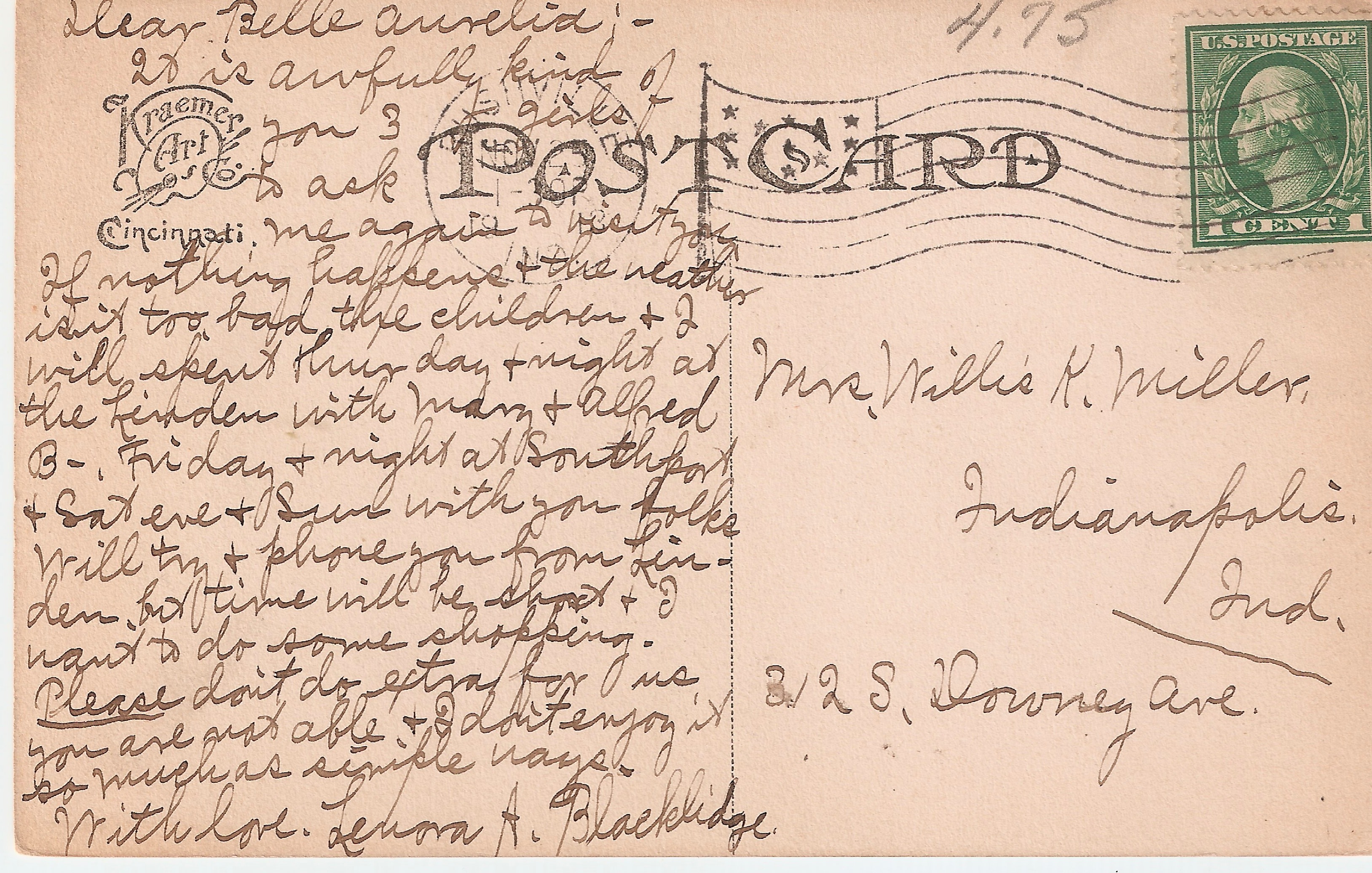
     On November 25, 1913, Lenora A. Blacklidge, who lived on a farm two miles northeast of Rushville, Indiana, mailed a postcard to her friend, Isabelle Aurelia Miller, of 312 South Downey Avenue in the neighborhood of Irvington in Indianapolis. 

Dear Belle Aurelia,

     It is awfully kind of you three girls to ask me again to visit you. If nothing happens & the weather isn't too bad, the children & I will spend their day & night at the Linden (a hotel at 311-317 N. Illinois St, Indianapolis) with Mary and Alfred B. (cousins to her husband--they also managed the Linden Hotel) Friday night at Southport & Saturday eve. & Sun. with you folks. Will try & phone you from Linden, but time will be short & I want to do some shopping. Please don't do extra for us. You are not able & I don't enjoy it so much as simple ways. With Love, Lenora A. Blacklidge

Lenora A. Blacklidge sent this postcard of the Masonic Temple in Rushville to Mrs. Willis K. Miller. in 1913

Lenora Blacklidge filled her note to Belle Miller with logistics

    Lenora Alexander Blacklidge (1874-1958) grew up in Rushville and graduated from Indiana University in 1897. At some point in her youth, she met Isabelle Aurelia Moore Miller, a Butler University alum. They might have been a part of the same sorority, Kappa Alpha Theta. Isabelle married Willis K. Miller on June 28, 1900, and in October of that same year, the newlyweds visited Lenora Alexander in Rush County. (Rushville Republican, October 28, 1900, 4)

     Lenora Alexander married Amos Blacklidge, who had attended Purdue University, and together they started a dairy farm two miles northeast of Rushville. The Millers and Blacklidges visited each other often during the early 1900s. A Rushville Republican article published on June 14, 1909, noted that Blacklidges spent the weekend in Irvington with friends and attended the baccalaureate at Butler University. The Millers visited the Blacklidge farm several times. On August 10 and 11, 1912, Willis and Isabelle Miller along with their ten-year-old son, Herschel, spent the weekend at the Blacklidge farm. Young Herschel could have played with the Blacklidge boys, William and Lawrence. (Rushville Republican, Aug. 12, 1912, 5)

Lenora Alexander Blacklidge c1910 (photo courtesy of Blacklidge descendants on Ancestry.com) 

Amos Blacklidge c1901 (courtesy of Blacklidge family descendants via Ancestry.com

August 16, 1913 at the Blacklidge Farm

     Amos Blacklidge, who had suffered from heart disease, went out to the backyard of his farmhouse to pump some water in a bucket. Lenora Blackidge was inside the house and heard her husband groan and drop to the ground. She rushed outside and then frantically called for a local doctor. She did not know it at the time, but her husband was already dead. He was only 48 years old. The Rushville Republican carried his obituary on the front page. 

    With two young sons, Lenora had to raise some cash so on September 23, 1913, she held an auction at her farm. Jersey cows, mules, a hog, and numerous implements like harnesses and incubators and other things too numerous to mention were up for bid. 

From the Daily Republican (Rushville, IN), September 23, 1913

The Millers Receive a Postcard from Lenora A. Blacklidge

     Likely worried about her friend, Isabelle, known as "Belle," wrote to Lenora Blacklidge and invited her and the boys to Irvington following the untimely death of Amos Blacklidge. She now had her answer. If nothing happens & the weather isn't too bad, the Blacklidge family would arrive on November 29 and 30, 1913. 

     Isabelle Aurelia Moore, a Butler University graduate, married fellow Butler attendee, Willis K. Miller. The couple did not immediately set up housekeeping in Irvington, but in 1907 they purchased the beautiful home at 312 South Downey Avenue from Allen R. Benton for $6000. (Indpls. Star, Aug. 10, 1907, 13) The couple would have known the house quite well as they both attended classes nearby in their younger years and they might have even been in the house when Dr. Benton was the president of Butler University. Mr. Miller immediately began to remodel the house. He added a large brick arts and crafts-era front porch and he took out a building permit for a brick garage in 1912. (Indpls. Star, Dec. 19, 1912, 17) 

     Willis K. Miller was a serial entrepreneur. His obituary noted that he sold "old-fashioned" fireplace mantels; got involved in a coffee plantation in Central America; dabbled in real estate and construction; and operated a cement and gravel company. He also bought a nearby wooded lot on what is today 290 South Downey Avenue. Isabelle Miller stayed home and raised their son, Hershel. She was an active club woman. Indianapolis newspapers frequently noted that she hosted the Irvington Tuesday Club or the Irvington Auxiliary of Public Health Nursing Association at her home on Downey Avenue. 

Herschel, Isabelle, and Willis Miller, 1915 (photo courtesy of the Indiana Historical Society)

The Millers added a large front porch and a driveway to the back garage. This photo was likely snapped around 1915. (photo courtesy of Irvington Historical Society)

Postscript

     On the surface, Lenora Blacklidge's note to Belle Aurelia Miller is rather ordinary. It is filled with logistics, but digging deeper, we see a woman who has just lost her husband and has just held an auction to earn some money. She is alone and is raising two young boys. Her good friend, aware of her turmoil, has invited her to stay for a weekend in Indianapolis. 

     We do not know how long their friendship endured. Lenora Blacklidge eventually remarried although a horrifying tragedy still awaited. Her son, William, and her daughter-in-law, and grandchildren moved to the Philippines where William took a teaching position.  Shortly thereafter the Japanese invaded and took the entire family prisoner. Lenora's daughter-in-law and grandchildren were rescued, but her son, Captain William Blacklidge, died in Japanese custody. A grief-stricken Lenora established an oratorical scholarship in her son's name for Rushville High School students. 

     After World War II, Lenora moved to Florida and occasionally stayed with her son Lawrence, who lived in California. Her second husband, Herbert Caldwell, died in 1950. In 1958, she returned to Rushville to attend a high school class reunion. As she was walking up a sidewalk to visit an old friend, she collapsed and died. She was 83 years old. 

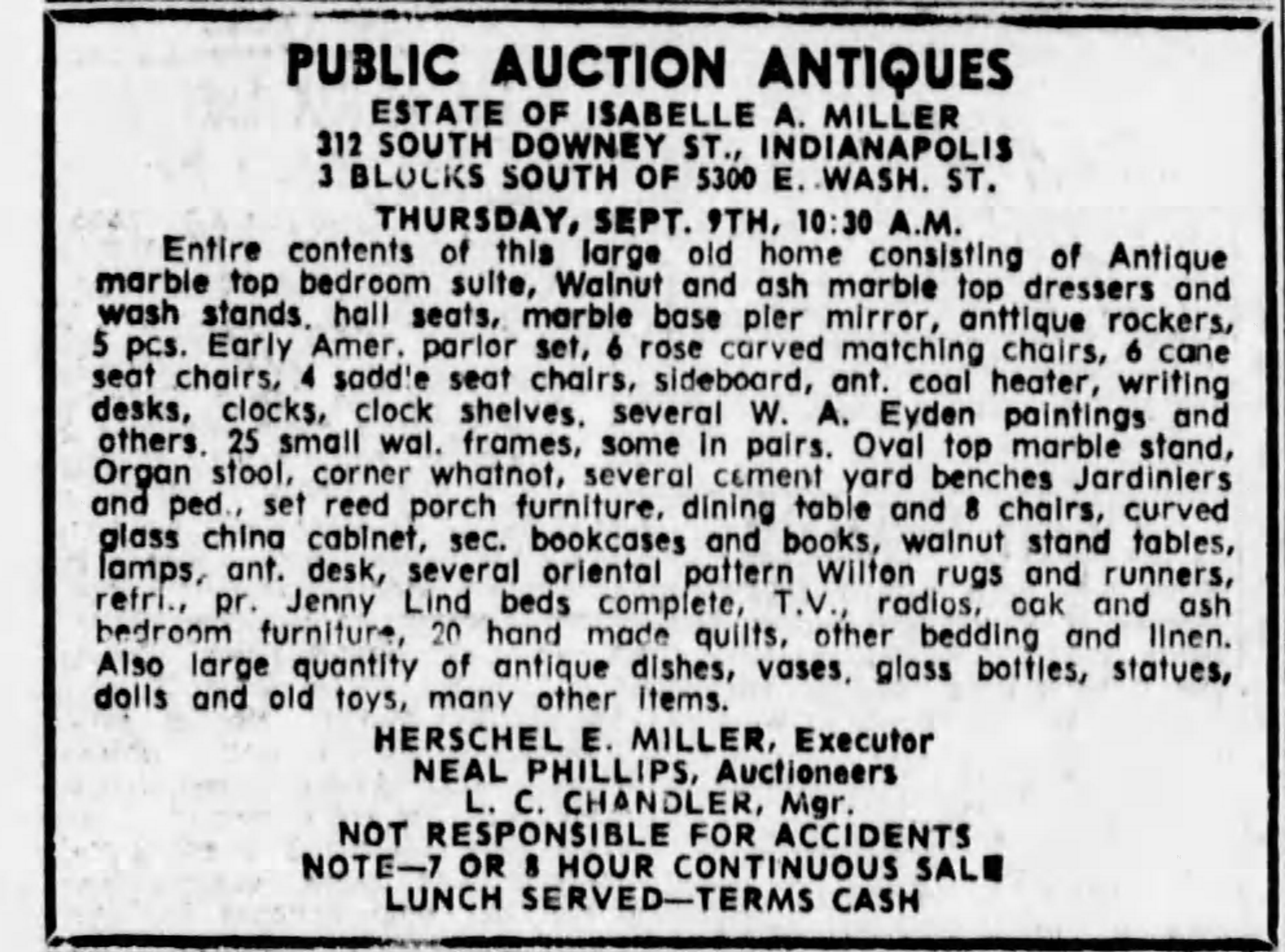
     Isabelle and Willis Miller continued to reside at 312 South Downey Avenue for decades. Willis died first at the age of 87 years old in 1955. Remarkably, Isabelle Miller lived to the age of 93. She died in 1965. Fifty-two years after Lenora Blacklidge had to auction off many animals and tools from her farm, Herschel Miller, the son of Willis and Isabelle, advertised an auction of his parents' estate on September 9, 1965. 

Indianapolis Star, September 5, 1965.

      A group of Irvington residents formed Irvington Historical Landmarks and purchased the Miller home in 1966. They restored the residence to the Benton family era. (1890-1907) They removed the Miller additions like the front porch and driveways.  The Millers and Blacklidges are long gone, but a brief note into their previous worlds still exists.  Please don't do extra for us...I don't enjoy it so much as simple ways. 


Sources:  I wish to thank Steve Barnett, Paula Schmidt, and Steve Schmidt of the Irvington Historical Society for their assistance with this article. The Miller family collection may be found at the Indiana Historical Society. 


Wednesday, May 6, 2020

Historic Photos of the Benton House Emerge

   Several years ago, the  Irvington Historical Society acquired the glass negatives that belonged to Osbert Sumner of 68 North Ritter Avenue. Mr. Sumner, a Canadian by birth, loved photography. As a young man, he documented his life. Most of the images are from his time as a member of the Indianapolis Canoe Club. His photographs are gorgeous and show beautiful river and stream scenes along with many male and female friends who floated down local waterways with him. Some of the photographs also show his hometown in Oakville, Ontario. The Irvington Historical Society will be exhibiting images from his collection in 2021.

   Hiding in plain sight in the Sumner collection were images of the Benton house at 312 South Downey Avenue. Nothing in the photographs made sense however, as the aging Professor Allen R. Benton, a widower after 1900, lived alone in the beautiful Second Empire home. So, who were all of these young people hanging out at his residence on a summer day?

    The answer required some detective work, that I must say, is still ongoing. Thanks to a subscription to Newspapers.com, I was able to find some morsels to assist with the mystery. On May 25, 1901, the Indianapolis News carried this society bit on page 22:

      Mr. and Mrs. F. C. Gardner have taken the residence of Dr. Allen R. Benton at Irvington for the summer and will go there on Wednesday.

     F. C. Gardner? Who was this? My research led me further to Fred C. Gardner, the future secretary-treasurer of the Atkins Saw Company. The rising business star was very active with the Disciples of Christ where he might have met Allen R. Benton. He later replaced Dr. Benton as the treasurer for Butler University in 1903. Mr. Gardner was 39 years old in 1901 as was his wife Cara Davis Gardner. They had two children, four-year-old Mary and two-year-old, Margaret. They lived at 1318 North Broadway in 1901.

     The Gardners likely found the Benton house  as a quiet retreat away from the city. But where did Professor Benton go? Society snippets in both the Indianapolis Journal and News indicated that he traveled to visit relatives for part of the summer although he was occasionally home. Did the Gardners remain in his house during those times?

      Then, I found this amazing blurb published on page three in the Indianapolis Journal on July 3, 1901:

      Mr. and Mrs. Fred C. Gardner have taken Professor Benton's home in Irvington for the summer and have invited a number of friends out to spend the Fourth with them.  

     Did I just uncover the exact day and year as to when these amazing photographs were snapped? Osbert Sumner was 29 years old and single at the time. What was his connection to Fred C. Gardner? They were both active members of the Republican Party and in the Masons. Was Mr. Gardner also a member of the Canoe Club? In one of the photographs, a young man is wearing patriotic-striped socks. Wouldn't one do that on the Fourth of July?

      By examining photos of Mr. Gardner in the Indianapolis newspapers, I am able to determine that he is in these historic images along with Osbert Sumner, of whom we already knew what he looked like. The women in the photos still need more research. One of them might be Cara Davis Gardner. Another might be her sister Hazel Bird Davis, who never married, and lived with the Gardners at the time. Two of the younger girls in the photos might be Mary and Margaret Gardner.

    On the day that the photographs were snapped, it appears to be late in the afternoon or early evening as the sun is in the western sky. Mr. Gardner, who has a beard and is wearing a dark suit, can be seen holding the shutter release cable in a few of the images. You will note that the address of the house prior to the neighborhood's annexation as 364 Downey Avenue. This fact also tripped me up in the beginning.

      More work is needed, but this exciting find adds new imagery about one of the neighborhood's most important landmarks. You will note that there were no immediate neighbors and that there used to be a carriage house or a barn nearby. The photos were taken before the brick was painted and it appears that Professor Benton used planks as a front sidewalk.

Fred C. Gardner, in the center, posed with three ladies, one of whom might have been his wife, Cara Davis Gardner, and one of whom might have been his sister-in-law, Hazel Davis, along with a young man on the stoop of the Benton home at 312 South Downey Avenue most likely on July 4, 1901.

An unidentified young girl sat along the stairs leading to the Benton home at 312 South Downey Avenue on July 4, 1901. A carriage house or barn can be seen in the distance. Note that the sidewalk leading up to Professor Benton's home used to be wooden planks. 

Children posed on the lawn of the Benton home at 312 South Downey Avenue on July 4, 1901. Two of the young girls in the photo are perhaps Mary and Margaret Gardner, the children of Fred and Cara Davis Gardner.

A group of younger adults gathered at the Benton home at 312 South Downey Avenue most likely on July 4, 1901. We only know the name of Fred Gardner, who is seated second from the right. His wife, Cara Davis Gardner, and his sister-in-law, Hazel Davis, might be seated nearby. 

Osbert Sumner, an amateur photographer and member of the Indianapolis Canoe Club, posed on the lawn at the Benton home at 312 South Downey Avenue with several other younger people including Fred C. Gardner, seated in the chair, on July 4, 1901. Mr. Sumner, who is seated on the ground, later moved to 68 North Ritter Avenue. 

A woman watches over the children at a lawn fete on the grounds of the Benton home at 312 South Downey Avenue on July 4, 1901. 

Fred C. Gardner as he appeared on March 1, 1906, in the Indianapolis Star
The Benton House at 312 South Downey Avenue in the spring of 2020 (photo by Wm. Gulde) 


Scans of these historic images are courtesy of the Irvington Historical Society. I also wish to thank Deedee Davis and Paula Schmidt for their assistance with this post.