Showing posts with label Downey Avenue. Show all posts

Wednesday, May 27, 2026

The Zaisers Built a Beautiful Bungalow on Downey Avenue

     Sophia and Lenoir Zaiser had been residents of Indianapolis for decades, but clearly they still loved visiting their childhood home in Cincinnati. Mr. Zaiser owned a stamp and stencil business for many years on South Meridian Street in Indianapolis. After retiring from that line of work, he began to invest in real estate. In the spring of 1916, he took out a building permit to erect a two-story bungalow at 345 South Downey Avenue in Irvington for $2800. He was 65 and she was 61. 

     Several months after moving into their new residence Mrs. Zaiser sent a postcard of her beautiful new home to her cousin, Mary Dickmeier, who lived in the Clifton neighborhood of Cincinnati. She announced that they would be visiting soon. Blurbs in the society pages noted that the Zaisers often visited Cincinnati. In 1918, they stayed with the Dickmeiers for three weeks. 

      Their Irvington home appears to have been an investment as they did not stay long. By 1919, they had sold the property to the McCormick family and moved out of Irvington to 3945 North College Avenue. Some of their children remained in the area and both of the Zaisers died in their son William's home at 6102 East Washington Street in the early 1930s. 

     Someone in the Dickmeier family kept the postcard. Eventually, it ended up on Ebay and thankfully, the photo is now back at home where it will be protected by the Irvington Historical Society. 


Lenoir and Sophia Zaiser built the bungalow located at 345 South Downey Avenue in 1916.

Sophia Zaiser wrote a postcard with the image of their Downey Avenue home on it to a cousin in Cincinnati, Ohio in 1917. 

Lenoir and Sophia Zaiser frequently visited the Dickmeiers who lived in the Clifton neighborhood in Cincinnati. In 1917, Sophia Zaiser sent a postcard to her cousin Mary Dickmeier, who lived in this double at 348 Howell Avenue in Cincinnati. (Google Streetview, 2024)

     I wish to thank Deedee Davis who rescued this wonderful photograph from Ebay. 

Sources:  Polk's Indianapolis City Directories, 1916-1919; Building Permit for 345 South Downey Avenue:  "Building Permits," Indianapolis Star, May 2, 1916, p. 15; Visit to Cincinnati--Indianapolis Star,  October 31, 1918, p. 7; Obituary for Mrs. Zaiser--"Mrs. Sophia G. Zaiser," Indianapolis Star, September 20, 1931, p. 2: Obituary for Mr. Zaiser--"Lenoir Zaiser, Age 82, Is Dead," Indianapolis News, October 31, 1933, p. 7.

Monday, November 24, 2025

Downey Avenue Christian Church Founded 150 Years Ago

      On September 19, 1875, 40 people gathered for the very first formal religious service conducted in the new town of Irvington. With just a smattering of houses scattered here and there, the community welcomed what would be known as Butler University in 1875. Ovid Butler, the founder of the college, associated the university with the Disciples of Christ, a denomination founded in the United States in the early nineteenth century. The new administration building on campus had a chapel and it was in that room that the Disciples worshipped and prayed for 18 years. Most of the members came from the college, but services were open to all. Butler students were required to attend during those early years.

     The weather on that Sunday in 1875 turned cooler and into the 40s so Professor John O. Hopkins recommended that the congregants move into his classroom where it was warmer. He also preached the first sermon. Later that year, the church welcomed 87 charter members. Nearby, many local residents gathered at Pleasant Run Creek for baptisms. An Indianapolis News article in 1879 reported that the church baptized 30 new members in the icy stream. As both the town and the college grew, the Disciples needed a larger space. That dream became a reality in 1893 with the dedication of a new brick church located at 111 South Downey Avenue. 


The chapel in the Administration Building (Butler Hall) served as the first space for members of the Disciples of Christ in Irvington to worship. (photo courtesy of the Irvington Historical Society)

The Brick Church (1893-1952)

     On September 5, 1892, church members broke ground at 111 South Downey Avenue for their first sanctuary away from the Butler campus. Designed by William F. Sharpe of Crawfordsville, Indiana, and erected by J.H. Jameson, the brick structure had several gables and a bell tower. At the dedication ceremony on April 9, 1893, congregants sat on carved oak pews and heard a sermon by the Reverend Carey E. Morgan, a Butler University graduate. Many of his former teachers sat in the pews before him.   

     Participation in the church swelled with the new facility. In 1914, the board added an education building just south of the church. The arrival of the Christian Board of Missions nearby also increased membership as many employees attended services at Downey Avenue Christian Church. Sunday schools, Boy Scout troops, and Camp Fire Girls increased the participation of younger Irvington residents in the church. 

     With the church population rising and repairs needed on the 59-year-old structure, the board of directors made the surprising decision to tear down the brick structure for a modern stone edifice.  There is no evidence that church members disapproved of this decision although it was likely that a few might have mourned the loss of the pretty church. 


Sketch in the Indianapolis News, February 24, 1892, p. 6

View of Downey Avenue Christian Church from South Downey Avenue looking north towards Julian and Downey Avenues in 1952 (photo courtesy of Don Rouse)


Downey Avenue Christian Church in 1952 from Julian Avenue; You will note the Education Building was  just south of the structure. (photo courtesy of Don Rouse)

Members of the Downey Avenue Christian Church at 111 South Downey Avenue could enter through doors on Julian or Downey Avenues. This photo was likely taken in 1952. Frederick William (Bill) Wiegmann served as the minister. (photo courtesy of Don Rouse)

Easter services in 1952 served as the final time that Downey Avenue Christian Church members attended worship in the brick church. The structure was razed shortly after this service. (photo courtesy of Don Rouse)

Members of a Sunday School program posed for this photograph in 1934 at the Downey Avenue Christian Church at 111 South Downey Avenue. (Photo courtesy of Don Rouse)

The Stone Church (1953--?)

     After the board decided to build a new church building, they hired Edward J. Clark to design the new structure. The architect had designed numerous churches in Indiana including the nearby Linwood Avenue Christian Church at 4424 East Michigan Street. The new church, a "modified" Gothic, was to be clad in limestone from southern Indiana. With a seating capacity for 475 people in the main hall, Clark also added room for 375 additional people in "Fellowship Hall." He included a youth chapel, rumpus rooms, and parlors. The cost came in at $250,000. 

     On a snowy Sunday morning on December 14, 1952, hundreds of church members gathered on the site for the cornerstone laying. Paul F. Brown, the board president, presided while Frederick W. Wiegmann and other dignitaries offered prayers and words. Ida Lamberson Russell, who had the distinction of being present at the 1893 dedication, "helped" to put the stone in place. Also assisting was Hilton U. Brown, the venerable publisher of the Indianapolis News. Both of them had witnessed Irvington grow from a small village into a thriving neighborhood. Several members placed items into the cornerstone box. John D.  Bruckman added a bible. Other items included an invitation to the 1893 dedication, a ceremonial shovel used to break ground, and various church programs. 

     The sanctuary opened in 1953 and for 72 years, the structure has been part of the neighborhood. In 2005, the congregation had a shock when an arsonist attempted to damage the building. Quick work by the fire department saved the structure allowing the congregation to restore the church. The Downey Avenue Christian Church is the oldest denomination within the boundaries of Irvington followed by the Irvington Methodist Church and First Baptist Church. On December 7, 2025, the congregation will be hosting a special service celebrating 150 years in operation with a reception afterwards. 


Frederick William Wiegmann, Francis W. Payne, and Paul F. Brown placed the ceremonial box into the cornerstone on December 14, 1952. We do not know the name of the boy in the photo so if you recognize him, let us know! Behind the crowd, you can see the Creighton Apartments located on the northwest corner of Julian and Downey Avenues. (photo courtesy of Don Rouse)

On December 14, 1952, Downey Avenue Christian Church members gathered to lay the cornerstone of their new church. Beyond the group you can see the former Scot Butler home at 124 South Downey Avenue. In 1952, the house served as the American Legion Post No. 38. To the north of that house you can see the side of 5339 Julian Avenue. That home along with the Butler residence and another house at 5319 Julian Ave were torn down to make way for the new mid-century Board of Church Extension structure. (Photo courtesy of Don Rouse)

On December 14, 1952, Downey Avenue Christian Church members filed past their new building under construction. Behind the beams, you can see the former educational building that had served the church since 1914. It was later razed for a new fellowship hall. (photo courtesy of Don Rouse)

Workers placed beams into position for the new Downey Avenue Christian Church in 1952. Behind the crew you can see the Creighton Apartments and homes along both Julian and Downey Avenues. (Photo courtesy of Don Rouse)

Workers for E. B. Ball finished the new Downey Avenue Christian Church in 1953. (photo courtesy of Don Rouse)

Associate Minister Enos Nelson preached to a packed congregation at the Downey Avenue Christian Church in 1953. (photo courtesy of Don Rouse)

Teens gathered for a Friday night dance in Fellowship Hall adjacent to the church c1955 (photo courtesy of Don Rouse)
The board added a new education wing to the church in 1962. (Photo courtesy of Don Rouse)

The congregation added beautiful stained glass windows to the sanctuary in 1975 in honor of the centennial of the church. (photo courtesy of Don Rouse) 

     I wish to thank Don Rouse for his generosity in loaning me photos for this post, and for providing key historical information.


Sources: George Earle Owen,  A Century of Witness: A History of the Downey Avenue Christian Church, 1875-1975, Indianapolis, 1975; Early Years--"City News," March 31, 1879, 4; Brick Church--"A New Church in Irvington," Indianapolis News, September 5, 1892, p. 2; "Irvington's New Church," Indianapolis News, December 24, 1892, 6; "New House of Worship," Indianapolis Journal, April 10, 1893, 3; "Irvington Church Dedicated," Indianapolis News, April 10, 1893, p. 6; Stone Church--"Downey Avenue to Break Ground," Indianapolis News, May 3, 1952, 4; "Downey Avenue to Lay Stone," Indianapolis News, December 13, 1952, 3; "New Irvington Church Ceremony to be Tomorrow," Indianapolis Star, December 13, 1952, 12; "Downey Avenue Congregation to Dedicate New Edifice," Indianapolis Star, October 31, 1953, 10; Architect--"Edward J. Clark Dies: Designed Many Churches," Indianapolis Star, January 29, 1965, 9. 

Friday, August 29, 2025

Lost Irvington: The Downey Home

      Several wealthy families resided in the grand home that used to sit at 5433 University Avenue from 1874 until 1929 including the Downeys, Goes, Thompsons, and Hibbens. The imposing two-story home complete with a tower sat on four acres of ground on the southeast corner of University and Downey Avenues. It has been gone for almost 100 years and nine smaller houses now occupy the site. A speculator, a banker, a grocer, an artist, a prominent teacher, and others all left their mark upon the residence. The deliberate demolition of a house like this seems impossible today, but the last owner, Mrs. Jessie Landon, likely saw dollar signs in the summer of 1929 since the place sat on such a large lot. Her timing, however, could not have been worse. Just as contractors reduced the home to rubble the country fell into the Great Depression. It would take twelve years before the area was redeveloped.  


The Downey Years (1874-1884) 

     James E. and Mary Julian Downey arrived in Irvington in 1871. In fact, they built the very first home in the new town in 1871 on the northwest corner of East Washington Street and Audubon Road. Three years later, they built an even bigger home on what would become 5433 University Avenue in the Woodland Park Addition in 1874. Their timing, however, could not have been worse as an economic panic swept the United States and ruined the lives of many investors including the Downeys. The couple formally declared bankruptcy in 1878, but managed to keep their home and four acres of land for several more years before moving out of state. 

     Red-headed James E. Downey married Mary Julian in Centerville, Indiana. When Mary's father, Jacob Julian founded Irvington along with another investor named Sylvester Johnson, the Downeys followed the Julians to the new town of Irvington. Mary Julian Downey might be the only person in Indianapolis to have had two streets named after her family. She lived next to Downey Avenue and could walk two blocks to the north to walk down Julian Avenue. She loved her Julian name so much that she gave three of her sons that middle name and one of her sons received it as a first name. In total the couple would have eight children live into adulthood. She is also credited, along with her father, of naming the new community after her favorite author, Washington Irving. Joseph Robert Downey, the only son not to receive the Julian name, wrote about his life in 1950 and his memories of that house were published by the East Side Herald. 

      Joseph Downey described their wooded lot as full of beech, oak, maple, dogwood, and paw paw trees. He noted that his father, ever an entrepreneur, was both a "promoter and plunger" who was always trying to find ways to make money. Five-year-old Joseph nearly died in the house after he and his brothers slid down the steep staircase railing. He hit his head on the lowest newel post. One local doctor thought that he might not live, but he did. The Irvington years were some of the happiest in his life and their sudden departure from the town upset him greatly. 

     While Irvington was largely a peaceful place and far away from the problems of the city, it was not immune from crime. At 3:00AM on May 20, 1878, the Downeys were awakened by a noise inside the house. Mr. Downey rushed downstairs and saw two men in the darkness. One was crawling on his knees. Upon confronting the intruders, one of the men shot at Mr. Downey, but the bullet sailed over his head and into a wall. The thieves ran out of the house with some of the family silver. They were never caught. 

     With bills mounting, the Downeys welcomed boarders into their home. They were fortunate in that Butler University officials moved the campus from north of downtown Indianapolis and into Irvington. Some of those first tenants included students, but their most prominent renters were the Merrill sisters. Much has been been written about Catharine Merrill over the years. A beloved teacher, she made history, as one of the earliest female university professors in the United States. A brilliant woman, she lived in Europe from 1859 until 1861 where she studied German. In Ireland she witnessed beggars from the potato famine. In England, she visited a great exhibition featuring artwork by Joseph Turner. In Italy, she wrote about the efforts of people to unite that country just as her own country fell apart and into the Civil War. While living in the Downey home, Miss Merrill had access to the "western parlor" where she held salons every Thursday evening. Students, professors, and neighbors attended these events where there might be poetry readings, book discussions, or even games. Young Joseph Downey recalled sitting on the lap of Butler professor, David Starr Jordan, who drew various kinds of fish on a piece of paper for him. Miss Merrill's kindness towards the Downey children was never forgotten. After Miss Merrill retired from Butler University, she moved out of the Downey home. One year later, the Downeys also moved away. 


The 1889 map of Irvington shows the Downey Home on Lot 21 and facing Spratt Avenue (University Avenue)

Rocky Mountain News, September 1, 1914

Mina Merrill and Catharine Merrill (courtesy of the Indiana State Library Digital Collection)

The Rental Years (1884-1890)

     Columnist, Grace Julian Clarke, noted in one of her essays on Irvington that after the Downeys moved out of Irvington that a rental company took over the ownership of the home. As of this writing, we only know of one family who leased that house during these years, and we only learned about that fact very recently. 

     Hezekiah and Cornelia Goe leased 5433 University Avenue in 1888. Why do we know this fact? In the possession of the descendants of the Goes is another photograph of the Downey home. On the back of that photo, someone has written "birthplace of Percy Goe," one of the five children of Hezekiah and Cornelia. Mr. Goe earned a comfortable living as a grocer and opened up a business at 130 South Audubon Road. The couple soon built a beautiful residence of their own at 128 South Ritter Avenue. More will soon be written about that lovely home.  


Faded photograph of the Downey-Thompson-Goe-Hibben home c1915; The image was snapped during the Hibben-era by a member of the Goe family. (photo courtesy of the Kingsbury family)

Percy Goe (1888-1921) was the fourth child of Hezekiah and Cornelia Goe. He was born at 5433 University Avenue. (photo courtesy of the Kingsbury family)

The Thompson Years (1890-1902)

     Edward and Mary Thompson along with their daughter, Bona, arrived in Irvington full of hope. All hailed from Edinburg, Indiana where Mr. Thompson became wealthy as a banker and from farming. They purchased the Downey home so that their only surviving child could attend nearby Butler University. By all accounts, she was a gifted student who won prizes for her speeches. While living in the house, the Thompsons added a new dining room, a kitchen with built-in cabinets, and a fruit-storage closet for canned foods. They enlarged the house by a story and a half complete with dormers in the roofline. The servants likely slept up there. They also lengthened the front tower. They added gas, electricity, and a shower. Their daughter would have a pleasant place in which to study and live.

      In 1897, Bona graduated from Butler University and then matriculated to Wellesley College. Mrs. Thompson had not been feeling well for some time. She thought a trip to Europe might lift her spirits and perhaps her health so she and Bona sailed across the ocean in 1899; however, the trip did not go as planned. While in Paris, it was Bona who started to feel unwell and not Mrs. Thompson. She seemed to rally and then they traveled to England, but once again Bona seemed to be suffering from something. The pair arrived back to the US to discover that Bona had contracted typhoid fever on their journey. She was not able to go back to Wellesley and could scarcely make it out of her bedroom in the large house on University Avenue. 

     Bona Thompson lingered for weeks before dying on October 12, 1899, at the age of 21. Their neighbor and friend, Dr. Allen R. Benton at 312 South Downey conducted the funeral service. Devastated by the loss of their only child, Edward and Mary donated land and thousands of dollars to Butler University for a new library. Mrs. Thompson grew sicker and watched from across the street as workers began building the new Bona Thompson Memorial Library, but she never lived to see it completed. Some folks in the neighborhood noted that she had died from heartbreak, but many others said that she wanted to live to see the completion of the library. She and her husband had even gone to Hot Springs, Arkansas in hopes of a respite in her health, but nothing worked and she died in the spring of 1902.  Dr. Allen R. Benton conducted the funeral service on April 16.  Six months later, Edward Thompson had a series of strokes and died on December 18, 1902. Dr. Benton once again led his third funeral at 5433 University Avenue. 

T.C. Steele painted a portrait of Bona Thompson from a photograph after her death. The original painting hangs at Butler University while a copy hangs at the Bona Thompson Memorial Library, currently the home of the Irvington Historical Society. 

Neither Edward nor Mary Thompson lived long enough to see the completion of the library named in their daughter's honor, but both knew that construction had started. The library is located at 5350 University Avenue and served Butler University students from 1903 until 1928. 

The Hibben Years (1903-1929)

     Thomas and Jane Hibben moved into the Downey home and immediately made significant changes to the residence. They not only enlarged the place,  but they also re-landscaped the property with stunning flower gardens. Mr. Hibben, whose family came from Rushville, Indiana, had made a fortune in the dry goods wholesale business. His father was a founder of the firm Hibben and Hollweg. Thomas joined the firm in 1900. It appears that one of his passions was art and he was considered one of the best etchers in the Midwest. With their comfortable income, the Hibbens purchased numerous paintings and etchings and filled their home with art. 

     Mrs. Hibben might have already known about the grand house as her Aunt Catharine Merrill had leased rooms from the Downeys in the late nineteenth century. Perhaps she visited the residence as a girl and might have witnessed a few of those Thursday-evening salons. The Hibbens were likely very proud of their children who all went on to achieve some impressive feats. By age 28, Paxton Hibben, served as a legate for the American delegation in the Netherlands. Their daughter, Helene, a future teacher, received commissions as a young woman as sculptress. Some of her bas reliefs of prominent Hoosiers are still around today.  Their son Thomas, Jr. became an architect and James became a chemist. Hazen served as teacher with her sister, Helene. 

     Thomas Hibben's sudden death in 1915 at the age of 54 shocked his family. His obituary ran on the front pages of the local newspapers. Mrs. Hibben died in 1920. Their daughters Helene and Hazen continued to live on in the house until 1929. The sisters operated an early pre-school for wealthier Irvington families where kids learned to speak some rudimentary French. In 1929, the women sold their home to Jessie Landon, one of the wealthiest women in Indianapolis. She and her husband Hugh lived at the former Eli Lilly mansion called Oldfields at the time. 

       Then, Mrs. Landon did something unthinkable for many Irvington residents. She bulldozed the Downey home in the summer of 1929. Why did she do it? Was she plotting a new development? Neighbors must have been very concerned since Butler University had just pulled out leaving many of the nearby buildings vacant. In the end, she did nothing with the property. She fell ill and died the following year. 

     A little over a decade later, contractors erected smaller homes on the once grand acreage. With World War II coming to a close, dozens of new families flocked to the site. 

(Indianapolis News, July 6, 1915, p. 1)

Thomas E. Hibben, Sr. was also a talented etcher. His work, Spanish Doorway, may be seen at the Irvington Historical Society. 

Helene sculpted a bas relief of James Whitcomb Riley. She also sculpted numerous other prominent Hoosiers of the early twentieth century. (Irvington Historical Society)

Indianapolis Star, August 18, 1928, p. 18

     I wish to thank Kathy and Dick Meyer for the photograph and new information about the Goes in the Downey Home. I also wish to thank Steve Barnett for his expertise and knowledge about the Downey Home. 

Sources;

Downey Era--Joseph R. Downey, Boyhood Days in Irvington, Irvington Historical Society, 1991 (first published by the East Side Herald in 1950); Bankruptcy--"In Bankruptcy," Indianapolis News, November 27, 1878, p. 4; Burglary--"Burglary," Indianapolis News, May 20, 1878, p. 1; Mr. Downey Obituary--Rocky Mountain News, September 1, 1914.

Catharine Merrill--Katharine Merrill Graydon, Catharine Merrill, Life and Letters, (Mitchell Publishing, 1934). 

Rental Years--Information on the back of a photograph provided by the Kingsbury family 

Thompson Era--US Census Records, 1900; "Miss Bona Thompson," Indianapolis News, October 13, 1899; Obituary for Mary Thompson--Franklin Democrat, April 18, 1902, p. 1; "Funeral of Edward C. Thompson," Indianapolis Journal, December 23, 1902, p. 3; 

Hibben Era--US Census Records, 1910 and 1920; History of Hibben School--"Hibben School Founded to Care for Children During Days of War," Indianapolis Star, August 23, 1931, p. 8; "Thomas E. Hibbens Dies at N.Y. Athletic Club," Indianapolis News, September 6, 1915, p. 1; "Mrs. Janie K. Hibben Dies," Indianapolis Star, October 17, 1920, p. 1.

General Overview--Grace Julian Clarke, "Some of 'Original' Irvington's History Recalled by House Razing," Indianapolis Star, May 26, 1929, p. 72; "Another Landmark Gone," Butler Alumni Quarterly, July 1929, pp. 79-80; Edward J. Hecker, Sr., "Old Irvington Residence Recalled," Irvington Review, December 12, 1940; Sheri Patterson, "Memories of Irvington Downey Home Recalled," Indy East, July 31, 1985, p. 1


Thursday, May 29, 2025

Historic Glass Negatives See the Light


     In 1965, Richard and Colleen Wilson moved into 68 North Ritter Avenue. Under the basement stairs the couple discovered a soap crate filled with several hundred historic glass negatives. The family kept the artifacts for years and then donated the collection to the Irvington Historical Society in 2012.

     After receiving a grant, members of the Irvington Historical Society scanned all 338 images.  Director, Steve Barnett, determined that the photos belonged to Osbert Sumner, who lived at the Ritter Avenue home from 1904 until his death in 1932. Over the next decade researchers thoroughly examined each photograph. A major breakthrough occurred in 2022, when local researcher Deedee Davis discovered a Sumner family diary at the Oakville, Ontario Historical Society. Osbert Sumner originally lived in that town before moving to Indianapolis. The diary provided key entries that helped unlock many of the mysteries of the collection.

     Mr. Sumner's photographs contains incredible documentation of life in Canada and Indianapolis from 1899 to 1903. His subjects included family members and friends, canoe outings, parades, a convention, and even the funeral of President Benjamin Harrison. Some of the photos had been developed, but many will now be seen for the first time in over 125 years.

     To see these incredible photos in person, visit the Bona Thompson Center at 5350 University Avenue in Indianapolis. The collection will be on display from May 31 until November 16, 2025. We are open on the weekends from 1-4PM.  I have included a small sample below. 


Osbert Sumner photographed an unidentified girl on the steps leading to the Benton Home at 312 South Downey Avenue in Irvington. He most likely took the photo on July 4, 1901. He attended a celebration there. 


George Sumner, the father of Osbert Sumner, kept a diary. From one of his entries, we know that this photo was likely taken on October 10, 1900 in downtown Indianapolis. The elder Sumner, who lived in Oakville, Ontario, was visiting his family here. The city hosted a "Fall Carnival" complete with temporary ornamental arches leading into Monument Circle. 

Osbert Sumner captured a fallen cyclist in the Morton Place neighborhood of Indianapolis near the intersection of East 19th and North Delaware Streets. Note the beautiful esplanade that used to be in the middle of the street c1900. 

Osbert Sumner (1872-1932) received a camera as a gift from his fellow co-workers in 1898. For the next several years, he documented life in Indianapolis and back in his hometown of Oakville, Ontario. He loved the outdoors and many of his photos show excursions in canoes on various waterways in central Indiana. 

Tuesday, May 28, 2024

Book Recommendation

      If you are looking for a great book to read that involves an Irvington family, then I can absolutely recommend Lost Rights: The Misadventures of a Stolen American Relic by David Howard. This true story centers around the Shotwell family, who first moved to Irvington in 1892.  Charles A. Shotwell and his wife, Clara, lived at both 104 Johnson Avenue and later at 55 South Downey Avenue. Mr. Shotwell worked for the Board of Trade in downtown Indianapolis. As a young man, he purchased a looted historic document from an Ohio Civil War veteran. As Sherman's army marched to the sea, members of his regiments stole many artifacts including North Carolina's copy of the Bill of Rights. The early founders of the Republic commissioned one copy per colony and one for the federal government. Charles Shotwell purchased an original copy of the Bill of Rights.

     David Howard takes us on a journey from Irvington to California to Broad Ripple and to the East Coast. The book reads like a thriller and I could not put it down. What happened to that original Bill of Rights? I will not spoil the story. You can find Mr. Howard's book online or at the Indianapolis Public Library. While Mr. Shotwell primarily displayed the Bill of Rights at his downtown office, the document was also likely stored in the two houses featured below. 


The Shotwells moved to Irvington in 1892 and lived in this house at 104 Johnson Avenue as early as 1900. (photo snapped in the spring of 2024)

Charles and Clara Shotwell moved from their Johnson Avenue home to this American Foursquare located at 55 South Downey Avenue. (photo snapped in the spring of 2024)


Monday, August 22, 2022

Postcard Sent to the Miller Family of 312 South Downey Avenue

     Many years ago, I collected historic postcards, especially those of my childhood home of Rushville, Indiana. My middle-aged world intersected with my youth when I began reading the backs of these cards only to discover that one of these artifacts was mailed to 312 South Downey Avenue, today known as the Benton House, a glorious historic architectural gem and museum in Irvington. The note, postmarked from Rushville, sent me into numerous rabbit holes to unravel the connections between my home county and my adopted neighborhood. 

The Benton House at 312 South Downey Avenue in the summer of 2019 (photo by Bill Gulde)

Lenora A. Blacklidge Writes a Note

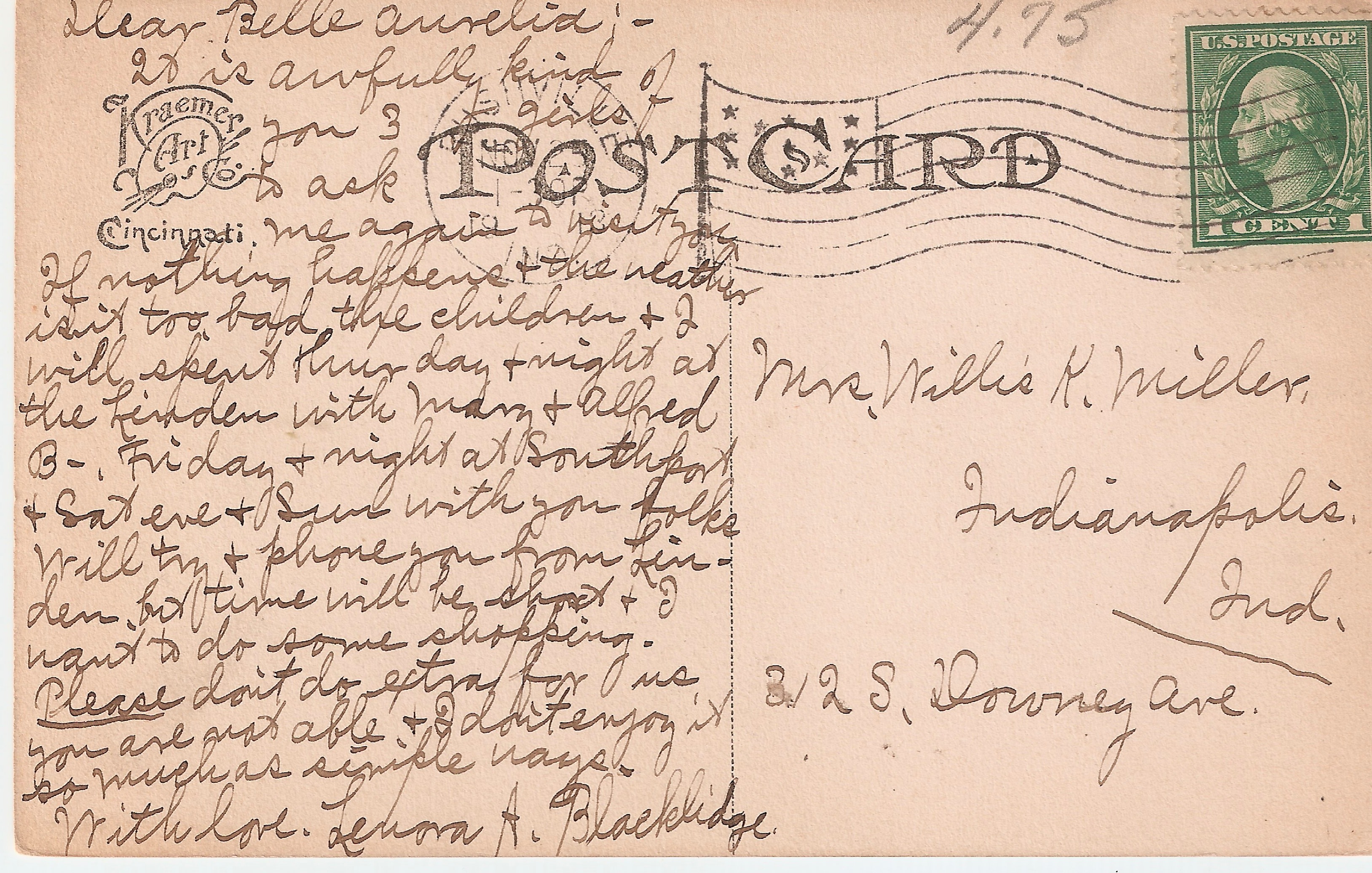
     On November 25, 1913, Lenora A. Blacklidge, who lived on a farm two miles northeast of Rushville, Indiana, mailed a postcard to her friend, Isabelle Aurelia Miller, of 312 South Downey Avenue in the neighborhood of Irvington in Indianapolis. 

Dear Belle Aurelia,

     It is awfully kind of you three girls to ask me again to visit you. If nothing happens & the weather isn't too bad, the children & I will spend their day & night at the Linden (a hotel at 311-317 N. Illinois St, Indianapolis) with Mary and Alfred B. (cousins to her husband--they also managed the Linden Hotel) Friday night at Southport & Saturday eve. & Sun. with you folks. Will try & phone you from Linden, but time will be short & I want to do some shopping. Please don't do extra for us. You are not able & I don't enjoy it so much as simple ways. With Love, Lenora A. Blacklidge

Lenora A. Blacklidge sent this postcard of the Masonic Temple in Rushville to Mrs. Willis K. Miller. in 1913

Lenora Blacklidge filled her note to Belle Miller with logistics

    Lenora Alexander Blacklidge (1874-1958) grew up in Rushville and graduated from Indiana University in 1897. At some point in her youth, she met Isabelle Aurelia Moore Miller, a Butler University alum. They might have been a part of the same sorority, Kappa Alpha Theta. Isabelle married Willis K. Miller on June 28, 1900, and in October of that same year, the newlyweds visited Lenora Alexander in Rush County. (Rushville Republican, October 28, 1900, 4)

     Lenora Alexander married Amos Blacklidge, who had attended Purdue University, and together they started a dairy farm two miles northeast of Rushville. The Millers and Blacklidges visited each other often during the early 1900s. A Rushville Republican article published on June 14, 1909, noted that Blacklidges spent the weekend in Irvington with friends and attended the baccalaureate at Butler University. The Millers visited the Blacklidge farm several times. On August 10 and 11, 1912, Willis and Isabelle Miller along with their ten-year-old son, Herschel, spent the weekend at the Blacklidge farm. Young Herschel could have played with the Blacklidge boys, William and Lawrence. (Rushville Republican, Aug. 12, 1912, 5)

Lenora Alexander Blacklidge c1910 (photo courtesy of Blacklidge descendants on Ancestry.com) 

Amos Blacklidge c1901 (courtesy of Blacklidge family descendants via Ancestry.com

August 16, 1913 at the Blacklidge Farm

     Amos Blacklidge, who had suffered from heart disease, went out to the backyard of his farmhouse to pump some water in a bucket. Lenora Blackidge was inside the house and heard her husband groan and drop to the ground. She rushed outside and then frantically called for a local doctor. She did not know it at the time, but her husband was already dead. He was only 48 years old. The Rushville Republican carried his obituary on the front page. 

    With two young sons, Lenora had to raise some cash so on September 23, 1913, she held an auction at her farm. Jersey cows, mules, a hog, and numerous implements like harnesses and incubators and other things too numerous to mention were up for bid. 

From the Daily Republican (Rushville, IN), September 23, 1913

The Millers Receive a Postcard from Lenora A. Blacklidge

     Likely worried about her friend, Isabelle, known as "Belle," wrote to Lenora Blacklidge and invited her and the boys to Irvington following the untimely death of Amos Blacklidge. She now had her answer. If nothing happens & the weather isn't too bad, the Blacklidge family would arrive on November 29 and 30, 1913. 

     Isabelle Aurelia Moore, a Butler University graduate, married fellow Butler attendee, Willis K. Miller. The couple did not immediately set up housekeeping in Irvington, but in 1907 they purchased the beautiful home at 312 South Downey Avenue from Allen R. Benton for $6000. (Indpls. Star, Aug. 10, 1907, 13) The couple would have known the house quite well as they both attended classes nearby in their younger years and they might have even been in the house when Dr. Benton was the president of Butler University. Mr. Miller immediately began to remodel the house. He added a large brick arts and crafts-era front porch and he took out a building permit for a brick garage in 1912. (Indpls. Star, Dec. 19, 1912, 17) 

     Willis K. Miller was a serial entrepreneur. His obituary noted that he sold "old-fashioned" fireplace mantels; got involved in a coffee plantation in Central America; dabbled in real estate and construction; and operated a cement and gravel company. He also bought a nearby wooded lot on what is today 290 South Downey Avenue. Isabelle Miller stayed home and raised their son, Hershel. She was an active club woman. Indianapolis newspapers frequently noted that she hosted the Irvington Tuesday Club or the Irvington Auxiliary of Public Health Nursing Association at her home on Downey Avenue. 

Herschel, Isabelle, and Willis Miller, 1915 (photo courtesy of the Indiana Historical Society)

The Millers added a large front porch and a driveway to the back garage. This photo was likely snapped around 1915. (photo courtesy of Irvington Historical Society)

Postscript

     On the surface, Lenora Blacklidge's note to Belle Aurelia Miller is rather ordinary. It is filled with logistics, but digging deeper, we see a woman who has just lost her husband and has just held an auction to earn some money. She is alone and is raising two young boys. Her good friend, aware of her turmoil, has invited her to stay for a weekend in Indianapolis. 

     We do not know how long their friendship endured. Lenora Blacklidge eventually remarried although a horrifying tragedy still awaited. Her son, William, and her daughter-in-law, and grandchildren moved to the Philippines where William took a teaching position.  Shortly thereafter the Japanese invaded and took the entire family prisoner. Lenora's daughter-in-law and grandchildren were rescued, but her son, Captain William Blacklidge, died in Japanese custody. A grief-stricken Lenora established an oratorical scholarship in her son's name for Rushville High School students. 

     After World War II, Lenora moved to Florida and occasionally stayed with her son Lawrence, who lived in California. Her second husband, Herbert Caldwell, died in 1950. In 1958, she returned to Rushville to attend a high school class reunion. As she was walking up a sidewalk to visit an old friend, she collapsed and died. She was 83 years old. 

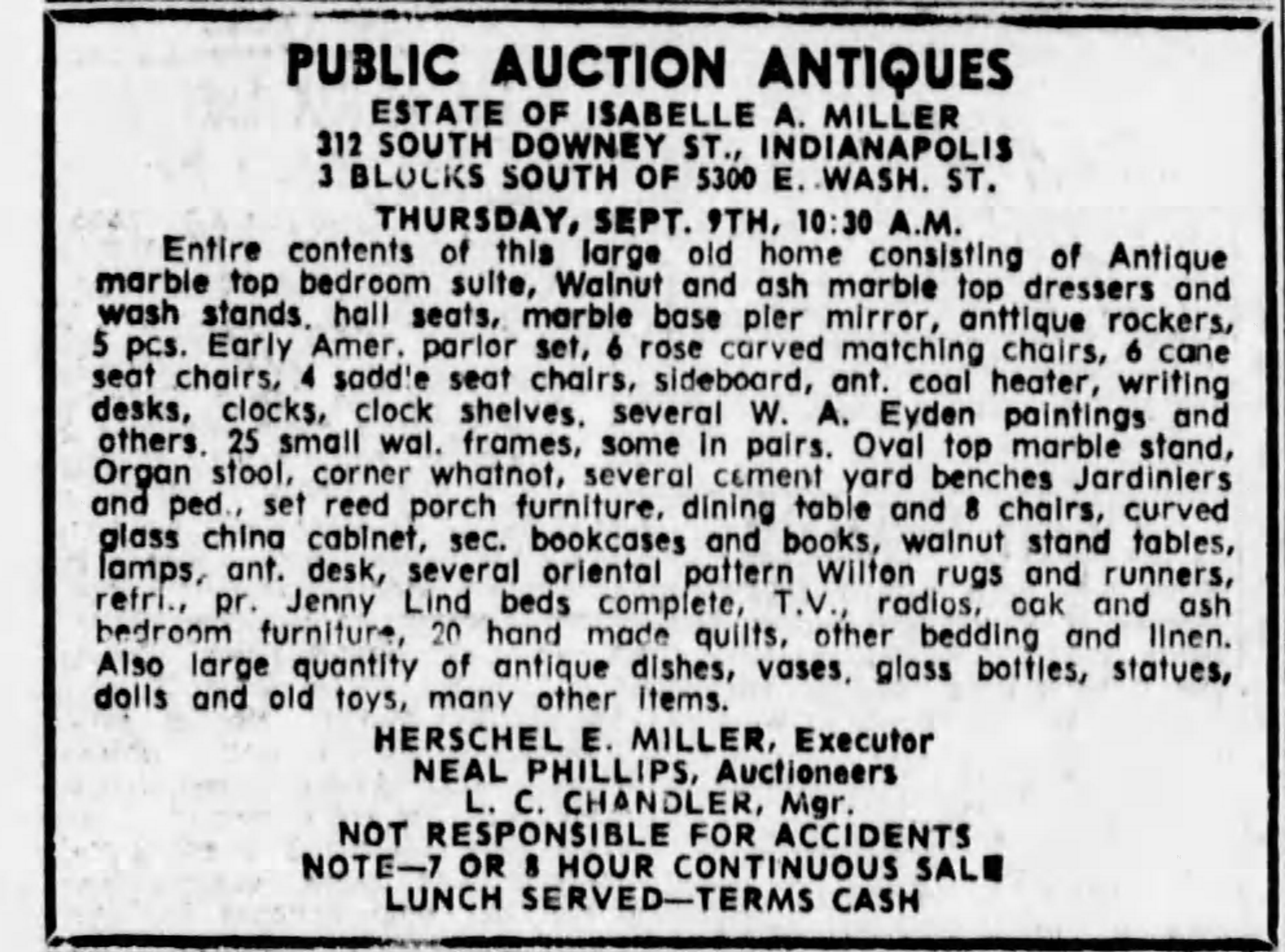
     Isabelle and Willis Miller continued to reside at 312 South Downey Avenue for decades. Willis died first at the age of 87 years old in 1955. Remarkably, Isabelle Miller lived to the age of 93. She died in 1965. Fifty-two years after Lenora Blacklidge had to auction off many animals and tools from her farm, Herschel Miller, the son of Willis and Isabelle, advertised an auction of his parents' estate on September 9, 1965. 

Indianapolis Star, September 5, 1965.

      A group of Irvington residents formed Irvington Historical Landmarks and purchased the Miller home in 1966. They restored the residence to the Benton family era. (1890-1907) They removed the Miller additions like the front porch and driveways.  The Millers and Blacklidges are long gone, but a brief note into their previous worlds still exists.  Please don't do extra for us...I don't enjoy it so much as simple ways. 


Sources:  I wish to thank Steve Barnett, Paula Schmidt, and Steve Schmidt of the Irvington Historical Society for their assistance with this article. The Miller family collection may be found at the Indiana Historical Society. 


Thursday, November 19, 2020

Irvington at 150: Street Names A-D

 Anyone researching their historic home in Irvington must understand that some of the street names in the neighborhood have been changed two and three times. To complicate matters even further, addresses have also been changed. Local historian, Larry Muncie, has done much of the groundwork on the history of street names. In one of his books, Irvington: Three Windows on Irvington History (1989), Mr. Muncie even provides maps to help understand the changes. 

Irvington was a separate town from 1870 until it was annexed by the city of Indianapolis in 1902. There appears to have been two major corrections on street names in the area. The first came in 1898 when the town board tried to clear up the confusion for some of the names. The next major correction occurred in 1903 when an engineer working for the city of Indianapolis recommended that several street names be changed due to similar or exact names within the city of Indianapolis. There were other years when names changed, but those two were the most important. 

After Butler University moved into the neighborhood, developers made an effort to name some of the streets after prominent writers or scholars. They also named several of the avenues after early families. In some cases, we do not know the origin of the name but we can speculate. In the following series, we will attempt to clarify the origin of the neighborhood's street names. If you have additional information on street names, please let us know! 

Arlington Avenue: Formerly called Line Street, the earliest known use of "Arlington Avenue" appears in an April 8, 1896 Indianapolis News article, (9) about a rail line in Irvington. Two years later, the Irvington Town Board formerly adopted the name. The presumption is that the street is named after Arlington Cemetery in Virginia; however, there is no evidence for this fact yet. Arlington Avenue (Line) is one of the original streets of Irvington. 

Atherton Drive: When investors redeveloped Butler University's Irvington campus into a housing addition in the mid-1940s, they added Atherton Drive. They named the circular street after John H. Atherton, the long-time Secretary-Treasure for Butler University. Mr. Atherton raised millions of dollars for the school over the years and was instrumental in securing the Fairview site for the campus; thus spelling the doom for the Irvington location. 

John J. Atherton (courtesy of Indianapolis News, March 22, 1944)


Audubon Road:
When the founders of Irvington placed covenants upon the residents, they decreed that no birds could be shot within the town limits. So, in 1903, when the neighborhood had to change the name of Central Avenue, they chose to rename it after John James Audubon, the famous naturalist and birder.  To complicate the matter even further, Audubon Road north of Lowell Avenue used to be called Maxwell Street. That small section was also renamed in 1903 after the birder. Audubon Road (Central) is one of the original streets of Irvington. 

Portrait of the naturalist, John James Audubon in 1826 (public domain)


Auvergne Avenue:
James Downey and Charles Brouse had grand ideas when they platted their addition to Irvington in the far southwestern part of the neighborhood in the mid-1870s. They envisioned beautiful villas on large lots. While at least a handful of imposing homes were constructed, their vision was compromised by the economic depression that lingered through the 1870s. They named one of their winding streets, Auvergne Avenue, after the region in France. Most of the residences along the small street were largely constructed after World War II but at least one nineteenth-century home still remains at 740 Auvergne Avenue. 

James Downey and Charles Brouse named one of their platted streets after the Auvergne region in France. (public domain)

Bancroft Street: While this street is often associated with the Emerson Heights neighborhood, it actually has its origins in Irvington. The street has had three separate names. The link north of the Pennsylvania Railroad and south of Howe High School used to be called Brook Street. Another link between University Avenue and Brookville Road was formerly known as Parker Street. The Irvington Town Board changed those two names in 1898 to Bancroft. Later in 1903, the city of Indianapolis changed Pleasant Street just north of Washington Street to Bancroft as well. Although unconfirmed, the street was likely named after the American historian George Bancroft. (1800-1891)

Bankers Lane:  The small street that connects East Washington Street to Pleasant Run Parkway South Drive first appeared in the Indianapolis City Directory in 1941. Named for Frances and Anna Banker, who resided at 4711 East Washington Street next to the lane, the street became well known because of the streamlined Art-Deco apartments built along it in 1943. Mr. Banker earned a comfortable living as the president of the Brooklyn Brick Company. He also owned an extensive property in South Dakota. 

A photo from his obituary published in the Indianapolis News, November 26, 1945

Photo published in her obituary in the Indianapolis Star, October 1, 1944.

Beechwood Avenue: One of Irvington's original streets, the southern avenue was likely named for the large numbers of beech trees that still existed when Julian and Johnson platted the town. East of Arlington Avenue, the street used to be known as Center Street.

Berry Avenue: One of Irvington's shortest streets, Berry Avenue, was formerly called Perry Street until 1903. The old name had to be changed after the city of Indianapolis annexed the town. The origin of the name is unknown at this time.

Bolton Avenue: Formerly called Maple Avenue, the city of Indianapolis changed the name to Bolton Avenue after the poet Sarah T. Bolton in 1903. Although largely forgotten today, Mrs. Bolton was a popular poet in Indiana in the nineteenth century. Her most famous poem was "Paddle Your Own Canoe." A nearby park in Beech Grove is also named for her as she owned land there. 

City officials wanted to change the name from Maple to Tarkington Avenue, but local residents objected due to the length of the writer's name so they compromised on renaming the street after the Indiana poet, Sarah T. Bolton. (public domain)

Bonna Avenue: The tragic story of Bona Thompson is now quite frequently told in Irvington. The young Butler graduate went on a European tour with her mother, but became ill and died of typhoid fever. Her grief-stricken parents donated the money and the land for the Bona Thompson Library at Butler's Irvington campus in 1902.  When city officials needed to change the name of Railroad Street in 1906 they blundered and misspelled the new street name as Bonna instead of Bona. For more than a century, no one has bothered to change the incorrect spelling of Miss Thompson's name. 

Bosart Avenue: The Bosart family, who resided in the large brick home formerly belonging to the Wallace family at 4704 East Washington Street, owned the land on what would become Bosart Avenue. As both the city of Indianapolis and Irvington started to expand, the Bosart land became highly valuable in the late nineteenth and early twentieth centuries. 
Ruth Bosart (1858-1943)
Timothy Bosart (1844-1900) (photos courtesy of the Bosart family via Ancestry.com) 

Brookville Road: The old highway known as Brookville Road predates Irvington by many years and is named for the city in southeastern Indiana. Later federal highway officials gave it the number U.S. 52. 

Burgess Avenue: Due to the fact that it meanders, town founders seemed to confused as to where Burgess Avenue terminated. Josephus Collet named the original Burgess Avenue in his addition after the Reverend Otis A. Burgess, the president of Butler University in the 1870s. His street started east of Emerson Avenue (then National) and then snaked south of the Baltimore and Ohio Railroad all the way to Ritter Avenue. Then, in 1898, local officials decided to rename Grand Avenue in between University and Ritter as Burgess as well. That section of Burgess Avenue (then Grand) was part of the original plat. 

The Reverend Otis Burgess was responsible for moving Butler University (then North Western Christian University) to Irvington in 1875. Developer Joseph Collet named a street after him. 


Butler Avenue: North Western Christian University moved to Irvington in 1875. They changed their name to Butler University in 1877. The nearby street just east of campus was also named Butler Avenue. In 1898, town officials changed a small section of Lake Street from Washington Street to the Pennsylvania Railroad as Butler Avenue as well. 

Campbell Avenue: John W. Chambers platted four additions near Lowell Avenue in the early 1870s. By the end of the decade, he faced legal trouble like many land speculators after the Panic of 1873. It was Chambers who named a small street north of Lowell Avenue (then Walnut Street) and south of Michigan Street (then Chambers Street) as Campbell. It is unknown at this time why Campbell was chosen as the name although Mr. Chambers did name other streets in his subdivisions after fellow investors. 

Addendum: Steve Barnett, the director of the Irvington Historical Society, notes that the street might have been named for Dr. John Campbell (1831-1917), who operated an early drug store in the neighborhood. The Campbells moved to Colorado in 1881. 

Catherwood Avenue: Formerly known as Warren Street from Washington to the Pennsylvania Railroad and then as Parkman and Jennison Streets south of the rail line, the city of Indianapolis consolidated all of the names into Catherwood Avenue in 1903. The street was named for the writer Mary C. Catherwood, a writer who briefly lived in Indianapolis in late nineteenth century.  Although her work is forgotten today, her books were widely read in Indianapolis. 

The nineteenth-century regional writer, Mary C. Catherwood (1847-1902), briefly lived in Indianapolis. She was known for her attempt to capture Midwestern regional dialects in her work. (public domain) 


Clyde Avenue: James Downey and Charles Brouse, local developers, envisioned a beautiful community south and west of Irvington. Two of the streets in that development were called Louise (no longer exists) and Clyde. Louise Street was most likely named after the daughter of Charles Brouse. It is not known at this time who Clyde might have been related to as neither Downey nor Brouse seem to have anyone by that name in their families. The addition later became part of Irvington. 

DeQuincy Street: While DeQuincy Street is most commonly associated with the Emerson Heights neighborhood just west of Irvington, the street has its origins in Irvington just north of Washington Street. Originally called Quincy Street, the town board added the "De" in 1898. 

Dewey Avenue: On April 30, 1898, Admiral George Dewey at the Manilla Bay in the Philippines told his subordinate, "You may fire when ready..." Six hours later, the United States Navy defeated the Spanish Navy in that now famous battle as part of the Spanish-American War. Thousands of miles away in the town of Irvington, Indiana leaders in that community sought new names for some of the streets. One of the avenues they wanted to rename was East Street, a very undeveloped meandering path between University and Arlington Avenues. It is believed that when they learned of the victory, local officials renamed the street as Dewey Avenue in 1898. Second Street east of Arlington Avenue in Elizabeth Cain's addition was also renamed for the Admiral. 

Very few streets in Irvington are named for military leaders, but after Admiral George Dewey led the victory against the Spanish in the Philippines, the neighborhood honored him with a street name in 1898. Numerous other municipalities across the country did as well including New York City. (public domain)


Downey Avenue:  Jacob Julian, one of the founders of Irvington, asked his son-in-law, James Downey to join him in the investment. Mr. Downey became one of the chief promoters for the new town. He and his wife Mary also built two of the earliest homes in the neighborhood. Their second residence, a large brick Second-Empire villa was located on the southeastern corner of University (then called Spratt) and Downey Avenue. The Downeys did not remain in Irvington for very long as they moved to the western United States. Despite at least one attempt to rename it, the street name has never been changed. 

An ad placed by James E. Downey for Irvington in the January 19, 1871 edition of the Indianapolis News


Sources: Larry Muncie, Three Windows on Irvington History, 1989; "Changes in Street Names," Indianapolis Journal, January 18, 1903, 3; "Irvington's New Names," Indianapolis News, November 3, 1898, 7; Interview with Steve Barnett, Director of the Irvington Historical Society, November 15, 2020. "Would Change Names of 149 Streets in City," Indianapolis News, December 18, 1916, 8. 


I would like to thank both Larry Muncie and Steve Barnett for their assistance with the research for this post.