Showing posts with label Layman Avenue. Show all posts

Monday, September 1, 2025

A Layman Avenue Scene in 1962

      Frank and Marie Widner frequently visited with their good friends, Louis (Bud) and Anna Lucille (Lucy) Downey of 315 North Layman Avenue. The men had gone to Indiana University together and had remained life-long friends. Mr. Widner, who snapped the photo, worked as an editor for the Indianapolis Times. Later, he served as the night editor for the Indianapolis Star.  Mr. Downey worked as a sales representative for Gulf Oil. The sharply-focused photo taken in 1962 shows a sunny but perhaps chilly day. Behind the friends, you can clearly see many of the houses on the east side of the street all the way to Michigan Street. The canopied-avenue looks much the same today as it did 63 years ago. 

Ann Lucille "Lucy" Downey, Marie Widner, and Louis "Bud" Downey in front of 315 North Layman Avenue in 1962; Frank Widner, a journalist, took the photo. (photo courtesy of Mike Widner)  

     I wish to thank Mike Widner for the photo and information on the Widners and the Downeys. 

Sources:  Widners--Email correspondence with Mike Widner; "Frank Widner Former News Editor of the Star Dies, Indianapolis Star, May 9, 1995, p. 19; Obituary for Marie Louise Kiefer Widner, Indianapolis Star, May 14, 1998, p. 23; "Louis C. Downey Dies; Services Set Wednesday," Indianapolis Star, May 29, 1967, p. 27; Obituary for Anna Lucille Sparrow Downey Lane, Indianapolis Star, July 6, 2005, p. 18. 

Wednesday, July 9, 2025

Layman and Lowell Avenues in the Early 20th Century


     Between 1903 and 1907, James G. and Kate Kingsbury resided in the two-story home located at 98 North Layman Avenue. Almost as soon as he moved in, Mr. Kingsbury took out a building permit for an addition on to the home in the autumn of 1903. He also applied for a building permit in the following year to repair a barn on the property. 

     The Kingsburys were not the first to reside in the house. The Hannas lived at 98 North Layman in the late 1890s and the Williams family resided in the house in the early 1900s. Thomas Hanna (1841-1901) had been the Lt. Governor for the state of Indiana from 1881-1885. 

     For reasons unknown, 74-year-old James G. Kingsbury and 67-year-old Kate Kingsbury moved to a new house located nearby at 71 North Ritter Avenue. Photos from the Kingsbury family show the homes that existed at the intersection of Lowell and Layman Avenues between 1903 and 1915. 

James G. Kingsbury posed with his son, Theodore Kingsbury, at 98 North Layman Avenue c1903 (photo courtesy of the Kingsbury family)

James G. Kingsbury posed in front of his home at 98 N. Layman Avenue c1903. Behind him, you will note that no houses had yet been built on the south side of the 5600 block of Lowell Avenue. If you look closely, you can see the side of 5716 Lowell Avenue. (photo courtesy of the Kingsbury family)


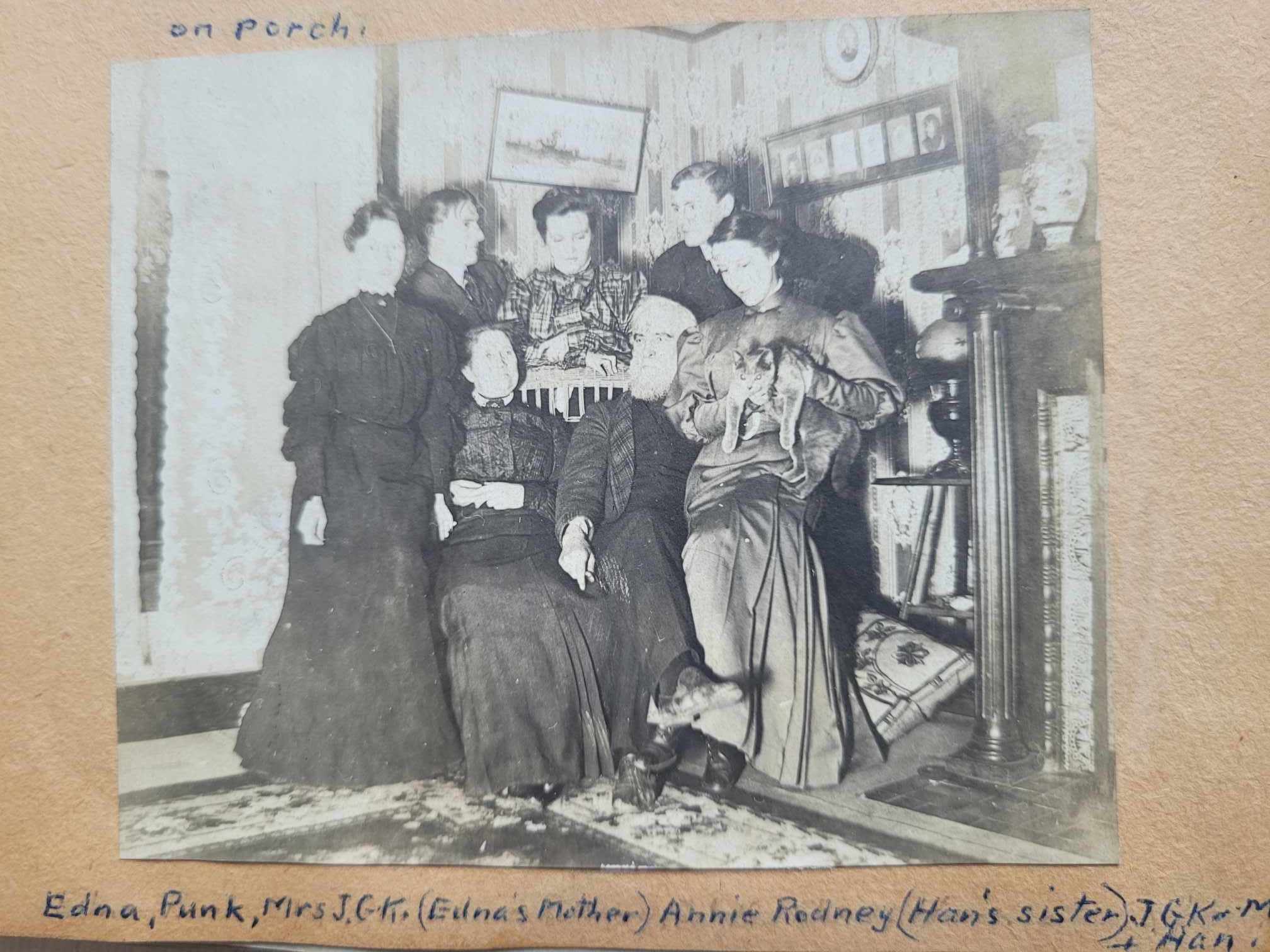
Friends and family of the Kingsburys gathered in the dining room of their home at 98 North Layman Avenue c1903. Seated (left to right): Kate Gunckel Kingsbury, James G. Kingsbury, Hannah Rodney Kingsbury (holding a cat); Standing (left to right): Edna Gunckel, Nathan Howard ("Punk") Kingsbury, Annie Rodney (sister to Hannah), and  Theodore Kingsbury (photo courtesy of the Kingsbury family)

308 North Layman Avenue

     Frederick M. and Alice Dickerman resided in the newly-constructed home at 308 North Layman Avenue in 1906. If they had looked out their dining room window, they would have seen James G. Kingsbury mowing his yard at 98 North Layman. Mr. Dickerman worked as a postal clerk for a railroad. The Dickermans lived in a variety of Irvington homes before moving to Los Angeles, California. 

James G. Kingsbury mowed his yard at 98 North Layman Avenue. Behind him you can see 308 North Layman Avenue c1906. (photo courtesy of the Kingsbury family)


5602 Lowell Avenue

     Cornelia Kingsbury, the daughter of Theodore and Cornelia Goe Kingsbury, was the subject of this photograph in the winter of 1915. The Kingsburys resided at 5515 Lowell Avenue at the time. Behind the baby, you can see several houses in the 5600 block of Lowell Avenue. The most visible home is 5602 Lowell Avenue (on the left). Wellington and Anne Downing had resided in that home since 1905. Mr. Downing was a contractor and built many homes in that section of Irvington. 

Cornelia Kingsbury in front of her home at 5515 Lowell Avenue in 1915. Behind her, you can see the intersection of Lowell and Layman Avenues. (photo courtesy of the Kingsbury family)


Up Next:  The First Concrete Block House in Irvington? 

     I wish to thank Kathy and Dick Meyer for their stories and photos of Irvington. I also wish to thank Katherine Meadows who assisted me with research on 98 North Layman Avenue. 

Sources: Interview with Kathy and Dick Meyer, June 9, 2025; 1910 Federal Census; Polk's Indianapolis City Directory, 1903-1915; Frame addition to 98 North Layman Avenue: "Building Permits," Indianapolis Journal, November 14, 1903, p. 8; Repairs to Barn: "Building Permits," Indianapolis Journal, April 9, 1904, p. 10.

Friday, December 13, 2024

Snowy Layman Avenue Images

      Donald and David Peters, who resided at 312 North Layman Avenue, enjoyed some fun playtime after a snowstorm struck Irvington in the winter of 1945. Several inches of snow provided plenty of fun for sledding and snowball fights. Behind the boys, you can see that few people had ventured out yet. Other residents of the block on that snowy day included the Weaver, Ensworth, May, Davis, Schowe, Stobaugh, Jenkins, and Reel families. 


David and Donald Peters sled down a small incline at 312 North Layman Avenue during the winter of 1945. Behind the boys, you can see the snow on the rooftops in the 300 block of Layman Avenue. (photo courtesy of the Peters family) 

Donald Peters saluted the photographer, most likely his mother or father, in the winter of 1945. Behind him, you can see the houses in the 300 block of Layman Avenue. (photo courtesy of the Peters family)

David and Donald Peters posed in front of their home at 312 North Layman Avenue on a snowy day in 1945. (photo courtesy of the Peters family)

Donald and David Peters prepared to have fun on a snowy day in front of their home at 312 North Layman Avenue. (photo courtesy of the Peters family)

David and Donald Peters enjoyed the fresh snowfall in front of their home at 312 North Layman Avenue. (photo courtesy of the Peters family)

     I wish to thank the Peters family for their generosity in loaning me photos and telling me their stories. 

Sources: Information for the names of neighbors along Layman Avenue came from Polks's Indianapolis City Directory (1945). 

Thursday, October 3, 2024

Family Moved Into Layman Avenue Home

      In the late summer of 1940, neighbors in the 300 block of North Layman Avenue likely noticed a new family moving into 312. Of course, if they looked closely, they would have seen someone who looked familiar. Marjorie Jones Peters had grown up in 312 North Layman Avenue. Her parents, Morris and Lillian Jones, had purchased the house in 1923. Mr. Jones worked as an insurance agent and received a job opportunity in Chicago so the older couple sold the house to Orville and Marjorie Peters. A member of the Jones-Peters family would reside in the home for nearly 70 years. 

     Orville and Marjorie Peters had been renting a small double nearby at 740 North Bancroft Street. Their new home on Layman Avenue had two stories and three bedrooms. Their sons, Donald and David, soon welcomed a sister, Susan, in 1943. Images from scrapbooks from the family show that the three children had the entire area as their playground. Like many neighborhood kids, they attended School #57 and Howe High School. 

     Shortly after moving into their Layman Avenue home, Mr. Peters left his position as an auditor for Standard Oil Company and transferred into a similar position for the Barbasol Shaving Cream Company. He would also later work for Jones and Laughlin Steel Company. When he wasn't working, he could generally be found on a golf course so it was likely no surprise to his family that after he retired, he helped to take care of the Pleasant Run Golf Course. 

     One by one, Mr. and Mrs. Peters watched as their children graduated from high school, attended college, and got married. Then, they received a shock with the arrival of a fourth child, Douglas Peters, in 1958. Doug recalled in an interview that he lived a happy and adventurous childhood with good friends from the neighborhood. Like his siblings, he attended School #57 and Howe High School. 

Next Up: Layman Avenue Scenes


Orville and Marjorie Peters posed with their third child, Susan Peters, in the summer of 1944 along the front sidewalk leading up to 312 North Layman Avenue. (photo courtesy of the Peters family)


Marjorie Jones Peters had grown up in 312 North Layman Avenue. She moved back into her childhood home in 1940 and remained for the rest of her life. (photo courtesy of the Peters family)

Family reunion: Marjorie Jones Peters hosted her sister's family at 312 North Layman Avenue c1950. Like Marjorie, Betty Jones Fox had grown up in the house. Top: David Peters (in cap), Walter Fox (brother-in-law to Marjorie Jones Peters), Orville Peters in white t-shirt; Betty Fox, sister of Marjorie Fox; smaller children--Marjorie Fox, Tom Fox, and Susan Peters. Donald Peters stood in the front. You can also see 316 North Layman Avenue behind the group. (photo courtesy of the Peters family)

Donald, David, and Susan Peters posed for this photograph at 312 Layman Avenue in 1946. (photo courtesy of the Peters family)

Marjorie Peters held her niece, Marjorie Fox c1948 in front of 312 North Layman Avenue. Her son Donald helped little Marjorie look at the camera by pointing at the photographer. David Peters is at the right and Susan Peters is in the front. (photo courtesy of the Peters Family)


Susan and David Peters in the side yard of 312 North Layman Avenue in the summer of 1944; (photo courtesy of the Peters family)

Susan Peters played with a cat in the backyard of 312 North Layman Avenue in the summer of 1944. (photo courtesy of the Peters family)

Susan and David Peters in the backyard of 312 North Layman Avenue in the summer of 1944 (photo courtesy of the Peters family)

Susan Peters rode her bike and posed for this photograph in front of her home at 312 North Layman Avenue, c1950. (photo courtesy of Doug Peters)

Grandmothers, Lillian Jones and Carolyn Peters, gathered on the front porch at 312 North Layman Avenue with Donald Peters and Bob Jones in 1951. (photo courtesy of the Peters family)

Doug Peters (right) was the fourth and final child of Orville and Marjorie Peters. In this photo, he posed with nephew, Mark Peters, in the front yard of 312 North Layman Avenue in 1961. Behind the kids, you can see the home located at 315 North Layman Avenue. (photo courtesy of the Peters family)


Lillian and Morris Jones sold their home at 312 North Layman Avenue to their daughter, Marjorie Jones Peters and their son-in-law, Orville Peters, in 1940. They were pictured in front of their home in 1935. (photo courtesy of the Peters family)

     I wish to thank Doug Peters for the use of the family photos and stories.

Sources:  Interviews with Douglas Peters, 2024; US Federal Census, 1950; Polk's City Directory: Indianapolis, 1940, 1941. 

Thursday, December 3, 2020

Irvington at 150: Street Names I-M

In part three of our series on street names more historical information has been uncovered. Additional research will be needed as you will see that we don't know the origins for a few of the street names. Thanks to the efforts of historians like Larry Muncie and Steve Barnett, many of the mysteries have been solved. A romantic novel, prominent residents, a poet, a local girl, and the founders of Irvington have streets named for them in this grouping. If you have additional information on any of these avenues please let us know.

Irvington Avenue: On the evening of March 16, 1903, the Indianapolis City Council renamed Elm Avenue as Irvington Avenue. The Indianapolis News reported that the street was nearly named Tennyson Avenue, but local residents objected. It was obvious as to why Elm had to go as there was already another street in the city with that name, but why did this small side street get such a grand name? It wasn't the first time that a street in the town had been named for Irvington. Early maps show that Julian Avenue connecting what is today South Butler (then Lake) and South Hawthorne (then Commercial) as Irvington Avenue. It would seem to have been more appropriate for a major boulevard to have donned the name of the town; however, Elm Street won the day. To further complicate the story, an early plat of neighborhood shows that South Irvington Avenue used to be known as Cherry Avenue. 

Irwin Street: The small street located north of Washington Street did not appear in the Indianapolis city directory until 1941. Likely developed at the same time as nearby Elizabeth Street, the first families to dwell along Irwin included the Shocks, Kaisers, Matthews, and Washburns. Developers were also building homes along Irwin north of Irvington so it is unknown at this time as to the origin of the name. Is Irwin related to nearby Elizabeth? Perhaps someone knows the answer. To view beautiful photographs taken of the street in the 1950s, click on the "Irwin Street" link below. 

Ivanhoe Street:  On November 25, 2019, the BBC named Ivanhoe as one of the most influential novels ever written. Walter Scott, who published his book in 1819, set the fictional tale in 12th-century England complete with Normans, Saxons, jousting tournaments and a witch trial. The popular three-volume set was likely found on the shelves of many Irvington homes. A small street in the South East Irvington Addition, formerly called Fourth Street, was renamed after the popular tale in 1898. 

Ivanhoe was first published in 1819 but was still popular in 1916 when this edition came out.

Jenny Lane: On August 29, 1926, an ad in the Indianapolis Star announced the exciting news that several lots would be for sale for future homes along a brand new street called Jenney Lane. Later, city officials dropped the second "e". The small stretch was named for the Jenney family who resided in a beautiful home at 4603 East Washington Street. Charles D. Jenney (1864-1926) earned a comfortable living managing his own electrical company. Throughout the mid and late-1920s, contractors built charming brick bungalows and doubles along the lane. 

Indianapolis Star, August 29, 1926

Some early articles about homes along the street referred to it as Jenny's Lane. This ad appeared in the Indianapolis Star, November 17, 1929.

Johnson Avenue: Sylvester Johnson founded the town of Irvington along with Jacob Julian. His stunning Second Empire-style home faced Audubon Road. His backyard complete with a beautiful orchard abutted what is today Johnson Avenue. The small street became longer in 1898 when the town board named a stretch from Julian Avenue to the Pennsylvania Railroad after Johnson as well. 

Julian Avenue: The original Julian Avenue stretched from Ritter Avenue to Arlington Avenue (then Line) and is named for the family who made Irvington possible. Jacob Julian arrived first and founded the town. His more famous brother, George Washington Julian, arrived in 1874. George Julian, a retired Congressman, built a beautiful Italianate residence just south of Jacob's home on South Audubon Road (then Central Avenue). Congressman Julian's daughter, Grace Julian Clarke, was an important figure for women's suffrage in Indiana. She lived in the family home at 115 South Audubon Road until her death in 1938. Local historian, Steve Barnett, recently discovered that part of Julian Avenue from South Irvington Avenue to Downey Avenue was originally called Ohmer Avenue in 1871. West of Ritter Avenue, both Houston and Irvington Avenue became Julian Avenue in 1898. East of Arlington Avenue, Chestnut Street also became Julian Avenue in that same year. 

Kenmore Road: When researching homes in the Irvington Terrace Addition, it is important to know that some of the street names have been changed. For instance, Kenmore Road began as Eldridge Street. The Buckeye Realty Company developed much of the area beginning in 1913. Newspaper stories touted beautiful homes constructed by R. L. Castle. The original name of Eldridge (sometimes spelled Eldredge) came from John and Alanson Eldredge, who owned acres of land in the area in the 1840s. ("The Story of a Lot," Indianapolis News, May 16, 1914) The city of Indianapolis changed the name in 1916 to Kenmore Road. (Indianapolis News, October 17, 1916, 19) The origin of the name is unknown at this time. 

Photos of several Irvington Terrace homes developed by the Buckeye Realty Company were featured frequently in the Indianapolis newspapers of the 1910s including this house at 45 Kenmore Road (formerly 51 Eldredge/Eldridge Street). ( Indianapolis Star, December 20, 1914)


Kenyon Street: Sixteen years after the first residents purchased lots along Kenyon Street, the Indianapolis Star paid a visit in 1929 and described the avenue as "one of the most attractive streets in Indianapolis." The author further gushed that it is "lined with beautiful maple trees, well-kept lawns, and attractive new bungalows." First platted in 1913 by the Buckeye Realty Company under the leadership John Chilcote, the street is one of the few in the addition that has not been renamed. But what is the origin? There were Kenyons living in Irvington, but we see no connection just yet. Mr. Chilcote was a native of Ohio and developed numerous housing additions in the Columbus and Lima areas. Could the street be named for the Ohio college? 

From the Indianapolis Star, July 8, 1929

Kitley Avenue: Check any atlas of Warren Township produced in the nineteenth century and you will see the Kitley family name. In fact, John Kitley owned the area of what was to become Irvington Terrace in the 1850s. Other Kitleys continued to farm south of Irvington. Today, the only vestige of the Kitleys in the Irvington area is the street that bears their name. 

Layman Avenue: In the spring of 1896, the Irvington Town Board united Layman Avenue (north of Washington Street) with that of Tilford Street (north of Lowell Avenue) under one name--Layman Avenue. Tilford had been an early investor in the Chambers Addition north of Lowell, but by the late nineteenth-century, the town was more enamored with the wealthy Layman family who lived in the former Jacob Julian home at 29 South Audubon Road. (then Central) James T. Layman, a Civil War veteran, had made his money in the wholesale trade. He and his wife Cora Belle Parks Layman moved into their Second Empire mansion in 1887. At least one son, Theodore, also served on the Irvington Town Board. 

James Townsend Layman and Cora Belle Parks Layman c1910 in front of their home at 29 South Audubon Road (photo courtesy of Isabelle Layman Troyer)

The Layman home at 29 South Audubon Road c1910 (photo courtesy of Isabelle Layman Troyer)


Leland Avenue: This avenue first appears in the Indianapolis newspapers as Leland Street as early as 1905, but no houses were built upon the avenue until the mid-1920s. North of Tenth Street, contractors erected beautiful brick Tudor homes in a development called Emerson Highlands. Later they developed the street south of Tenth Street. So who was Leland? Is it a first name or a last name? Do you have information? The origin of the name eludes us at the moment. 

A sketch of the home of the Harryman family of 1101 Leland Avenue can be seen in an ad in the Indianapolis News, May 14, 1927.

Wayne Harryman helped to develop the Emerson Highlands neighborhood along Leland Avenue. He lived in a beautiful stuccoed English Tudor next to this house at 1101 Leland Avenue. (Indianapolis Star, May 26, 1929)

Lesley Avenue: Formerly called Greene Street, the name appears to have changed to Lesley Avenue in 1903. The street was named after Daniel Lesley, who resided at 5716 Lowell Avenue with his wife and two children. Mr. Lesley was a tax accountant and frequently made the news for exposing government corruption. Both he and his wife Edith Thompson Lesley hailed from Winchester, Indiana. 

Daniel Lesley (with a mustache) posed with his relatives most likely in Randolph County, Indiana c1885. Pictured: Jacob, Amos, Daniel, and Rueben Lesley (photo courtesy of Lesley family descendants via Ancestry.com) 

Lowell Avenue:  Irvington residents appear to have had love affair with writers from the Romantic era. In 1898, when the town board decided to rename a confusing hodgepodge of streets into one name, they chose to rebrand the long street after the poet and editor of the Atlantic Monthly, James Russell Lowell (1819-1891). Mr. Lowell was good friends with Ralph Waldo Emerson and John Greenleaf Whittier, who also received Irvington street names. Previous names of the street included Elm Avenue (in between North Audubon Road and Irvington Avenue) and Walnut Avenue (in between North Audubon Road and North Arlington Avenue). Larry Muncie in his book, Irvington: Three Windows on Irvington History, 1989, mentions that at one point part of the street was also called Ohio Street. 

James Russell Lowell (1819-1891) (public domain)

Maple Lane: William Alexander and Flora McDonald Ketcham filed for a plat for the subdivision of Pleasanton in 1915. This small addition to Irvington emulated the original plan for the area complete with winding streets. Most of the development for the new community, however, did not really take off until the early 1920s. The Ketchams chose Maple Lane as one of their streets although there was already a Maple Road (38th Street) in northern Indianapolis. Trees seem to be a theme for street names in Pleasanton. 

An ad for new homes along Maple Lane in Pleasanton from the Indianapolis News, September 23, 1921


Market Street: A small section of Market Street runs through Irvington. The more famous part of the street begins in downtown Indianapolis and was aptly named for the markets that still operate along that well-known avenue. 

Melvenia Street: Clarence and Josephine Hurst lived in a small cottage along an unnamed lane south of Burgess Avenue in the 1920s. By 1924, the Indianapolis city directory listed the Hursts on Melvenia Street. Melvenia Street? Where did that name come from? Who was Melvenia? It turns out that the answer was right in front of me. The Hursts had one daughter--Melvenia Hurst. She married John Martin and eventually moved to Florida where she passed away in 2005. We are in the process of attempting to track down family members to learn more about her. In 1940, the city of Indianapolis further honored her by naming another section south of Brookville Road as Melvenia. It had formerly been called "Haugh." 

Michigan Street: John Chambers was an early investor in Irvington. He developed land north of Lowell Avenue in between Ritter Avenue and just east of Arlington Avenue. He named one of the streets after himself. Unfortunately, like many early investors, Mr. Chambers went bankrupt. When the city of Indianapolis annexed Irvington, they changed Chambers to Michigan to align with the street that originated in the original mile square of Indianapolis. Mr. Chambers was completely erased from the story of the neighborhood; however, his name lives on in deeds and abstracts. 

John W. Chambers, who developed land north of Lowell Avenue and east of Ritter Avenue, went bankrupt in 1877. Later a street named for him became Michigan Street. (Indianapolis News, February 6, 1877)


Sources:  Larry Muncie, Irvington: Three Windows on Irvington's History. 1989; Irvington Avenue--"Mr. Warweg's Ordinance," Indianapolis Journal, March 17, 1903, 10; Kenyon Street--"Our Street," July 8, 1929, 8; Layman Avenue--"New Town Officers," Indianapolis News, May 12, 1896, 7: Melvenia Street--"Changes Sought in Street Names," Indianapolis Star, February 6, 1940, 5: "Changes in Street Names," Indianapolis Journal, January 18, 1903, 3; "Irvington's New Names," Indianapolis News, November 3, 1898, 7. 

Sunday, March 4, 2018

Who Lived Here? The Polen-Rennoe Families (1905-1944)

Luther Polen began life in log cabin near Azalia, Indiana in Bartholomew County. By the time of his death, he had managed to provide a comfortable life for his family in a fashionable house in Irvington. On October 3, 1894, he married Margaret Goble, who came from a family of printers in Greenfield. He worked at Union Station in downtown Indianapolis at the time and eventually became the stationmaster in 1900.

By 1905, the couple moved into the large American Four Square at 34 North Layman Avenue. Mr. Polen officially left his job with the railroad and became a real estate agent in 1908. His earliest sales seem to have not come from Indiana, but rather from Oklahoma. He led groups of potential investors, mainly from Greenfield, down to Oklahoma so that they could purchase farmland. Several Hancock County families moved to that state. The Daily Reporter and the Hancock Democrat noted that Mr. Polen shepherded at least two separate groups of people to Oklahoma in both 1909 and 1910. One has to wonder what became of these folks and their descendants when the Dust Bowl decimated that state in the 1930s.  Soon, the local Indianapolis newspapers carried ads for Luther Polen for land and real estate closer to home. In fact, Polen sold many houses in the Irvington area.

When he wasn't selling real estate, Mr. Polen also sold used cars. He did not have car lot so he would offer one automobile at a time. For instance, in October of 1918, he attempted to sell a used Ford. In 1919, an ad noted that Mr. Polen had a used newly-painted Oakland for sale complete with a new dome light. In subsequent years, he sold an Auburn and a Pathway. He also sold cocker spaniel puppies at the expensive price of $10 to $15 each. He saw a potential investment even in his own large home on Layman Avenue. In 1924, he turned the house into a double.

Margaret Polen was an accomplished business woman.  She served as the bookkeeper for her family's printing business in Greenfield for many years. Eventually, she managed to convince her husband to join the family operation in 1928. She was an active club woman and newspaper articles from the 1910s and 1920s noted her attendance. On July 29, 1924, she hosted a bridge party along with her daughter, Gertrude, for the Delta Delta Delta Sorority. Women played cards at five separate tables set up in the living and dining rooms.

Neighbors along Layman Avenue must have noted the preparations for a big wedding in the home on October 22, 1919, as Gertrude Polen, the only child of the couple, married Lieutenant Henry Elberg. Flowers filled the residence as the young couple stated their vows. It was not a marriage made in paradise, however, as the couple later divorced. Gertrude remarried her forever partner, Edgar Rennoe, in 1926.

Shock and sadness overwhelmed the family on May 2, 1930. Luther Polen was driving along Emerson Avenue towards Brookville Road. Mrs. Polen sat in the passenger seat while Mrs. S.O, Wiggins, a family friend,  who dwelled in the Maplewood Apartments (#5) on Johnson Avenue, sat in the backseat. Unbeknownst to the group, Henry Sayre, who resided in a hotel, was speeding towards them. Unable to stop in time, Mr. Polen slammed into Sayre's car. Everyone in the Polen car was injured. While Mrs. Polen and Mrs. Wiggins survived, Mr. Polen eventually succumbed from his injuries on June 18, 1930.  Henry Sayre was charged with reckless driving, speeding, and assault and battery.

Although it must have been difficult, Mrs. Polen carried on and worked at the printing business. Her daughter, son-in-law, and two grandchildren also resided with her at 34 North Layman Avenue. The Rennoes, who deserve a separate chapter in this story, dwelled at the home until 1944. Mr. Rennoe worked for Standard Oil.  They eventually moved to 801 North Bolton Avenue. Mrs. Polen passed away in 1946.

Luther Polen submitted this photo in 1926 to Fellow Citizens of Indianapolis.

Gertrude Polen married a World War One veteran, Lieutenant Henry Elberg, in 1919. They later divorced. The Indianapolis Star published this photo of the nineteen-year-old bride.  

Gertrude's second marriage to Edgar Rennoe was covered in the Indianapolis News in 1926. The couple eventually moved into 34 North Layman Avenue and remained there until 1944.  

Gertude Polen Rennoe, the daughter of Luther and Margaret Polen, was very active in numerous clubs. She was President of the School #57 PTA in 1935. Edgar and Gertrude had two children, Edgar, Jr. (Jack) and Margaret Rennoe.  

Mr. Polen frequently sold cars through ads in the Indianapolis newspapers. In 1920, he sold an older Auburn.  (photo credit: Momentcar.com) 

Luther and Margaret Polen moved into 34 North Layman Avenue in 1905. Their daughter, Gertude, and son-in-law, Edgar Rennoe, later resided in the home until 1944. Mr. Polen converted the home into a double in 1924.  

Sources:  "3 Injured in Car Crash," Indianapolis Star, May 3, 1930, 20; Mr Polen's obituary appeared in the Indianapolis Star, June 19, 1930; Oklahoma references: "Bright Side of Oklahoma," Daily Reporter (Greenfield), January 12, 1910, 1; Daily Reporter, October 16, 1909, 2; "Bridge Party for Delta Delta Delta," Indianapolis Star, July 29, 1924, 4.

Tuesday, November 21, 2017

Our Lady of Lourdes Cheerleaders--1956

In September of 1956, five young ladies from Our Lady of Lourdes Catholic School assembled in a backyard to practice for the most exciting football game of the year. Every autumn, the Catholic Youth Organization hosted a football jamboree on the west side of Indianapolis for all Catholic schools in grades six through eight. The local diocese owned land across from Bush Stadium on West 16th Street so that local Catholic high schools could have a "home" field.

Lynda Foster (820 North Layman Avenue), Terry McDonnell (419 North Bancroft Street), Judy Lindeman (5234 East Michigan Street), Mary McDavitt (655 North Ritter Avenue), and Katy Grothaus (340 North Ritter Avenue) all worked very hard for the big day. Terry McDonell Wilgus Knisely recalls that one of the most exciting moments came when the parade of teams began and the cheerleaders rode in the back of a convertible waving their school colors of blue and gold as Our Lady of Lourdes families cheered along. Each young lady then walked across a small stage as their name was called over the loudspeaker. Teams from schools like Little Flower, St. Joan of Arc, Christ the King, St. Patricks, Holy Spirit, and numerous others would scrimmage for about ten minutes. Teams who scored could have bragging rights the next day.

All five girls faced a big decision that year as they would have to decide where they would go to high school. Lynda Foster, Terry McDonnell, and Judy Lindeman chose Scecina High School while Mary McDavitt selected Our Lady of Grace in Beech Grove. The Grothaus family moved to Mississippi so Katy attended a high school there. The young women had no inkling on that autumn day in 1956 that they would not all be together again in one room for fifty years! They reunited at an Our Lady of Lourdes class reunion in 2007 at DuFour's Restaurant in Irvington and three of them gathered to pose for a photograph. 

The photographs and the memories of this day are courtesy of Terry McDonnell Wilgus Knisely.

Our Lady of Lourdes Cheerleaders posed in the backyard of the McDavitt family at 655 North Ritter Avenue in September of 1956.  Pictured from left to right: Lynda Foster, Terry McDonnell, Judy Lindeman, Mary McDavitt and Katy Grothaus

Our Lady of Lourdes Reunion Photo in 2007. Pictured left to right: Katy Grothaus Boeding, Judy Lindeman Johns, Terry McDonnell Wilgus Knisely  

Sunday, November 12, 2017

Lost Irvington--A Church

In 1900, the Indianapolis News announced that the Methodists of Irvington would be getting a larger building. There had been members of this faith in the neighborhood since its founding in 1870 and they had met in a variety of places. Mrs. Frances Barbour (possibly Barber) donated two lots on Layman Avenue north of East Washington Street with the stipulation that the Methodist build a brick edifice. The building committee seemed thrilled at the donation, but they had planned a wooden chapel. Mrs. Barbour's requirement forced the Methodists to raise some additional cash which they managed to do. By the winter of 1901, they moved into their new Gothic and Romanesque-inspired church.

For the next 25 years, the congregation met on Layman Avenue. However, by the late 1910s and early 1920s, the church membership had grown dramatically. Eventually, the congregation built a stunning church at 30 North Audubon Road. They kept the Layman Avenue structure and used it for a variety of purposes. In 1937, the Irvington Church of Christ moved into the facility and remained until 1964. Revivals and radio broadcasts could be heard from the older chapel throughout the mid-twentieth century. The Church of Christ grew too large for the smaller structure and they also moved out.

In 1965, the Irvington Methodist Church once again acquired the structure and demolished it for a parking lot for their booming congregation.  The site is still a parking lot in 2017 and most local Irvington residents do not know that a beautiful brick church once stood on the site.

In this photo, taken around 1948, Cynthia Hopping posed for parents, Don and Helen Louise Brown Hopping, on the steps of their home at 21 Layman Avenue. Behind her, you can see the former Irvington Church of Christ. The second image came from an advertisement in the Indianapolis News in 1944.

Cynthia Hopping posed on the steps of 21 Layman Avenue c1948. Behind her you can see the former Irvington Methodist Church/Irvington Church of Christ at 25 Layman Avenue. 

An ad in the Indianapolis News 1944. The church was torn down in 1965.
The historic image is courtesy of Ted Lollis.  

Sources:  "Irvington's New Church," Indianapolis News, October 6, 1900.
                "Meeting," Indianapolis Sentinel, February 22, 1885, 5.  

Tuesday, January 5, 2016

Wonderful Restoration Work

Two historic homes have been or are currently being renovated in Irvington. In both cases, homeowners have beautifully returned the dwellings to their original appearance. The American Four Square at 76 North Layman Avenue was likely built around 1908 and was first occupied by the Thomas family who resided there for years.  The current owners have removed vinyl siding and have restored the lovely clapboards hidden underneath for a few decades. They have also restored the beautiful porch. It will be exciting to see the final results on this grand home.

76 North Layman Avenue (c1908) is undergoing a significant renovation in 2016

5360 East Washington Street has also been extensively renovated. The home, likely built around 1909, has had its stucco and wood clapboard siding restored as well as several features inside the house. The front porch, which had been enclosed in the mid-twentieth century, has been reopened although the 1950s-era stone remains.  Kudos to both homeowners for these beautiful restorations.

5360 East Washington Street in 2016

Friday, December 5, 2014

Kingsbury Home on Layman Avenue

James L. Kingsbury and his wife Minnie likely moved into 348 North Layman Avenue in the late nineteenth century.  Mr. Kingsbury's father lived around the corner at 71 North Ritter Avenue.  The elder Kingsbury published a newspaper in Crawfordsville and eventually moved operations to Indianapolis in the 1870s.  Upon James G Kingsbury's passing in 1913, his son, James L. Kingsbury  took control of the Indiana Farmer.  James L. Kingsbury would later serve two terms in the Indiana House of Representatives as Irvington's legislator in the 1920s. A loyal Republican, James L. Kingsbury also served as the Warren Township Assessor in his elder years.

Minnie and James L. raised their two sons, John Kaylor and Layman Dwight Kingsbury, in the beautiful two-story Gothic Revival home in northern Irvington. The Kingsburys possessed a large tract of land and had lovely orchard. They remained in the home until their deaths in the 1940s and 1950s.  Their oldest son, John, became a physician and would make history as the doctor who took the death bed confession of Madge Oberholtzer, a woman who was brutally raped and attacked by the powerful Ku Klux Klan leader, D.C. Stephenson, in 1925.  Her words helped to bring down the KKK in Indiana and in America.

Kingsbury Family Portrait:  James L. Kingsbury can be seen standing next to a tree in the center of the photo. Standing in front of him, you can see John Kaylor Kingsbury. Nearby, stood Layman Dwight Kingsbury. Presumably Minnie Kingsbury is one of the ladies in the photo, but which one? The older lady standing at the far right might be Mrs. Kaylor, the mother of Minnie Kaylor Kingsbury.  (c1905)

Kingsbury home and orchard (c1900)
 
To see a contemporary photo of 348 North Layman Avenue, click on the link below. The historic images are courtesy of the Larry Muncie Collection Irvington Historical Society.