Wednesday, March 23, 2022

From the Scrapbook of a T.C. Howe High School Student


          Phyllis Halcomb, the daughter of Oscar and Mary King Halcomb, was very involved at Thomas Carr Howe High School before graduating in 1948. Photos in her scrapbook and stories from her daughter, Mary Lee Pappas, reveal that she was an active teenager who had several friends. In fact, many of the young women that she met at the school remained her friends for life.  

     Phyllis was the fifth child out of seven for the Halcombs. Her dad sold shoes for the Marrott and Patterson Shoe Companies. Like many Americans, the Halcombs struggled during the Great Depression and had to watch every penny, but they eventually recovered. Phyllis spent most of her youth living in a double at 3723 East Michigan Street. Her mother was a homemaker who managed the seven children and the household. 

     Phyllis was known as a stylish dresser. Her mom helped to sew many of the outfits that she donned at school and at various social events. Her life centered around the D.M.O. sorority. "Sub-debs" and "Squires" were tolerated at high schools in the mid-twentieth century but not sanctioned. The D.M.O. admitted only ten girls. Phyllis served as the president of the club during her senior year.

     In the fall of 1947, three young women vied to be the Homecoming Queen for Howe High School. In that era the football team chose who would serve as the queen and they chose Phyllis Halcomb with Ellen Barnes and Virginia Eubanks as the runner-up. During half-time in the game between Howe and Warren Central High School, Principal C.M. Sharp crowned Phyllis in front of a cheering crowd. 

     Hayrides in Brown County, trips to Lake Manitou and Freeman, slumber parties with friends were all documented in her scrapbook. One of those fun parties took place in the spring of 1946 at the home of Gladys Ferguson, who lived at 5201 East Burgess Avenue. Snapshots from that fun day reveal that bobby socks ruled the day.


Pat Clause, Marilyn Doherty, and Phyllis Halcomb gathered on the steps next to Howe High School in the Fall of 1947 (photo courtesy of Mary Lee Pappas)

Phyllis Leffler and Mariana Fullen held on to Phyllis Halcomb next to Howe High School in the fall of 1947. (photo courtesy of Mary Lee Pappas)

Pat Clause, Phyllis Halcomb, Phyllis Leffler, Mariana Fullen, and Carol Schneider posed near Howe High School in the fall of 1947. (photo courtesy of Mary Lee Pappas)

In the fall of 1947 Phyllis Halcomb was named the Homecoming Queen for Howe High School. She graduated from the school in 1948. (photo courtesy of Mary Lee Pappas)

Winnie Locklear and Gladys Ferguson stood near the Ferguson home at 5201 East Burgess Avenue in 1946. (photo courtesy of Mary Lee Pappas) 

Jean Shaffer and Mariana Fullen gathered near the Ferguson home at 5201 East Burgess Avenue in 1946. (photo courtesy of Mary Lee Pappas)

Jean Shaffer, the daughter of Lawrence and Eleene Shaffer of 135 South Spencer Avenue, stood along a back sidewalk at the Ferguson home at 5201 East Burgess Avenue in 1946. (photo courtesy of Mary Lee Pappas)

In 1946, Gladys Ferguson, the daughter of Clarence and Verna Ferguson, hosted a party for her girlfriends at her home at 5201 East Burgess Avenue. (photo courtesy of Mary Lee Pappas)

Mariana Fullen, the daughter of Harman and Merlene Fullen of 126 Berry Avenue, posed along the back sidewalk of the Ferguson home at 5201 East Burgess Avenue. (photo courtesy of Mary Lee Pappas)

Winnie Locklear, the daughter of Harper and Esther Locklear of 336 Grand Avenue, sat along the back sidewalk of the Ferguson home at 5201 East Burgess Avenue in 1946. (photo courtesy of Mary Lee Pappas)

Gladys Ferguson (left) hosted her friends, Phyllis Halcomb, Winnie Locklear, Carol Schneider, and Jean Shaffer at her home located at 5201 East Burgess Avenue. The garage behind the young women is no longer standing, but you can see the rear of the bungalows located on Burgess Avenue and the side of 359 Grand Avenue. (photo courtesy of Mary Lee Pappas) 


    I wish to thank Mary Lee Pappas for the use of her family photos and for the stories of her mother. I also wish to thank Deedee Davis. 


Sources: Interview with Mary Lee Pappas, March 18 and 21, 2022: D.M.O. events--Bobby Manners, "Sub-debs and Squires," Indianapolis Star, January 27, March 17, April 7, 1946; D.M.O. president--Bobby Manners, "Sub-Debs and Squires," Indianapolis Star, December 28, 1947; Homecoming queen--"Howe to Crown Football Queen," Indianapolis News, October 22, 1947, 31. 

Monday, March 7, 2022

Milroy Family Moved to Irvington

      For the first twenty-five years of their marriage, Russell and Leona Harton resided in the village of Milroy in southern Rush County. They also raised their two children, James (Jim) and Marilyn there. Mr. Harton worked for the highway department. During World War II, International Harvester, a factory located on Brookville Road in Indianapolis, desperately needed workers as many young men were off fighting in the war. The plant likely paid much better than the Rush County Highway Department where Mr. Harton had been employed. While he likely started working at the factory in 1943, the family did not permanently relocate to Indianapolis until three years later. 

     On March 23, 1946, the middle-aged couple and their seventeen-year-old daughter Marilyn moved to a double at 132 Good Avenue in Irvington. Their son James was away at Indiana University, but came home and stayed with them whenever he was on break. Mr. Harton now had a very easy commute to the factory. He also lived near other neighbors who worked at International Harvester.  Ralph Law, who resided on the other side of the double at 130 Good Avenue worked at the plant as did James Lowery, who dwelled across the street in a double at 123 Good Avenue. 

     Most of the homes along the 100 block of Good Avenue were built between 1921 and 1925. By 1947, only one couple, Edwin F.  and Sarah M. Lay still remained from the 1920s. There was a housing shortage in the United States and in Indianapolis following World War II so the Hartons might have received a tip about the available double from either Ralph Law or James Lowery. It would not have been a quiet street as the Pennsylvania Rail line, a double track, was only one house away. Just across the tracks at 203 Good Avenue, the Hartons could view the Bruckman Ice and Fuel Company from their front porch. It had a coal yard. Their new life in Indianapolis would be very different from the old one in Milroy. They didn't stay in the small duplex for long however as the Hartons soon rented a nineteenth-century cottage located at 220 South Ritter Avenue in 1948. 


Ralph Law (left) chatted with his new neighbor and co-worker, Russell Harton.  Mr. Law and his wife, Mildred lived at 130 Good Avenue in 1946. Behind the men, you can see the bungalows located at 109 (far left), 115 and 117 Good Avenue. The Moorman, Green, and Agnew families resided in those homes in 1946. (photo courtesy of Tom Harton)

The Harton family moved from Milroy, Indiana to 132 Good Avenue on March 23, 1946. Russell Harton worked for International Harvester. Behind him, you can see the bungalow at 117 Good Avenue (left) and part of the double located at 123-25 Good Avenue. (photo courtesy of Tom Harton)

Marilyn Harton of 132 Good Avenue stood near the family automobile in 1946. The seventeen-year-old youth transferred from Milroy High School to Howe High School during her junior year and graduated from Howe in 1947. Behind her, you can see the Agnew home located 117 Good Avenue. 

James (Jim) Harton stood on the front porch of his family's new home at the double located at 130-32 Good Avenue in March of 1946. He was away at Indiana University when his parents made the decision to move from Milroy, Indiana to Irvington. (photo courtesy of Tom Harton)

Shortly after the Hartons moved to Good Avenue, their cousins, the Foysts of New Castle, Indiana came for a visit in 1946. The most visible home in the photo is 117 Good Avenue. Pictured; Joe Foyst, Jim Harton, Marilyn Harton, Mary Ann Foyst, and Martha Lee Foyst (photo courtesy of Tom Harton)

Marilyn Harton of 132 Good Avenue chats with Maria Keller, whose family lived at 136 Good Avenue in May of 1946. Mickey, the Harton family dog, was still getting used to his new home in Irvington as he started life in Milroy, Indiana. Behind the young women, you can see part of 117 Good Avenue and most of the double located at 123-125 Good Avenue. (photo courtesy of Tom Harton)

Butch, the Harton family cat, examines his new home at 132 Good Avenue in Irvington in 1946. The Hartons of Milroy, Indiana had recently moved into the double and brought their pets with them. (photo courtesy of Tom Harton)

     I wish to thank Tom Harton and Marilyn Clarkson for both the photos and stories about the Hartons. I also wish to thank Anne Hardwick. 

Irvington Historical Society

Sources: Good Avenue families:  Polk's Indianapolis City Directories for 1924 and 1947; Move from Milroy to Irvington--Harton family e-mails and "Milroy," Rushville Republican, March 26, 1946; The Rushville Republican documented many events in the lives of the Harton and Thomas families. 

Friday, March 4, 2022

Blizzard of 1961

      Hundreds of high school basketball fans gathered in gymnasiums across the state of Indiana for sectional tournaments on Saturday night, February 25, 1961. As they started to cheer for their teams, a winter storm raged outside complete with howling wind, heavy snow, ice, and even thunder. Many of those teens and some adults had to spend the night in the gym as all highways in the state were closed. Many Hoosiers also lost power that evening. In nearby Cumberland,  passengers from New York City had to sit for over four hours in their train cars along the Pennsylvania Railroad because of downed power poles. The Indiana State Police spent hours rescuing stranded motorists. The sun came out on Sunday, but most schools, including the city schools, closed on the following Monday much to the chagrin of some parents. 

     In Irvington, several inches of snow and ice fell upon the neighborhood that night. Leona Thomas Harton, who resided at 5318 Lowell Avenue with her husband, Russell Harton, grabbed her camera and documented the morning after the blizzard. Her beautiful snapshots show ice on tree limbs and several inches of snow on the ground and on rooftops. 

Russell Harton of 5318 Lowell Avenue shoveled his sidewalk after a blizzard which struck on Saturday, February 25, 1961. He also had to clear his driveway because he still had to go to work at International Harvester on the following Monday. (photo courtesy of Tom Harton)

Leona Thomas Harton of 5318 Lowell Avenue snapped this image on Sunday, February 26, 1961. A blizzard had struck the state the night before. The most visible homes in the photo are the rear of the residences located at 99, 95, and 85 North Hawthorne Lane. (photo courtesy of Tom Harton)

     I wish to thank Tom Harton for the use of his family's wonderful Irvington snapshots. I also wish to thank Anne Hardwick. 

Sources:  Paul M. Doherty, "Blizzard Paralyzes State," Indianapolis Star, February 26, 1961, 1, 20; John Akelmire, "Was it Necessary to Shut All of Those Schools on Monday?" Indianapolis News, February 28, 1961, 8. 

Tuesday, March 1, 2022

Sounds of a Mandolin on Irvington Avenue

      Howard Caldwell, Sr. stopped by the Felt home at 64 North Irvington Avenue to serenade Elsie Felt. Both had been students at Butler University so the photograph was likely taken in 1913 or 1914. The formidable woman in the photo was most likely Elsie's Mom, Martha Felt. Howard and Elsie would later marry and have two children. They were affectionately called "Popo" and "Momo" by their adoring grandchildren. Behind the group, you can see the houses located at 77, 85, 87, and 99 North Irvington Avenue. 


Howard Caldwell, Sr. serenaded Elsie Felt and her mother, Martha Felt, at their home at 64 North Irvington Avenue c1914 (photo courtesy of Ginny Hingst) 

   Ginny Hingst recently found this photo in a family book. She is the granddaughter of Howard and Elsie Felt Caldwell. To learn more about the Caldwells or Felts, click on their names below. 


Friday, February 11, 2022

Pioneering Black Suffragist Lived in Irvington

      On June 19 and 20, 1916, women from all over the state of Indiana gathered during a convention to hear the keynote speaker and the president of the National Franchise League, Carrie Chapman Catt. Dozens of state leaders and some politicians also attended the two-day event. The estimated 500 delegates rose to their feet and applauded as Mrs. Catt stood to speak. Other franchise groups attended the conference as did some politicians. Mrs. Catt was blunt in her speech. She had been disappointed by the stance of several of Indiana's elected officials who did not support suffrage for women. She noted that the United States had been "inconsistent" with regard to the freedom of half of the population. She noted that more Republicans favored women's suffrage than Democrats. Part of her speech was xenophobic as she noted that "if there are incompetents voting now, then something should be done to stop the naturalization of ignorant foreigners." She also raged against apathetic women who supported the cause but did nothing. Her speech angered some in the audience including some Democrats. 

     Also sitting in the audience that day was another Carrie although most at the event likely did not know her name. Carrie Whalon of 438 South Ritter Avenue had come to the convention in her role as the president of the First Colored Woman's Suffrage Club. She was not alone and sat next to two of her fellow neighbors, Minnie Highbaugh and Lizzie Compton. It is not known how many of the 500 delegates present were black, but there were at least three.  

     So who was Carrie Whalon? We must start with the fact that there are several unknowns about her life including the spelling of her last name. Both her will and death certificate spell her name as Whalon, but in many newspapers, including the black-owned Indianapolis Recorder, her name was spelled as "Whallon" or "Whallen" in many articles. Carrie Stofer was born in 1870 as the daughter of Jack Stofer and Minnie Berry Stofer  Grubb Williams in Mount Sterling, Kentucky. At some point, she married William Jackson and had two children, Stofer and Louvenia (possibly Lavenia). We do not know what happened to Mr. Jackson, but the 1900 Federal Census indicates that she married  Thomas Tipton, a laborer at a planning mill in Montgomery County, Kentucky. Mr. Tipton had six children of his own and with Carrie's two children made for a very large family. Gaps in her life remain, but we know that she married for the final time on August 1, 1910, to John Whallon (also spelled Whallen) in Louisville, Kentucky. There were Whalons living at the intersection at Greenfield and Ritter Avenue in Irvington so this is likely how she ended up moving north. 

     We are not sure of the exact moment that Carrie and John Whalon moved to Irvington. We do know that her children did not move up to Indianapolis right away. An Indianapolis Recorder article indicated that her son Stofer came up from Mount Sterling, Kentucky to visit his Mom, Mrs. Carrie Tipton Whalon, at 425 West St. Clair Street. Another Recorder blurb from the same year noted that Mr. and Mrs. Whalon moved into their home at 5521 Greenfield Avenue. John Whalon is listed at that address until 1915. 

      By 1916, Carrie Whalon no longer lived at the Greenfield Avenue address. She appears to have moved in with the Tarpennings, a white family at 260 South Ritter Avenue, where she "lived in the rear" of the home. She was frequently listed as a "cook" so she likely served as a domestic for various Irvington families. She did not live there long.

     In the summer of 1916, Carrie Whalon achieved a dream of buying her own home. The Indianapolis Recorder noted that Mrs. Whalon purchased a "beautiful two-story frame home at 438 South Ritter Avenue." A later ad called it a "pretty" three-bedroom cottage. Behind her would have been an open field, and farmland existed south of her along Brookville Road. She would have heard the rumble of the trains along the nearby Baltimore and Ohio Railroad and from the new Irvington Ice and Coal Company located about a half block north. Her son and later his wife and grandson moved in with her. 

      While she was busy setting up her new house, she was also very committed in 1916 as president of the First Woman's Colored League in Indianapolis. The club met weekly in various women's homes primarily on the west side of Indianapolis so Mrs. Whalon would have had the added expense of traveling from Irvington to the west side. The inaugural meeting took place on April 27, 1916, at the home of Mrs. Ida Winston at 401 West Pratt Street (later 9th Street). Mrs. Whalon spoke as the presiding officer and served tea to the new members along with two white guests, Grace Julian Clarke and Mrs. Orville O. Carvin of Irvington. Both Mrs. Clarke and Carvin had long been involved in the suffrage movement and were there to advise the ladies on their new club. Black women were seldom invited into long-standing franchise leagues, thus the need for a separate club. 

     Throughout the year, the ladies of the First Woman's Colored League continued to meet. On October 5, 1916, the women invited Mrs. Claudia Pash to speak to the club as she had already voted three times as women in certain parts of the United States had the right to vote. On October 17, 1916, Carrie Whalon hosted the group at her home in Irvington. The women asked their husbands and other men to attend since black men in Indiana did have the right to vote. All over the state, women were encouraging their husbands, brothers, and fathers to elect candidates who were in favor of women's suffrage. The First Woman's Colored League was no different. 

     After the ratification of the 19th Amendment in 1920, millions of women cast their vote for the first time. Although we have no record of it, it is highly likely that Carrie Whalon was one of those women. She joined the Republican Party and was very involved in a local black chapter in Irvington. An Indianapolis Recorder article noted that Mrs. Whalon served as the secretary of the club. During the Indianapolis mayoral primary in 1921, there were three candidates on the Republican ticket. In April of that year, the club met at the Knights of Pythias building at 202 1/2 South Audubon Road to endorse a local favorite, Thomas Carr Howe. He spoke to the club that night as did numerous other speakers. Although Mr. Howe did not win the nomination, Carrie Whalon and other black women in Indiana now had a political voice in state and federal politics. 

     At some point during the 1920s, Carrie Whalon became sick. Doctors diagnosed her with cancer. She continued to remain politically active. She was also very involved at the First Baptist Church at 231 Good Avenue where she helped to organize a chapter of the Mother's Aid Society. In another era, it is likely that Mrs. Whalon would have run for a political office, but there were few opportunities for black women in the 1920s as the Ku Klux Klan dominated the state of Indiana in that era  Likely knowing that the end was near, she signed her last will and testament on January 4, 1926. She left her house and her money to her children and to her mother. Her death certificate in 1927 indicated that she was buried at the Floral Park Cemetery on Holt Road although there does not appear to be headstone. 

African-American women lined up at the polling station at 904 Indiana Avenue on November 2, 1920 to vote. Carrie Whalon would have cast her first ballot at a polling site in Irvington. We do not have a photograph of her. (photo appeared in Indianapolis News, November 2, 1920, 13) 

Carrie Whalon and her son Stofer Jackson along with his wife Sarah Jackson resided at 438 South Ritter Avenue. The family lived in the cottage from 1916 until her death in 1927. Stofer Jackson worked as a driver for Dirk's Grocery in Irvington for many years. The Whalon-Jackson home was located two houses north of Greenfield Avenue. On the Sanborn Fire Insurance Map (1908), you can see it just below the "T" and "O" in the name "Tomlinson." The house was demolished in the 1970s for a warehouse. (IUPUI digital archives) 

Carrie Whalon was very active in the First Baptist Church of Irvington at 231 Good Avenue. At least two other members, Lizzie Compton and Minnie Highbaugh, were also involved in the suffrage movement. (photo taken in 2012) 

For further reading on Indiana's suffrage movement:  Anita Morgan, "We Must Be Fearless," The Woman Suffrage Movement in Indiana. Indianapolis: Indiana Historical Society Press, 2020. 

     I wish to thank Anne Hardwick who greatly aided in the research for this post. I also wish to thank Steve Barnett and Paula Schmidt at the Irvington Historical Society. If anyone has a clarification or additional information about this interesting woman, please reach out to us. 

Irvington Historical Society

Sources: State Suffrage Convention and Carrie Chapman Catt:  "Leaders of Suffrage Leagues and National Head to Confer," Indianapolis Star, June 18, 1916, 47; "Disappointed Over Suffrage Conference," Indianapolis News, June 20, 1916, 3; Carrie Whallon, Minnie Highbaugh, and Lizzie Compton at the convention: Indianapolis Recorder, June 24, 1916, 2; Marriage to John Whallon, Kentucky Marriage Licenses on Ancestry.com; Visit from her son: Indianapolis Recorder, May 20, 1911, 8; Move to Greenfield Avenue--Indianapolis Recorder, July 22, 1911, 4; Purchase of 438 South Ritter--Indianapolis Recorder, June 24, 1916, 8; First Woman's Franchise Club: Indianapolis Recorder, April 15, 1916, 8; Indianapolis News, April 22, 1916; Indianapolis Recorder, May 6, 1916, 2; Indianapolis Recorder, September 23, 1916, 2; Indianapolis Recorder, October 7, 1916, 2; Republican party chapter in Irvington--"Robison Best Asset of Shank Campaign," Indianapolis News, April 21, 1921; Death announcement--Indianapolis Recorder, August 31, 1927; Her will and death certificate were obtained on Ancestry.com 


Friday, January 28, 2022

Whittier Place in the Early 20th Century

      After the city of Indianapolis extended Whittier Place from Lowell Avenue to the corporation line (later Pleasant Run Parkway) in 1902, many couples and families moved into brand new homes along the street. Early twentieth-century photos from the Hackleman family, who resided at 5438 Lowell Avenue documented some of the families and homes in the area. 

321 North Whittier Place

     In December of 1909, a local attorney named Samuel W. Huls purchased a lot on Whittier Place to build a house, most likely on speculation. In January of 1910, he took out a building permit and constructed a new home at 321 North Whittier Place for $2,500. Another local attorney named Louis A. Robertson purchased the new residence from Huls. Perhaps Mr. Robertson was preparing for his future as he married Mary Josephine Delker on October 11, 1911. Soon the couple welcomed several sons into the world and remained in the two-story home for many years. Shortly after the completion of the house the Hackleman girls, who lived at 5438 Lowell Avenue, posed for photographs in their backyard. Behind the girls, you can see the Robertson home and other dwellings in the 300 block of North Whittier Place. 


Grace Hackleman posed with her doll c1911 near her home at 5438 Lowell Avenue. Behind her you can see the Robertson house at 321 North Whittier Place. (photo courtesy of Anne Gribble Spurgeon)

Florence Hackleman (on left) and her sister Grace Hackleman (middle) posed with a neighbor girl c1911. Behind the kids you can see the carriage house that used to sit behind 5438 Lowell Avenue and the Robertson home at 321 North Whittier Place. (photo courtesy of Anne Gribble Spurgeon)

Little Gladys Hackleman posed with her doll c1910. Behind her you can see several houses on the east side of the 300 block of North Whittier Place. (photo courtesy of Anne Gribble Spurgeon)

Grace Hackleman posed with her doll c1910. Behind her you can see several houses on the east side of the 300 block of Whittier Place. (photo courtesy of Anne Gribble Spurgeon)

321 North Whittier Place on January 26, 2022


325 North Whittier Place

     In the summer of 1908, Clyde E. Springer, a contractor, took out a building permit on behalf of Sarah I. Bonar, a widow, to build 325 North Whittier Place. The unusual residence, built at a cost of $2000 was a blend of the shingle and Arts and Crafts styles. Mrs. Bonar and her widowed sister, Luthera Parr, along with other family members moved into the place in late 1908. The sisters only stayed in the home for three years before selling it to the Lawson family in 1911. 

A young girl posed with a boy who is holding a tennis racket c1912. Behind the kids, you can see 325 North Whittier Place. (photo courtesy of Anne Gribble Spurgeon)

325 North Whittier Place on January 26, 2022


333 North Whittier Place

    Edward and Madeline Hind moved into 333 N. Whittier Place in 1905. The couple had five children. Mr. Hind was involved in the fruit business. The house has one of the most unusual front porches in the city of Indianapolis. Photos from the descendants of the Hinds reveal that the field-stone porch was not original to the residence but was added by Mr. Hind in the autumn of 1914. Images from two separate collections reveal the changes to the residence. 


Edward O. Hind, Sr. posed with his two youngest children, Edward, Jr. and Theodore in front of their home at 333 North Whittier Place on February 21, 1909. Mr. Hind had not yet added his fanciful stone porch. (photo courtesy of Linda Goff via Ancestry.com) 

Edward O. Hind, Sr. posed with his children, Edward, Jr., Theodore, and Madeline on February 21, 1909 in front of their home at 333 North Whittier Place. (photo courtesy of Linda Goff via Ancestry.com) 

An unknown young woman, possibly Florence Hackleman, posed with her bike in front of the Hind family home at 333 North Whittier Place c1914. (photo courtesy of Anne Gribble Spurgeon)

Florence Hackleman (middle) stands next to two friends at 333 North Whittier Place c1914. The other girls might be Edna and Madeline Hind who lived at the house. (photo courtesy of Anne Gribble Spurgeon)

A young girl in a costume posed on the front porch at 333 North Whittier Place c1914. The Hind family lived at that address for many years. (photo courtesy of Anne Gribble Spurgeon) 

A young girl posed in front of the Hind family home at 333 North Whittier Place c1914. (photo courtesy of Anne Gribble Spurgeon)

333 North Whittier Place on January 26, 2022

     I wish to thank Anne Gribble Spurgeon for the use of her incredible family photo collection. I also want to thank Lisa Abner for her research on 325 North Whittier Place. Paula Schmidt and Steve Barnett at the Irvington Historical Society helped me understand the early years of these three homes and Paul Diebold assisted me with understanding the architectural elements of 325 North Whittier Place. 

Irvington Historical Society

Sources: 321 North Whittier Place--Lou A. Robertson obituary--Indianapolis News, July 30, 1962; Mary Josephine Delker Robertson obituary, Indianapolis News, September 7, 1989; Lot sale--Indianapolis Star, December 25, 1909, 10; Building permit--Indianapolis Commercial, January 10, 1919, 3:5; 325 North Whittier Place--Building permit--Indianapolis Commercial, June 4, 1908, 4:6;   333 North Whittier Place--"For Rent," Indianapolis News. February 25, 1905, 22; Building permit to remodel--"Building Permits," Indianapolis Star, October 28, 1914, 12; I also used the 1910 Federal Census for all three homes along with Polk City Directories. 

Friday, January 21, 2022

Cottage Built in 1905 Along Whittier Place

      Many changes greeted the citizens of Irvington in 1902. The community had been independent with its own town board and marshall for thirty-two years, but all of that changed in February when the city of Indianapolis annexed the suburb. The neighborhood would now receive city fire and police protection along with other benefits like sewers and sidewalks. In the summer of 1902, the city announced the extension of Whittier Place from Lowell Avenue to the corporation line. (later Pleasant Run Parkway) Within a few years, several families started building their dream homes along that small section of the street.    

334 North Whittier Place Connected to an Indiana Historian

        In the winter of 1905, members of the Cottman family obtained a building permit to construct a frame house at 334 North Whittier Place for Julia Cottman, the widowed mother of historian George S. Cottman. City directories indicate that she lived there until1907, but she later moved in with her son's family at 336 North Ritter Avenue. George S. Cottman was a writer and historian. In fact, he founded the Indiana Magazine of History in 1905. He later wrote books, pageants and essays while continuing to serve as the editor for his journal. He married Vida Tibbott, a former teacher whose family had deep roots in Irvington. Mrs. Cottman, who was much younger than her husband, was very involved in local women's clubs. She frequently hosted meetings in her home.

     After the elderly Julia Cottman moved in with her son, they rented her Whittier Place home to the Jenney family and then the Cottmans moved to the Seattle, Washington area in September of 1908, likely surprising many of their Hoosier friends. They did not remain gone for long as an Indianapolis News blurb announced that Vida Cottman returned one year later and moved into Julia Cottman's Whittier Place home in September of 1909. Mr. Cottman followed soon thereafter. The 1910 Federal Census indicates that George and Vida resided at the Whittier Place home along with their two-year old son, Evans and with 84-year-old Julia Cottman. Presumably, they didn't return to their Ritter Avenue address immediately because they had also rented that home out in their absence. By 1911, the Cottmans were back at 336 North Ritter Avenue. Their son, Evans, later wrote a short memoir about growing up in Irvington although he does not mention his brief tenure along Whittier Place. 


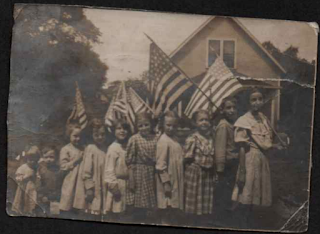
Members of the Hackleman family, who lived at 5438 Lowell Avenue, lined up with other neighborhood children for a parade c1910 in front of the Cottman home at 334 North Whittier Place. (photo courtesy of Anne Gribble Spurgeon)

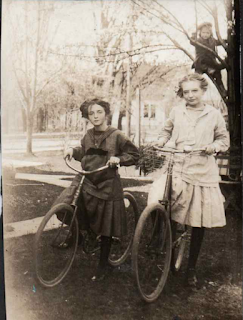
Grace Hackleman and Florence Hackleman rode their bikes while their sister, Gladys, posed in a nearby tree c1910. The Hacklemans resided at 5438 Lowell Avenue. Behind the girls, you can see the Cottman home located at 334 N. Whittier Place. (photo courtesy of Anne Gribble Spurgeon) 

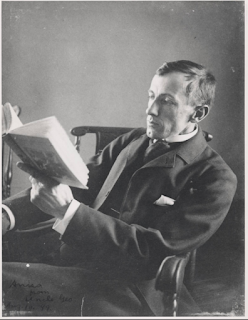
George S. Cottman was a prominent Indiana historian of the early twentieth century. He authored numerous books and pageants. The Cottmans briefly lived at 334 N. Whittier Place although they spent most of their Irvington years at 336 North Ritter Avenue. (photo courtesy of RayBoomhower.blogspot) 

George S. Cottman authored an early history of the state of Indiana in 1925. 

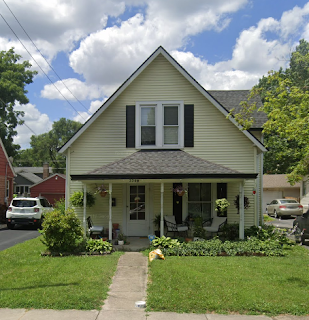
The Cottman home as photographed by Google in July of 2019


     I wish to thank Anne Gribble Spurgeon for the use of her incredible Conner/Hackleman photo collection. I also wish to thank Paula Schmidt and Steve Barnett at the Irvington Historical Society.

Irvington Historical Society

Sources: Opening of Whittier Place north of Lowell Avenue: Indianapolis Journal, August 19, 1902; Building permit and construction of Cottman home: Indianapolis Commercial, February 1905; Cottman Seattle move: Indianapolis Star, September 27, 1908, 18; Indianapolis News, September 25, 1909, 22;