Thursday, December 3, 2020

Irvington at 150: Street Names I-M

In part three of our series on street names more historical information has been uncovered. Additional research will be needed as you will see that we don't know the origins for a few of the street names. Thanks to the efforts of historians like Larry Muncie and Steve Barnett, many of the mysteries have been solved. A romantic novel, prominent residents, a poet, a local girl, and the founders of Irvington have streets named for them in this grouping. If you have additional information on any of these avenues please let us know.

Irvington Avenue: On the evening of March 16, 1903, the Indianapolis City Council renamed Elm Avenue as Irvington Avenue. The Indianapolis News reported that the street was nearly named Tennyson Avenue, but local residents objected. It was obvious as to why Elm had to go as there was already another street in the city with that name, but why did this small side street get such a grand name? It wasn't the first time that a street in the town had been named for Irvington. Early maps show that Julian Avenue connecting what is today South Butler (then Lake) and South Hawthorne (then Commercial) as Irvington Avenue. It would seem to have been more appropriate for a major boulevard to have donned the name of the town; however, Elm Street won the day. To further complicate the story, an early plat of neighborhood shows that South Irvington Avenue used to be known as Cherry Avenue. 

Irwin Street: The small street located north of Washington Street did not appear in the Indianapolis city directory until 1941. Likely developed at the same time as nearby Elizabeth Street, the first families to dwell along Irwin included the Shocks, Kaisers, Matthews, and Washburns. Developers were also building homes along Irwin north of Irvington so it is unknown at this time as to the origin of the name. Is Irwin related to nearby Elizabeth? Perhaps someone knows the answer. To view beautiful photographs taken of the street in the 1950s, click on the "Irwin Street" link below. 

Ivanhoe Street:  On November 25, 2019, the BBC named Ivanhoe as one of the most influential novels ever written. Walter Scott, who published his book in 1819, set the fictional tale in 12th-century England complete with Normans, Saxons, jousting tournaments and a witch trial. The popular three-volume set was likely found on the shelves of many Irvington homes. A small street in the South East Irvington Addition, formerly called Fourth Street, was renamed after the popular tale in 1898. 

Ivanhoe was first published in 1819 but was still popular in 1916 when this edition came out.

Jenny Lane: On August 29, 1926, an ad in the Indianapolis Star announced the exciting news that several lots would be for sale for future homes along a brand new street called Jenney Lane. Later, city officials dropped the second "e". The small stretch was named for the Jenney family who resided in a beautiful home at 4603 East Washington Street. Charles D. Jenney (1864-1926) earned a comfortable living managing his own electrical company. Throughout the mid and late-1920s, contractors built charming brick bungalows and doubles along the lane. 

Indianapolis Star, August 29, 1926

Some early articles about homes along the street referred to it as Jenny's Lane. This ad appeared in the Indianapolis Star, November 17, 1929.

Johnson Avenue: Sylvester Johnson founded the town of Irvington along with Jacob Julian. His stunning Second Empire-style home faced Audubon Road. His backyard complete with a beautiful orchard abutted what is today Johnson Avenue. The small street became longer in 1898 when the town board named a stretch from Julian Avenue to the Pennsylvania Railroad after Johnson as well. 

Julian Avenue: The original Julian Avenue stretched from Ritter Avenue to Arlington Avenue (then Line) and is named for the family who made Irvington possible. Jacob Julian arrived first and founded the town. His more famous brother, George Washington Julian, arrived in 1874. George Julian, a retired Congressman, built a beautiful Italianate residence just south of Jacob's home on South Audubon Road (then Central Avenue). Congressman Julian's daughter, Grace Julian Clarke, was an important figure for women's suffrage in Indiana. She lived in the family home at 115 South Audubon Road until her death in 1938. Local historian, Steve Barnett, recently discovered that part of Julian Avenue from South Irvington Avenue to Downey Avenue was originally called Ohmer Avenue in 1871. West of Ritter Avenue, both Houston and Irvington Avenue became Julian Avenue in 1898. East of Arlington Avenue, Chestnut Street also became Julian Avenue in that same year. 

Kenmore Road: When researching homes in the Irvington Terrace Addition, it is important to know that some of the street names have been changed. For instance, Kenmore Road began as Eldridge Street. The Buckeye Realty Company developed much of the area beginning in 1913. Newspaper stories touted beautiful homes constructed by R. L. Castle. The original name of Eldridge (sometimes spelled Eldredge) came from John and Alanson Eldredge, who owned acres of land in the area in the 1840s. ("The Story of a Lot," Indianapolis News, May 16, 1914) The city of Indianapolis changed the name in 1916 to Kenmore Road. (Indianapolis News, October 17, 1916, 19) The origin of the name is unknown at this time. 

Photos of several Irvington Terrace homes developed by the Buckeye Realty Company were featured frequently in the Indianapolis newspapers of the 1910s including this house at 45 Kenmore Road (formerly 51 Eldredge/Eldridge Street). ( Indianapolis Star, December 20, 1914)


Kenyon Street: Sixteen years after the first residents purchased lots along Kenyon Street, the Indianapolis Star paid a visit in 1929 and described the avenue as "one of the most attractive streets in Indianapolis." The author further gushed that it is "lined with beautiful maple trees, well-kept lawns, and attractive new bungalows." First platted in 1913 by the Buckeye Realty Company under the leadership John Chilcote, the street is one of the few in the addition that has not been renamed. But what is the origin? There were Kenyons living in Irvington, but we see no connection just yet. Mr. Chilcote was a native of Ohio and developed numerous housing additions in the Columbus and Lima areas. Could the street be named for the Ohio college? 

From the Indianapolis Star, July 8, 1929

Kitley Avenue: Check any atlas of Warren Township produced in the nineteenth century and you will see the Kitley family name. In fact, John Kitley owned the area of what was to become Irvington Terrace in the 1850s. Other Kitleys continued to farm south of Irvington. Today, the only vestige of the Kitleys in the Irvington area is the street that bears their name. 

Layman Avenue: In the spring of 1896, the Irvington Town Board united Layman Avenue (north of Washington Street) with that of Tilford Street (north of Lowell Avenue) under one name--Layman Avenue. Tilford had been an early investor in the Chambers Addition north of Lowell, but by the late nineteenth-century, the town was more enamored with the wealthy Layman family who lived in the former Jacob Julian home at 29 South Audubon Road. (then Central) James T. Layman, a Civil War veteran, had made his money in the wholesale trade. He and his wife Cora Belle Parks Layman moved into their Second Empire mansion in 1887. At least one son, Theodore, also served on the Irvington Town Board. 

James Townsend Layman and Cora Belle Parks Layman c1910 in front of their home at 29 South Audubon Road (photo courtesy of Isabelle Layman Troyer)

The Layman home at 29 South Audubon Road c1910 (photo courtesy of Isabelle Layman Troyer)


Leland Avenue: This avenue first appears in the Indianapolis newspapers as Leland Street as early as 1905, but no houses were built upon the avenue until the mid-1920s. North of Tenth Street, contractors erected beautiful brick Tudor homes in a development called Emerson Highlands. Later they developed the street south of Tenth Street. So who was Leland? Is it a first name or a last name? Do you have information? The origin of the name eludes us at the moment. 

A sketch of the home of the Harryman family of 1101 Leland Avenue can be seen in an ad in the Indianapolis News, May 14, 1927.

Wayne Harryman helped to develop the Emerson Highlands neighborhood along Leland Avenue. He lived in a beautiful stuccoed English Tudor next to this house at 1101 Leland Avenue. (Indianapolis Star, May 26, 1929)

Lesley Avenue: Formerly called Greene Street, the name appears to have changed to Lesley Avenue in 1903. The street was named after Daniel Lesley, who resided at 5716 Lowell Avenue with his wife and two children. Mr. Lesley was a tax accountant and frequently made the news for exposing government corruption. Both he and his wife Edith Thompson Lesley hailed from Winchester, Indiana. 

Daniel Lesley (with a mustache) posed with his relatives most likely in Randolph County, Indiana c1885. Pictured: Jacob, Amos, Daniel, and Rueben Lesley (photo courtesy of Lesley family descendants via Ancestry.com) 

Lowell Avenue:  Irvington residents appear to have had love affair with writers from the Romantic era. In 1898, when the town board decided to rename a confusing hodgepodge of streets into one name, they chose to rebrand the long street after the poet and editor of the Atlantic Monthly, James Russell Lowell (1819-1891). Mr. Lowell was good friends with Ralph Waldo Emerson and John Greenleaf Whittier, who also received Irvington street names. Previous names of the street included Elm Avenue (in between North Audubon Road and Irvington Avenue) and Walnut Avenue (in between North Audubon Road and North Arlington Avenue). Larry Muncie in his book, Irvington: Three Windows on Irvington History, 1989, mentions that at one point part of the street was also called Ohio Street. 

James Russell Lowell (1819-1891) (public domain)

Maple Lane: William Alexander and Flora McDonald Ketcham filed for a plat for the subdivision of Pleasanton in 1915. This small addition to Irvington emulated the original plan for the area complete with winding streets. Most of the development for the new community, however, did not really take off until the early 1920s. The Ketchams chose Maple Lane as one of their streets although there was already a Maple Road (38th Street) in northern Indianapolis. Trees seem to be a theme for street names in Pleasanton. 

An ad for new homes along Maple Lane in Pleasanton from the Indianapolis News, September 23, 1921


Market Street: A small section of Market Street runs through Irvington. The more famous part of the street begins in downtown Indianapolis and was aptly named for the markets that still operate along that well-known avenue. 

Melvenia Street: Clarence and Josephine Hurst lived in a small cottage along an unnamed lane south of Burgess Avenue in the 1920s. By 1924, the Indianapolis city directory listed the Hursts on Melvenia Street. Melvenia Street? Where did that name come from? Who was Melvenia? It turns out that the answer was right in front of me. The Hursts had one daughter--Melvenia Hurst. She married John Martin and eventually moved to Florida where she passed away in 2005. We are in the process of attempting to track down family members to learn more about her. In 1940, the city of Indianapolis further honored her by naming another section south of Brookville Road as Melvenia. It had formerly been called "Haugh." 

Michigan Street: John Chambers was an early investor in Irvington. He developed land north of Lowell Avenue in between Ritter Avenue and just east of Arlington Avenue. He named one of the streets after himself. Unfortunately, like many early investors, Mr. Chambers went bankrupt. When the city of Indianapolis annexed Irvington, they changed Chambers to Michigan to align with the street that originated in the original mile square of Indianapolis. Mr. Chambers was completely erased from the story of the neighborhood; however, his name lives on in deeds and abstracts. 

John W. Chambers, who developed land north of Lowell Avenue and east of Ritter Avenue, went bankrupt in 1877. Later a street named for him became Michigan Street. (Indianapolis News, February 6, 1877)


Sources:  Larry Muncie, Irvington: Three Windows on Irvington's History. 1989; Irvington Avenue--"Mr. Warweg's Ordinance," Indianapolis Journal, March 17, 1903, 10; Kenyon Street--"Our Street," July 8, 1929, 8; Layman Avenue--"New Town Officers," Indianapolis News, May 12, 1896, 7: Melvenia Street--"Changes Sought in Street Names," Indianapolis Star, February 6, 1940, 5: "Changes in Street Names," Indianapolis Journal, January 18, 1903, 3; "Irvington's New Names," Indianapolis News, November 3, 1898, 7. 

Friday, November 27, 2020

Irvington at 150: Street Names E-H

Irvington street names have a complicated history. Many of the avenues have been called by numerous names. In this second part of the series, you will note that some of the meandering paths in the neighborhood were named after local farm families, famous American writers, and investors. We do not know the origin of all of the names, but thanks to the hard work of a local historian, Larry Muncie, we do have precise dates for their naming. Feel free to contact us if you have more information!

Edmondson Avenue: Little is known about the origin of this street. It first appears in the Indianapolis City Directory in 1928. When Warren Park incorporated in the late 1920s, Edmondson Avenue became an eastern boundary for that neighborhood. More research is needed on this street.

Ellenberger Parkway:  In the mid-1920s, city officials began construction on Ellenberger Parkway; however, they did not pave nor link it with Tenth Street, which upset a few local residents. (Indianapolis Star, May 19. 1925) With the availability of federal funds during the Great Depression and working with the WPA, the parkway was completed by the mid-1930s. (Indianapolis Star, December 20, 1935, 18) The avenue was named for the prominent Ellenberger family who also sold the land for the nearby park. 

Members of the Ellenberger family gathered for a reunion at the family home at 5602 East 10th Street in 1914. Both a park and a nearby street are named for the Ellenbergers. 

Elizabeth Street: Although the name of the street is unknown at this time, we do know that many of the homes built along that stretch were developed by the Vogel Company in Wagner's Addition in 1941. The investors invited the public to tour twelve new residences on September 7, 1941. Two months later, the United States entered World War II.

Indianapolis Star, September 7, 1941, 31


Emerson Avenue:
Now a busy thoroughfare, Emerson Avenue began as a quiet street called National Avenue until 1898. The Irvington Town Board changed the name to Emerson after the essayist Ralph Waldo Emerson (1802-1882). Mr. Emerson would have likely been pleased that two of his good friends, George Bancroft and Nathaniel Hawthorne, also had streets named for them in the new college town, but he died before the renaming. 

Ralph Waldo Emerson (1802-1882) never knew that the little town of Irvington named a street for him. (public domain)

English Avenue: On September 1, 1873, city officials approved the contract to improve the first half mile of a new street in Irvington called "English" Avenue. The street was named after William Hayden English (1822-1896), a prominent banker and politician in Indianapolis. (Indianapolis News, September 2, 1873, 2) 

William Hayden English, a capitalist and politician, built an opera house and hotel on Monument Circle in Indianapolis. (public domain) 


Farrington Avenue:
After World War II, developers scrambled to build houses for the returning veterans who were starting their families. With assistance from the FHA and the GI Bill, families could apply for loans and purchase brand new two or three-bedroom residences along Farrington Avenue in the late 1940s and early 1950s. E. G. Bauer & Son built many of the houses along the new street. 

Fletcher Avenue: While Fletcher Avenue is most often associated with a near south side Indianapolis neighborhood, the street has a short stretch through southwestern Irvington. The street is named after Calvin Fletcher, an early resident of Indianapolis who went on to become a banker, farmer, and a politician. 

Calvin Fletcher (1796-1866) was an early leader in Indianapolis. His multi-volume diary captured life in the young capital and was later published by the Indiana Historical Society (public domain)


Good Avenue:
Walter and Ada Good joined Jacob Julian, Sylvester Johnson, and Lycurgus Rawles in platting most of southern Irvington in January of 1873. As a thank you for his investment, a small street north of Dewey (then East) and south of Bonna (then Railroad) was named Good Avenue. Later in 1903, the city of Indianapolis renamed South Street in between University Avenue and Rawles as Good Avenue as well. 


Graham Avenue: While it is unconfirmed at this moment, it is believed that Graham Avenue was named for William Henry Harrison Graham, a local resident and investor. Mr. Graham and his wife Ellen built a beautiful home on University Avenue. In 1897, he became the American consul at Winnipeg, Canada. He also went into business with Charles Brouse, who helped to develop several sections of Irvington. His widow, Ellen Graham, entered the history books when she sold their beautiful home to D.C. Stephenson, the Grand Dragon of the KKK in Indiana and the Midwest. 

Grand Avenue: The street used to be longer as it stretched from Audubon Road to Brookville Road, but the town board realized that it was a confusing route so the section from Audubon Road to Ritter Avenue was changed to Burgess Avenue. Only a small section of the street remains today. The name appears to be generic. 

Greenfield Avenue: Perhaps when Jacob Julian and Sylvester Johnson named a small stretch as Greenfield Avenue, they had hoped that one day the path might connect to the nearby Hancock County city. Both men were from Centerville, Indiana and would have passed through Greenfield along the National Road on their way to and from Irvington. Greenfield Avenue, however, never managed to make it out Irvington. 

Hawthorne Lane: In 1898, the Irvington Town Board chose to name both Commercial and Blount Streets after Nathaniel Hawthorne, the popular writer. Mr. Hawthorne died before the founding of the town, but his works like Scarlet Letter and Twice Told Tales would have rested on many bookshelves throughout the neighborhood. 

Nathaniel Hawthorne (1804-1864) was much admired by many in Irvington.


Hibben Avenue:
In December of 1913, the Irvington Improvement Association announced the exciting news that lots on a new street called Hibben Avenue would now be for sale. (Indianapolis Star, December 4, 1913, 4) The small street stretched from Downey to Ritter Avenue. The Association named the street for the wealthy Hibben family who dwelled in a villa at 5433 University Avenue. Thomas Hibben earned his fortune in the wholesale trade. His children were equally as talented. Paxton Hibben, a brilliant student, went on to become an author and a diplomat. Thomas Hibben, Jr. was an architect who designed buildings on Butler's Fairview campus while James Hibben taught chemistry at Princeton University. His daughter, Helene Hibben, was a prominent sculptor who opened an early kindergarten where the children spoke French. Her sister Hazen assisted her. The house where they lived on University was the previous home to the Downey and Thompson families; thus, three street names came from one house: Downey, Bonna, and Hibben. 

Courtesy of Hibben family descendants via Ancestry.com

Courtesy of the Hibben family descendants via Ancestry.com

Courtesy of Hibben family descendants via Ancestry.com 


Hill Street:
It appears that the small street located in Ritter's Lowell Subdivision was laid out in 1911. Curbs and sidewalks were not added until 1913. (Indianapolis Star, October 4, 1913, 3) Since there is a slight hill on the avenue, it appears that the name is geographical in nature. 

Howe Drive: Named for the nearby high school and a former president of Butler University, the narrow street has served as a conduit for thousands of teenagers over the decades. The residents of Irvington had long wanted a high school so when they finally received one in 1938 they decided to name it after Thomas Carr Howe (1867-1934). Mr. Howe served Butler University as a professor, dean, and as president. His untimely death, after being struck by an auto, shocked the community. 

Thomas Carr Howe, a former president of Butler University (public domain) 


Sources: Larry Muncie, Three Windows on Irvington History, 1989; "Changes in Street Names," Indianapolis Journal, January 18, 1903, 3; "Irvington's New Names," Indianapolis News, November 3, 1898, 7; "Would Change Names of 149 Streets in City," Indianapolis News, December 18, 1916, 8; Interviews with Steve Barnett and Larry Muncie, 2020. 

Thursday, November 19, 2020

Irvington at 150: Street Names A-D

 Anyone researching their historic home in Irvington must understand that some of the street names in the neighborhood have been changed two and three times. To complicate matters even further, addresses have also been changed. Local historian, Larry Muncie, has done much of the groundwork on the history of street names. In one of his books, Irvington: Three Windows on Irvington History (1989), Mr. Muncie even provides maps to help understand the changes. 

Irvington was a separate town from 1870 until it was annexed by the city of Indianapolis in 1902. There appears to have been two major corrections on street names in the area. The first came in 1898 when the town board tried to clear up the confusion for some of the names. The next major correction occurred in 1903 when an engineer working for the city of Indianapolis recommended that several street names be changed due to similar or exact names within the city of Indianapolis. There were other years when names changed, but those two were the most important. 

After Butler University moved into the neighborhood, developers made an effort to name some of the streets after prominent writers or scholars. They also named several of the avenues after early families. In some cases, we do not know the origin of the name but we can speculate. In the following series, we will attempt to clarify the origin of the neighborhood's street names. If you have additional information on street names, please let us know! 

Arlington Avenue: Formerly called Line Street, the earliest known use of "Arlington Avenue" appears in an April 8, 1896 Indianapolis News article, (9) about a rail line in Irvington. Two years later, the Irvington Town Board formerly adopted the name. The presumption is that the street is named after Arlington Cemetery in Virginia; however, there is no evidence for this fact yet. Arlington Avenue (Line) is one of the original streets of Irvington. 

Atherton Drive: When investors redeveloped Butler University's Irvington campus into a housing addition in the mid-1940s, they added Atherton Drive. They named the circular street after John H. Atherton, the long-time Secretary-Treasure for Butler University. Mr. Atherton raised millions of dollars for the school over the years and was instrumental in securing the Fairview site for the campus; thus spelling the doom for the Irvington location. 

John J. Atherton (courtesy of Indianapolis News, March 22, 1944)


Audubon Road:
When the founders of Irvington placed covenants upon the residents, they decreed that no birds could be shot within the town limits. So, in 1903, when the neighborhood had to change the name of Central Avenue, they chose to rename it after John James Audubon, the famous naturalist and birder.  To complicate the matter even further, Audubon Road north of Lowell Avenue used to be called Maxwell Street. That small section was also renamed in 1903 after the birder. Audubon Road (Central) is one of the original streets of Irvington. 

Portrait of the naturalist, John James Audubon in 1826 (public domain)


Auvergne Avenue:
James Downey and Charles Brouse had grand ideas when they platted their addition to Irvington in the far southwestern part of the neighborhood in the mid-1870s. They envisioned beautiful villas on large lots. While at least a handful of imposing homes were constructed, their vision was compromised by the economic depression that lingered through the 1870s. They named one of their winding streets, Auvergne Avenue, after the region in France. Most of the residences along the small street were largely constructed after World War II but at least one nineteenth-century home still remains at 740 Auvergne Avenue. 

James Downey and Charles Brouse named one of their platted streets after the Auvergne region in France. (public domain)

Bancroft Street: While this street is often associated with the Emerson Heights neighborhood, it actually has its origins in Irvington. The street has had three separate names. The link north of the Pennsylvania Railroad and south of Howe High School used to be called Brook Street. Another link between University Avenue and Brookville Road was formerly known as Parker Street. The Irvington Town Board changed those two names in 1898 to Bancroft. Later in 1903, the city of Indianapolis changed Pleasant Street just north of Washington Street to Bancroft as well. Although unconfirmed, the street was likely named after the American historian George Bancroft. (1800-1891)

Bankers Lane:  The small street that connects East Washington Street to Pleasant Run Parkway South Drive first appeared in the Indianapolis City Directory in 1941. Named for Frances and Anna Banker, who resided at 4711 East Washington Street next to the lane, the street became well known because of the streamlined Art-Deco apartments built along it in 1943. Mr. Banker earned a comfortable living as the president of the Brooklyn Brick Company. He also owned an extensive property in South Dakota. 

A photo from his obituary published in the Indianapolis News, November 26, 1945

Photo published in her obituary in the Indianapolis Star, October 1, 1944.

Beechwood Avenue: One of Irvington's original streets, the southern avenue was likely named for the large numbers of beech trees that still existed when Julian and Johnson platted the town. East of Arlington Avenue, the street used to be known as Center Street.

Berry Avenue: One of Irvington's shortest streets, Berry Avenue, was formerly called Perry Street until 1903. The old name had to be changed after the city of Indianapolis annexed the town. The origin of the name is unknown at this time.

Bolton Avenue: Formerly called Maple Avenue, the city of Indianapolis changed the name to Bolton Avenue after the poet Sarah T. Bolton in 1903. Although largely forgotten today, Mrs. Bolton was a popular poet in Indiana in the nineteenth century. Her most famous poem was "Paddle Your Own Canoe." A nearby park in Beech Grove is also named for her as she owned land there. 

City officials wanted to change the name from Maple to Tarkington Avenue, but local residents objected due to the length of the writer's name so they compromised on renaming the street after the Indiana poet, Sarah T. Bolton. (public domain)

Bonna Avenue: The tragic story of Bona Thompson is now quite frequently told in Irvington. The young Butler graduate went on a European tour with her mother, but became ill and died of typhoid fever. Her grief-stricken parents donated the money and the land for the Bona Thompson Library at Butler's Irvington campus in 1902.  When city officials needed to change the name of Railroad Street in 1906 they blundered and misspelled the new street name as Bonna instead of Bona. For more than a century, no one has bothered to change the incorrect spelling of Miss Thompson's name. 

Bosart Avenue: The Bosart family, who resided in the large brick home formerly belonging to the Wallace family at 4704 East Washington Street, owned the land on what would become Bosart Avenue. As both the city of Indianapolis and Irvington started to expand, the Bosart land became highly valuable in the late nineteenth and early twentieth centuries. 
Ruth Bosart (1858-1943)
Timothy Bosart (1844-1900) (photos courtesy of the Bosart family via Ancestry.com) 

Brookville Road: The old highway known as Brookville Road predates Irvington by many years and is named for the city in southeastern Indiana. Later federal highway officials gave it the number U.S. 52. 

Burgess Avenue: Due to the fact that it meanders, town founders seemed to confused as to where Burgess Avenue terminated. Josephus Collet named the original Burgess Avenue in his addition after the Reverend Otis A. Burgess, the president of Butler University in the 1870s. His street started east of Emerson Avenue (then National) and then snaked south of the Baltimore and Ohio Railroad all the way to Ritter Avenue. Then, in 1898, local officials decided to rename Grand Avenue in between University and Ritter as Burgess as well. That section of Burgess Avenue (then Grand) was part of the original plat. 

The Reverend Otis Burgess was responsible for moving Butler University (then North Western Christian University) to Irvington in 1875. Developer Joseph Collet named a street after him. 


Butler Avenue: North Western Christian University moved to Irvington in 1875. They changed their name to Butler University in 1877. The nearby street just east of campus was also named Butler Avenue. In 1898, town officials changed a small section of Lake Street from Washington Street to the Pennsylvania Railroad as Butler Avenue as well. 

Campbell Avenue: John W. Chambers platted four additions near Lowell Avenue in the early 1870s. By the end of the decade, he faced legal trouble like many land speculators after the Panic of 1873. It was Chambers who named a small street north of Lowell Avenue (then Walnut Street) and south of Michigan Street (then Chambers Street) as Campbell. It is unknown at this time why Campbell was chosen as the name although Mr. Chambers did name other streets in his subdivisions after fellow investors. 

Addendum: Steve Barnett, the director of the Irvington Historical Society, notes that the street might have been named for Dr. John Campbell (1831-1917), who operated an early drug store in the neighborhood. The Campbells moved to Colorado in 1881. 

Catherwood Avenue: Formerly known as Warren Street from Washington to the Pennsylvania Railroad and then as Parkman and Jennison Streets south of the rail line, the city of Indianapolis consolidated all of the names into Catherwood Avenue in 1903. The street was named for the writer Mary C. Catherwood, a writer who briefly lived in Indianapolis in late nineteenth century.  Although her work is forgotten today, her books were widely read in Indianapolis. 

The nineteenth-century regional writer, Mary C. Catherwood (1847-1902), briefly lived in Indianapolis. She was known for her attempt to capture Midwestern regional dialects in her work. (public domain) 


Clyde Avenue: James Downey and Charles Brouse, local developers, envisioned a beautiful community south and west of Irvington. Two of the streets in that development were called Louise (no longer exists) and Clyde. Louise Street was most likely named after the daughter of Charles Brouse. It is not known at this time who Clyde might have been related to as neither Downey nor Brouse seem to have anyone by that name in their families. The addition later became part of Irvington. 

DeQuincy Street: While DeQuincy Street is most commonly associated with the Emerson Heights neighborhood just west of Irvington, the street has its origins in Irvington just north of Washington Street. Originally called Quincy Street, the town board added the "De" in 1898. 

Dewey Avenue: On April 30, 1898, Admiral George Dewey at the Manilla Bay in the Philippines told his subordinate, "You may fire when ready..." Six hours later, the United States Navy defeated the Spanish Navy in that now famous battle as part of the Spanish-American War. Thousands of miles away in the town of Irvington, Indiana leaders in that community sought new names for some of the streets. One of the avenues they wanted to rename was East Street, a very undeveloped meandering path between University and Arlington Avenues. It is believed that when they learned of the victory, local officials renamed the street as Dewey Avenue in 1898. Second Street east of Arlington Avenue in Elizabeth Cain's addition was also renamed for the Admiral. 

Very few streets in Irvington are named for military leaders, but after Admiral George Dewey led the victory against the Spanish in the Philippines, the neighborhood honored him with a street name in 1898. Numerous other municipalities across the country did as well including New York City. (public domain)


Downey Avenue:  Jacob Julian, one of the founders of Irvington, asked his son-in-law, James Downey to join him in the investment. Mr. Downey became one of the chief promoters for the new town. He and his wife Mary also built two of the earliest homes in the neighborhood. Their second residence, a large brick Second-Empire villa was located on the southeastern corner of University (then called Spratt) and Downey Avenue. The Downeys did not remain in Irvington for very long as they moved to the western United States. Despite at least one attempt to rename it, the street name has never been changed. 

An ad placed by James E. Downey for Irvington in the January 19, 1871 edition of the Indianapolis News


Sources: Larry Muncie, Three Windows on Irvington History, 1989; "Changes in Street Names," Indianapolis Journal, January 18, 1903, 3; "Irvington's New Names," Indianapolis News, November 3, 1898, 7; Interview with Steve Barnett, Director of the Irvington Historical Society, November 15, 2020. "Would Change Names of 149 Streets in City," Indianapolis News, December 18, 1916, 8. 


I would like to thank both Larry Muncie and Steve Barnett for their assistance with the research for this post. 


Friday, November 13, 2020

Irvington at 150: A College Town

 In the early 1870s, officials at North Western Christian University had begun the process of scouting a new location. Founded in 1855 by members of the Disciple of Christ, the university had outgrown its location at East 13th Street and College Avenue in what was then northern Indianapolis.  Its name derived by the fact that when it was founded, Indiana was considered to be in the northwestern part of the United States. The investors had been open to educating both men and women. The college was one of the earliest co-educational schools in nation. Beset by financial problems, the board of directors hoped that they could sell their current location and find new investors who would donate land and money for the institution.

In the summer of 1873, two places within Marion County seriously competed for the university. Carter's Station, a now forgotten community near what is today Speedway, offered 42 acres and their agent, James Johnson, proposed funding two faculty chairs in medicine and law. Irvington, a brand new neighborhood east of Indianapolis, offered 25 acres and $130,000 in cash. Ovid Butler the chief stockholder in the university did not want to relocate but the area around the campus was rapidly developing and the college could easily obtain more cash by subdividing the university land into city lots. Irvington sweetened the pot to $150,000 while Carter's Station held firm. On July 24, 1873, the college announced that Irvington had won the bid. The new school would be built on land formerly owned by Josephus Collet.  

Irvington investors donated 25 acres of land for Butler University (formerly North Western Christian University) south of the Pennsylvania Railroad, east of South Emerson Avenue (then National), north of the Baltimore and Ohio Railroad, and west of South Butler Avenue on land formerly owned by Josephus Collet. (map of Irvington, 1886)

Butler, formerly North Western Christian University, was founded in 1855 and used to be at 13th and College in Indianapolis. (Courtesy of the Butler University digital archives)

The Main Hall was the first building completed at the Irvington campus and was dedicated in 1875. (Courtesy of the Irvington Historical Society)


Preparations for the campus began immediately with the construction of the main hall. The economic panic of 1873 nearly sabotaged the entire venture, but several key families stepped in to keep the university solvent. On September 14, 1875, campus officials dedicated the new building which contained both classrooms and a chapel. The structure was not as architecturally imposing as its previous Gothic-revival building, but the facility would serve its purpose for the next 54 years. The task for moving everything to Irvington fell to President Otis A. Burgess. A devout Disciple, Reverend Burgess was not as popular as a previous president named Allen R. Benton, who had left Indianapolis to start the University of Nebraska. (He would later return to Butler and move into the Ohmer home, later called the Benton House) Burgess was more strict about rules and he grew concerned that some of the professors were not as devout. David Starr Jordan, a young science teacher, irked Burgess more than the others with his strong views on Darwin. Jordan would later move to Indiana University where he eventually became the president. His career continued to skyrocket as he helped to found Stanford University. Jordan's passion about Darwin led him into racial purity theories and into the eugenics movement. Both IU and Stanford are removing his name from their campus buildings. Burgess, on the other hand, who left no such tarnished reputation still bears a street named after him in Irvington. 

Reverend Otis A. Burgess, the president of Butler, was responsible for moving the university from 13th and College to Irvington. The town's developers named a street for him. (public domain)

Butler was built upon land formerly owned by Josephus Collet. Mr. Collet also platted nearby housing additions. (see map above) (photo courtesy of the Collet family via Ancestry.com)

A very young David Starr Jordan briefly taught in the science department at Butler. He ran afoul of President Burgess so he resigned and moved to Indiana University in 1879. He later became the president of both Indiana and Stanford Universities. (public domain)


A steady stream of college students and some of their families began to move to the quiet town located along the National Road. Some commuted either by rail, foot, or the mule car from downtown. In 1877, the board of directors renamed the school after their founder, Ovid Butler. The arrival of the college was the economic kick that Irvington needed although housing construction remained modest at best throughout the remainder of the 1870s and into the 1890s. 

The Main Hall had a reception room for clubs to meet. (photo courtesy of the Butler University digital archives)
Butler added Burgess Hall in 1890. The new building contained science labs and classroom space. (photo courtesy of the Butler University digital archives)


The residence hall on Butler University's Irvington campus (photo courtesy of the Butler University digital archives)

The power station also housed the gymnasium in the late nineteenth and early twentieth centuries on Butler's Irvington campus. (photo courtesy of the Butler University digital archives)


Butler added an observatory on the Irvington campus for astronomy classes. (photo courtesy of the Butler University digital archives)

Butler added the Bona Thompson Library in 1902. This photo was likely snapped c1912. (photo courtesy of the Irvington Historical Society) 

Sources: George M. Waller, Butler University: A Sesquicentennial History, 2006; Competition for campus: Cambridge City Tribune, July 17, 1873; Indianapolis News, July 21, 1873.

The Irvington Historical Society has reissued and updated Paul Diebold's Greater Irvington. You may order it via the pre-sale price or later with the regular price at the link below.

Greater Irvington II


Thursday, November 5, 2020

Irvington at 150: The Beginning

 Jacob B. Julian and Sylvester Johnson walked into the Marion County Courthouse on November 7, 1870, to file a plat for a new experiment called Irvington. Neither man hailed from the area as both were from Centerville, Indiana in Wayne County. A simple ad in the Indianapolis News on the following day documented the moment:  

     A plat of the town of Irvington was filed for yesterday. It has one hundred and nine lots, containing one to ten acres each. 

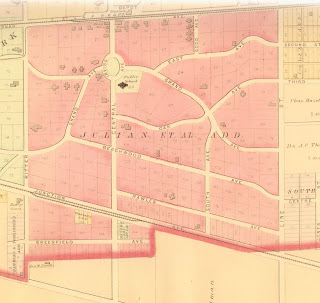
The original plat created by Julian and Johnson as seen in this early map: The men quickly added the Julian and Johnson Addition south of the Pennsylvania Railroad. Just to the west, Levi Ritter added 80 acres of additional land for development in 1871.  

In the Julian and Johnson Addition, the developers added one of the first parks in Marion County. By 1874, builders erected a school across the street from the circular green space. 


The men had been inspired by the development of the town of Glendale (1851), a suburb north of Cincinnati. In that neighborhood, families of means built large homes on wide lots out in a country atmosphere. Glendale was located along a major rail line and had a small commercial section along with a school. Julian and Johnson strategically purchased farmland and woods east of Indianapolis in Warren Township due to its proximity to two major rail lines and its location along the National Road. These men were investors, but they were also planning to sell a way of life.

Early accounts indicate that Sylvester Johnson, a founder of Irvington, visited Glendale, a town north of Cincinnati. The beautiful community became the model for Irvington. (photos courtesy of Glendale Archive and Cincinnati Refined) 


Both Julian and Johnson had earned comfortable livings in Wayne County as attorneys and as land speculators. Both men were Quakers and both had been irked by a local issue that involved the removal of the county seat from Centerville to Richmond. Their vision for Irvington was similar. Of course, it was a profit-making venture, but Johnson, who was devoted to the cause of temperance, wrote in covenants that banned the sale of intoxicating liquors. He also added numerous other provisions as well including the stipulations that no slaughterhouses nor soap factories would be built within the town limits. Julian was given the naming rights. Early accounts vary, but either Jacob or his daughter, Mary Julian Downey, named the new town after their favorite author, Washington Irving. 

The men must have done a good job of promoting the experiment as many people signed up to purchase lots before the town was even chartered. Levi Ritter, who owned 80 acres just to the west of the original plat, joined into the plan and it appears that he built the first new house in the neighborhood although there were still a few farmhouses nearby. Grace Julian Clarke, the niece of Jacob Julian, attributed his accomplishment to the fact that his house was clad in wood and not brick like many of the original residences so it was easier to build. His home used to stand on the grounds of the present School #57 and of course, the nearby street is named for his family. Johnson and Julian completed their homes soon after Mr. Ritter. A blurb in the Hancock Democrat (February 23, 1871) noted that Jacob Julian intended to build a residence in Irvington. A Cambridge City Tribune (October 31, 1872) article recorded that Mr. Julian and his family removed from his old house in Centerville to his new residence at Irvington, a suburb of Indianapolis, on Tuesday last.  Both Julian and Johnson sited their brick Second Empire homes facing South Audubon Road (Central Avenue). The imposing residences could be seen from the National Road and must have been impressive mirages for travelers who might have been sojourning across the state. 

Jacob Julian and Sylvester Johnson both hailed from Centerville, Indiana. They founded Irvington in 1870. Levi Ritter joined the duo as an investor in 1871. (Irvington Historical Society)


Julian, Johnson, and Ritter followed the Glendale plan of meandering streets. The romantic design had become popular in the United States. Crown Hill Cemetery, begun in 1863, had a similar plan. Homeowners in the new suburb were required to plant trees. Towering oak, maple, catalpa, elm, ash, and sycamores grew into incredible canopies providing pleasant shade for future residents. Many of the new neighbors possessed cows that were allowed to graze in the public green spaces. Sheep, horses, and chickens were also allowed within the town limits although many spats in the neighborhood over the animals spilled into the local press.  

The investors touted the possibility that a female seminary would be placed in the north circle although none ever materialized. Each person who built in Irvington was required to spend from $2500 to $10,000 on their homes. George W. Julian, the brother of Jacob Julian, spent $18,000 on his own home at 115 South Audubon Road (then called Central) in 1873. He rued the cost of his new residence and in his journal called the builders "scalawags." For most families in the 1870s, Irvington was out of financial reach. It largely became an exclusive enclave for white and Protestant families during the early years. Although few in number, some African Americans moved into the neighborhood and lived along the fringe in small houses. Many worked for the wealthy white families nearby. 

James Downey, the son-in-law of Jacob Julian, built one of the first homes in the neighborhood when he erected this Second Empire residence in 1871 on the northwest corner of East Washington Street and Audubon Road (then Central). Mr. Downey was a major promoter of the neighborhood during the early years. He and his wife, Mary Julian Downey, built an even larger brick home at what is today University Avenue and Downey Avenue. The nearby street was named for the family.

Jacob Julian moved into his beautiful home at 29 South Audubon Road (then Central) on October 24, 1872. Sylvester Johnson lived in a home that mirrored Julian's at 26 South Audubon Road. (photo courtesy of Isabel Layman Troyer) 


As the sounds of workmen building gorgeous villas on large lots emanated throughout the bucolic community, a startling development took place in 1873 that rocked Irvington and sent one its founders, Jacob Julian, into financial ruin. Economic malaise began in Europe and spread to the United States where investors had over-speculated on land near rail lines. Banks failed and it sent the country into the greatest depression it had ever experienced until an even bigger crisis came along in 1929. For Jacob Julian, it must have been a bitter moment. He had speculated on land all over the state of Indiana. He managed to hold on until 1876, but then was forced to declare bankruptcy. Some wondered if the new town would survive. Talks had been underway to lure a college into the neighborhood. Could that save the town?

Stay tuned for more posts on Irvington's 150th birthday. 


In 1897, the Indiana Woman profiled Irvington. Many of the early homes can be seen in this edition. The Irvington Historical Society has reproduced copies of the publication for sale at the Bona Thompson Center. 

Sources:  Information regarding James E. Downey: ad in the Indianapolis News, May 11, 1872; Downey home: "Death of Mrs. Downey, Wife of One of the Projectors of Irvington," Indianapolis News, October 14, 1898; Downey-Hibben home on University: Grace Julian Clarke, "Some of 'Original' Irvington's History Recalled by House Razing," Indianapolis Star, May 26, 1929

Sources regarding Jacob Julian: Obituary--"Death of Jacob B. Julian, An Aged Lawyer and Life-Long Indiana Resident," Indianapolis News, May 26, 1898; Moving to Irvington--Cambridge City Tribune, October 31, 1872, 1; Bankruptcy--"Petition in Bankruptcy," Indianapolis News,  September 4, 1876

Sources regarding Levi Ritter: New Plat--Indianapolis News, September 16, 1871; First home in Irvington--"Old Ritter Homestead, First House Built After Establishment of Irvington," Indianapolis Journal, June 28, 1903

George W. Julian house price and scalawag quote--Patrick Riddleberger, George Washington Julian, Indianapolis, 1966, 278. 

Sources regarding early Irvington:  "Hear Irvington History Retold," Indianapolis Star, August 29, 1912; Layout and future depot--Cambridge City Tribune, January 26, 1871; Paul Diebold, Greater Irvington, 1997; Gertrude Hecker Winders, A Glimpse of Irvington Then and Now, 1870-1970, 1970; Larry Muncie, Irvington Stories, 1992; Larry Muncie, Irvington: Three Windows on Irvington History, 1989