Showing posts with label Adams Family. Show all posts

Sunday, March 15, 2020

Early Photos of an Irvington Avenue Home

Florence and Marcia Doan, who grew up at 47 North Irvington Avenue, frequently played in the lot north of their home. Their father, Wilson Doan, was a prominent attorney who later sold one of his lots to his law partner, Charles Orbison around 1906. Before the sale of the lot, the Doans enjoyed the use of the wide open space. Photographs from 1903-05 show the girls playing in the lot with other neighborhood children and even enjoying a horse-driven wagon ride. Behind the kids in most of the photos, you can see the home of Jesse and Sarah Josephine Stuart Lowes at 59 North Irvington Avenue.

Jesse Lowes and Sarah Stuart married on November 23, 1892. Shortly after their marriage, the couple moved into their Irvington home around 1895. It is not known at this time if they built the house or if they are the second owners. The Indianapolis Journal noted in a "Society" snip in 1896 that the couple hosted some of Sarah's family from Acton, Indiana on Elm Avenue, the former name of Irvington Avenue. The couple had one daughter, Eunice Isabella, who likely played with Florence and Marcia next door.

Mr. Lowes first tried his luck as a grocer at 203 South Audubon Road along with Arthur L. Porter, but that partnership dissolved in 1900. He also became active in Republican Party politics and was one of the founders of the Irvington Republican Party Club. He worked for various Senators and even sold his Irvington Avenue home and moved to Washington DC with his family around 1905 to work in the US Senate. Upon his return to Indianapolis, the voters of Warren Township elected him as their Assessor in the 1920s.

Mrs. Lowes made headlines years later in 1925 when she testified at the murder trial of D.C. Stephenson, who was the Grand Dragon of the Ku Klux Klan in Indiana. At the time, the Lowes lived on Hibben Avenue just behind the Stephenson home. Mrs. Lowes testified that she heard the screams of Madge Oberholtzer in the middle of night on March 17, 1925, along with the sounds of barking dogs, which belonged to Stephenson. Her testimony along with many others helped to convict the Klansman of murder.

Both Mr. and Mrs. Lowes passed away in 1945 while their daughter, Eunice, who married Kenneth Johnson, died in 1990 at the age of 97. Their former home at 59 North Irvington Avenue was later enlarged and cut into apartments. To learn about another family, who lived in the house from the 1920s to the 1940s, click on "Adams Family" link below.

Marcia and Florence Doan gathered on the front porch at 59 North Irvington Avenue c1904. The older lady is possibly Sarah Lowes and the young girl next to her is possibly Eunice Isabella Lowes.
(Photo courtesy of Jim and Ann Brown; Indiana Album)

Florence Doan, who is standing barefooted in the tall grass next to her home at 47 North Irvington Avenue pulls her sister Marcia and an unidentified boy in a wagon. Behind the kids, you can see an empty lot and the Lowes family home at 59 North Irvington Avenue in June of 1903. (Photo courtesy of Jim and Ann Brown; Indiana Album)

Marcia and Florence Doan, who lived at 47 North Irvington Avenue, posed in their side yard c1904. Behind the girls, you can see the Lowes home at 59 North Irvington Avenue complete with a windmill under construction in the backyard. In the far distance you can see the Ingersoll residence that used to stand at 5408 Lowell Avenue. (Photo courtesy of Jim and Ann Brown; Indiana Album)

Florence Doan pushes her sister Marcia in a wheelbarrow next to their family's home at 47 North Irvington Avenue (then called 27 North Elm Avenue) c1903. Behind the girls, you can 59 North Irvington Avenue (then called 37 North Elm Avenue). Jessse and Sarah Lowes lived in that house along with their daughter Eunice. Across the street, you can see the cottage located at 72 North Irvington Avenue. That house has been greatly modified over the years. (Photo courtesy of Jim and Ann Brown; Indiana Album)

Tall grass and weeds stands on an empty lot behind the Doan sisters on a summer's day most likely in 1903. The house most visible in the photo is that of 59 North Irvington Avenue. (Photo courtesy of Jim and Ann Brown; Indiana Album)

On a wintry day, the Doan sisters posed for a photograph near their front porch at 47 North Irvington Avenue c1903. Behind the sisters, you can see the house at 59 North Irvington Avenue. (Photo courtesy of Jim and Ann Brown; Indiana Album)

59 North Irvington has been enlarged over the years and converted into apartments. (photo taken in the winter of 2020)
    To see more images from the Indiana Album, click on the link below:
https://indianaalbum.pastperfectonline.com/randomimages

I wish to thank Jim and Ann Brown for their wonderful hospitality and assistance with these posts and the Indiana Album, a digital museum dedicated to capturing images from throughout the state including Irvington.

Sources:  1900 Federal Census; Obituary for Jesse Lowes, Indianapolis News, March 3, 1945, 14; Early house--Indianapolis Journal, July 19, 1896, 13; Mr. Lowes jobs--Indianapolis News, February 3, 1900, 13; Indianapolis News, December 15, 1903, 3; Mrs. Lowes and DC Stephenson Trial--Noblesville Ledger, November 3, 1925, 2.

Sunday, November 11, 2018

Miss Estella Adams Wrote a Children's Book

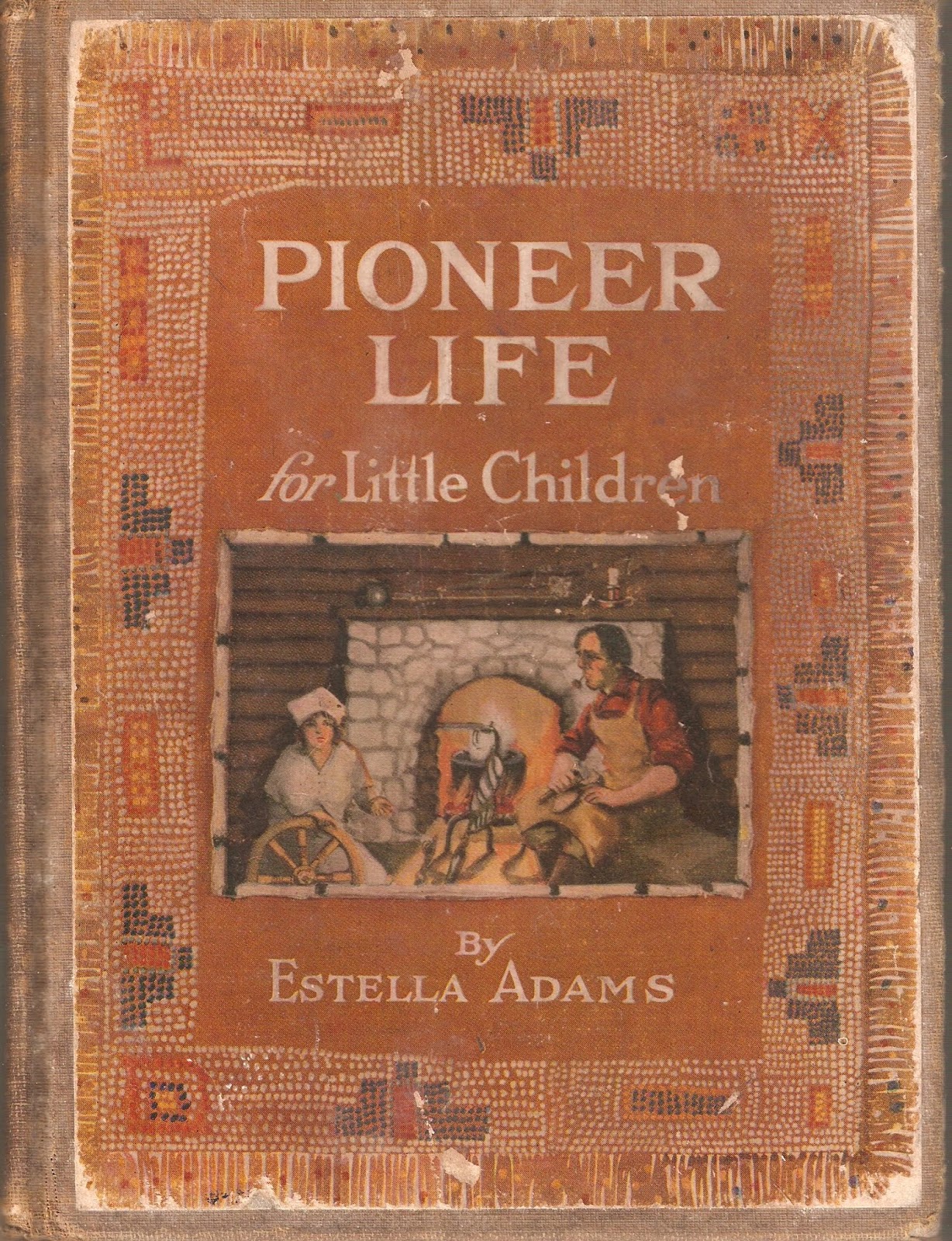
In 1916, Indiana celebrated one hundred years of statehood. Local residents put on pageants, plays, and festivals. Several histories also appeared that year including one by a local Irvington teacher, Estella Adams. The Bobbs-Merrill Company, a local printer, published her work, Pioneer Life for Little Children, and sold the book throughout the United States. Miss Adams taught first grade at School #57 at the time so the smaller children were her primary audience.

She likely wrote the book while living in her beautiful new home at 440 North Irvington Avenue. She resided there with her mother, Margaret, and her brother, George. City records indicate that Miss Adams took out a building permit in 1911 for the property. It is unknown how she was able to afford such a grand home, but the Indianapolis News in 1905 published that she had invested $200 in the Citizens Gas Company so perhaps she had earned a comfortable living with some shrewd investments.

Miss Estella Adams, a teacher at School #57, took out a building permit for 440 North Irvington Avenue in 1911. She lived here with her brother and mother. They sold the home to the Rush Family in 1920. (Photo taken in the summer of 2018)

The Rush family dwelled at 440 North Irvington Avenue throughout most of the 1920s. They put the house on the market in the summer of 1928 as Mr. Rush took a job in the East. (image courtesy of Indianapolis Star, July 15, 1928)

Pioneer Life was illustrated by Harrison Fisher and Marie Stewart. In the first third of the book, Miss Adams wrote about the lives of the Indians who lived in the Midwest. The illustrations in this part of the book are realistic and somewhat romanticized. Her treatment of the native peoples is much more respectful than many narratives of her day. The illustrator of this section chose to draw images of the Plains Indians and not those who actually dwelled in Indiana. In the second third of the work, Miss Adams described life for the white people who moved into the area. Like most children's histories, this section is sanitized. The Indians, according to the author, moved away because the deer and the bison were no longer as plentiful. How does one tell first graders that their ancestors actually forced the native peoples from their land and on to reservations? The illustrations in this section are more like etchings. She does challenge the children to think about the lives of the two groups.

Indian girls carry wood for the fire.
They string red and yellow beads.
They make pretty baskets.
The baskets are made of sweet grasses.
The girls make bowls of clay.
They paint the bowls after they are dry.
They carry water in these bowls.
Can you make a clay bowl?

Pioneer Life for Little Children appeared in print on August 6, 1916, and was used throughout the state of Indiana.

Two different illustrators contributed to the book Pioneer Life for Little Children. In this romanticized image, a young Indian girl, who has Caucasian features, looks hopefully off to the side. Miss Adams portrayal of the native peoples, although not accurate, was more sympathetic than many authors from the time period. 

Estella Adams, who taught at School #57, dedicated the book to the neighborhood children. 

Miss Adams dedicated the book to the children of Irvington. She and her family continued to dwell in their Irvington Avenue home until 1919. For unknown reasons, she took a leave of absence from the Indianapolis Public Schools and eventually moved to California. The Rush family purchased her house.

Miss Adams frequently experimented in her first-grade classroom at School #57 as she was a proponent of both the Montessori Method and the Fresh Air Movement. In the winter of 1916, she placed muslin over the screens in her classroom and did not put in the glass windows. Her room remained warm enough for the children and she noted improved results. (image courtesy of Indianapolis News, February 16, 1916)

Sources:  "Recent Publications," Indianapolis Star, August 6, 1916, 6; "Written Book on Pioneer Life," Indianapolis News, December 7, 1916, 13; Obituary for Margaret Adams, Indianapolis Star, July 8, 1933, 10.


Thursday, April 28, 2016

Growing Up Along Audubon Road

Thomas Richard or Dick Palmer was born in 1921 to Dr. Walter and Mary Fee Palmer. He spent his entire childhood at 333 North Audubon Road.  Dick was raised as an only child because his older brother died before his birth. He had no trouble finding playmates as there were several households in the area with children under ten years of age. Next door at 323 North Audubon Road dwelled little Nancy Ostrander and Eva Ham. Two doors down at 347 North Audubon Road resided Thomas Harrison, the youngest son of John and Elizabeth Harrison. Ruth Adams, the daughter of Henry and Pearl Adams lived across the street at 344 North Audubon Road. Other kids near his age like Bob Glass, Roger Schuck, and the Korbly brothers dwelled in the vicinity on Michigan Street, and along Lowell, Lesley, Graham, and Bolton Avenues. The Palmers, clearly very proud of their son, documented several key moments of his early life. You will see snapshots from his youth and scenes from the neighborhood in the following images.

Dick Palmer played with his toys on his front porch at 333 North Audubon Road in 1923.

Backyard fun:  Dick Palmer played in the backyard of his home at 333 North Audubon Road in 1922. 

Dick Palmer enjoyed the outdoors in the spring of 1922. Behind him, you can see the large Italianate home at 343 North Audubon Road. 

Dick Palmer on the front porch of his home at 333 North Audubon Road in 1923.

Mary Fee Palmer assisted her son Dick on her porch at 333 North Audubon Road in 1922.

333 North Audubon Road in 1922

333 North Audubon Road in 1923
The historic images are courtesy of Janet Chapman and Dick Palmer. 

Sunday, December 27, 2015

Who Lived Here? An Otolaryngologist and His Family Along Irvington Avenue

Dr. Daniel Shimer Adams and Ruth Brown Adams moved into the large house at 59 North Irvington Avenue in 1924. The 48-year-old ear, nose, and throat doctor worked downtown and had lived in a few other neighborhood homes before finally settling down on Irvington Avenue. The couple were married in Wanamaker in southeastern Marion County in the spring of 1910. They dwelled in that region of the county during the early years of their marriage, but eventually moved to homes along both Audubon Road and East Washington Street. Dr. Adams was the grandson of William and Susan Shimer, who were prominent farmers along Brookville Road in southern Irvington. Mrs. Adams was an active club woman and frequently hosted the Irvington Chautauqua Reading Club at 59 Irvington Avenue.  Society snippets from the Indianapolis Star revealed that she was also quite active with the Butler University Alumni Association. The couple had two children, George E. and Mary E.  The family dwelled in the large house throughout the Great Depression and moved from Irvington in 1941. Dr. Adams lived until 1964 and Mrs. Adams passed away in 1976.

Sometime in 1926 Dr. Adams sat for this photograph, which he submitted to the publisher of Fellow Citizens of Indianapolis.


59 North Irvington in 2015: This late-nineteenth-century home was converted into apartments in 1946.