Showing posts with label School #57. Show all posts

Monday, April 10, 2023

Factory Workers Gift a Bust of Washington Irving

      There are many busts of Washington Irving, but most of them are located in his home state of New York. He died in 1859 and eleven years later, a group of investors near Indianapolis decided to name their new suburb after the beloved writer. For years there had been talk of erecting a monument to the man in the neighborhood. After the city annexed Irvington in 1902, local officials promised a monument that never came. In 1936, Grace Julian Clarke, whose father was a founder of the community, called for park officials to erect a bust for the Irving Circle Park. Silas Carr, a city councilman, successfully petitioned for WPA funds and in the summer of that year sculptor William Kriner put the finishing touches on the limestone bust of the author. Perched atop a limestone pillar, the sculpture became the target of vandalism. Finally, the city moved the bust to a more protected place in 1943 in front of School #57 where it has been for 80 years. 

     By the early 1970s, the Irving Circle Park looked quite forlorn without its original fountain or a bust of Washington Irving. John Readle, a local policeman, decided that the small green space needed a facelift. He successfully lobbied the city and helped to raise funds to recreate the fountain.  (later replaced in the 1990s) He also worked with his contacts at the International Harvester plant on Brookville Road to recreate the bust.  The factory had been a major employer for the city since 1938. Hundreds of workers and executives lived in Irvington and on the east side for decades.

     Hollie E. Cox first began working for the factory in 1939 as a pattern maker.  The young man was just getting started in life. During World War II, he left the plant and served overseas in the European theater of the war. In fact, he fought at the Battle of Bulge during the brutal winter of 1944. He survived the war and returned home where his job still awaited him at International Harvester. He married Leona Boyle in 1948 and they later had two children, Katy and Russell. We are not exactly sure how Mr. Cox became involved, but he helped to recreate the new bust of Washington Irving in 1971. It was cast in iron and coated in copper. They used the Kriner bust as the model for the new Irving. Instead of a stone pillar, Mr. Cox and others welded the head upon a metal pole. And while the factory and the workers are now gone, the bust serves as an enduring legacy of their time on the eastside of Indianapolis.  


The new iron bust of Washington Irving is in the center of the photo while the older limestone bust is at the right in 1971. (photo courtesy of Katy Smith)

Hollie E. Cox (left) and another International Harvester employee work on the new Washington Irving bust in 1971. You can also see the original mold in the photo. (courtesy of Katy Smith)

Pattern maker, Hollie E. Cox, used the historic limestone bust as the model for the new iron bust in 1971. William Kriner, who sculpted figures on the Soldiers and Sailors Monument in Indianapolis, created this bust of Washington Irving in 1936. You can see the historic vandalism on Irving's neck. Local officials eventually moved the bust to the grounds of IPS #57. (Photo courtesy of Katy Smith)

Hollie E. Cox added a copper coating on the bust of Washington Irving in 1971 at the International Harvester plant on Brookville Road. (photo courtesy of Katy Smith)
The beautiful new copper-coated iron bust of Washington Irving in 1971 at the International Harvester plant on Brookville Road. (photo courtesy of Katy Smith)

Washington Irving still watches over the Irving Circle Park. He has suffered from the effects of weather and vandalism. Most recently, someone has drawn all over his face with a permanent marker. (photo taken on April 9, 2023)

William Kriner's limestone bust rests on a stone pillar in front of IPS #57. The ravages of weather have removed some of the features of his face. A previous act of vandalism in the 1940s is still visible on his neck. (photo taken on April 9, 2023)


  Photo provenance:  On February 11, 2023, I attended a reading by local poet Angela Barnes. While standing in line for her to sign my book, I met Katy Cox Smith, who was standing behind me. Her father helped to create the iron bust of Washington Irving in 1971. She generously sent scans of these historic family photographs.

Sources:  William Kriner bust--"Irvington Looks to Dedication of Life-Size Bust of Namesake," Indianapolis News, July 6, 1936, 20; "Washington Irving Bust to be Dedicated on Sept. 11," Indianapolis News, August 7, 1936, 15; Iron bust--Michael P. Tarpey, "Policeman's Pride in His Irvington to Restore Fountain," Indianapolis Star, September 22, 1971; "Indiana Rose Festival Selects City Policeman for Environment Award," Indianapolis Star, October 4, 1971; For more information on sculpture in Indiana--Glory June Greiff, Remembrance, Faith, and Fancy: Outdoor Public Sculpture in Indiana, Indiana Historical Press, 2000. 

Friday, July 5, 2019

Graduation Photo--1950

In the early spring of 1950, eighth graders gathered on the lawn of IPS #57 for their special graduation photo. Most of the kids later attended Thomas Carr Howe High School in the fall. While we do not know the name of every child in the photograph, we do have several of the names. Contact me at williamfranklingulde@gmail.com to add or correct any names. This photograph has been scanned thanks to Bill Sohn, a member of this class.

Graduation Photo, School #57: Front Row (left to right) James Riggs, Mark Mitzner, ?, Bill Sohn, Tom Litteral, ?, ?, Mike Stark, ?,?; Second Row: Joan Stumph, Donna Burris, Julia Wurster, ?,?,?,?, Earlene Terry, Virginia Garrison, ?, Nancy Pflueger, ?, ?; Third Room: Norma Soots, ?,?, Linda Huggins, John Stumph, ?, ? Dick Hildreth, ?,?,?, Margaret Moreland, Barbara Warrick, ? Patricia Lawhorn, Janet Newcomer; Fourth Row:  Pat Murphy, Jerry Coonse, ?, Cynthia Leslie, ?, Carolyn Barnett, Leonard ?, Judy Lawson, ?, Elizabeth Johnson, ? Jim Baker, Donna Funk

Wednesday, May 29, 2019

Mr. Whitaker's Shop Classroom--1949

Boys in the 1940s at School #57 in the seventh and eighth grades had to make a decision.  Did they want to take woodworking or metalworking from Mr. Hershel Whitaker?  Their classroom, a noisy place, was located in the basement of the school. For one young man, Bill Sohn of 378 South Downey Avenue, the choice was woodworking. Each child aimed towards creating a final product like a hall tree or a stool. Bill chose to create a lamp. At the end of the term, each student placed their item on display. Bill Sohn brought his camera to school and snapped the image seen below. Seventy years later, Mr. Sohn could still recall that the letters "D" and "P" were created by Don Peters, a boy who was a grade behind him. He also noted that for one month the boys and girls traded classrooms.  The boys went into the home economics classroom and the girls attended shop. Bill still recalls sewing a pin cushion.  Mr. Whitaker and his wife, Maria, resided at 5119 Norway Drive so he could have walked to school on nice days. You will see his hat hanging on a hook in the photo.

Boys in Mr. Hershel Whitaker's woodworking class displayed their final products in 1949. Bill Sohn, a student in the class, snapped this photo. He created one of the lamps on the table. 
The image and information for this story is courtesy of Bill Sohn.  

Saturday, January 19, 2019

School #57 Graduation--1949

Seventy years ago, several members of the eighth grade class at IPS #57 gathered in the front yard of the school for a photo on a warm spring day in 1949. The excited children had so many possibilities ahead of them. Most would attend nearby Howe High School in the autumn.

Members of the Class of 1949 of School #57; Names compiled by Harry Smith
Front Row, Left: Ted Helkema, Gene Toole, John Cordell, Bill Ropp, John Sauer, Gary Crawford, Bill Foster, John Garrison, Harold Brown, Harry Smith, Don Martin; Second Row, Left: Bob Cox, John Kirkhoff, Jack Webb, Anton Sohn, Shirley Garrett, Don Davis, Margarite Esther, Judy Wire, Judy Ball, Marilyn Titus, Judy Janneck, Marilyn Rasener, Bob Pirtle, Ben Benefield, Frank Parish, John Sanford; Third Row, Left: Marcia Shick, Stephanie Moore, Anabelle King, Paula Bailey, Daisy Harrison, Judy Henderson, John Gooch, Diane Hale, Stan Barnett, Charles Russell, Janice Carlock, Bob Schram, David Taylor, Rolland McMaster, Marilyn Lantz, Nancy Tanselle, Marilyn Banaka; Top Row, Left: Ruth Jenkins, Barbara Little, Nancy McMillin, Darlene Baird, Sara Snyder, Ann Schmidt, Kathleen Craig, Louis Hoynes, Jim Fleener, Nathan Negley, Jerry Christianson, Barbara Swengel, Lois Eikenberry, Jerry Webb, Martha Shortridge, Betty Cowell

World War II had been over for four years and Harry Truman was President of the United States. If the young people paid attention to the news, they would have noticed that Henry Schriecker, a Democrat, was the Governor of Indiana while Albert Feeney, another Democrat, served as the mayor of Indianapolis. Their parents likely read in the local newspapers that an organization called NATO had just been formed. Many of the adults probably worried about the Soviet Union as the Red Scare gripped Americans. By the end of year, the Soviets would have the atomic bomb. Some might have breathed a sigh of relief upon reading that the USSR had ended the Berlin Blockade. Hoosiers might have read or heard that Chaim Weizmann became the first president of Israel or that the Irish people finally received full independence from the United Kingdom.

On May 30, 1949, a television station called WFBM-TV started in Indianapolis. It would be several years before residents of Irvington would start placing these bulky boxes in their homes, but many in this photo had likely heard of the device. Most of the kids would have still listened to their favorite programs on the radio. Tarzan, Superman, the Lone Ranger, Buck Rogers, Captain Midnight, Lassie, and The Shadow were just some of the radio series that captivated the kids in this photo. Many of teens likely listened to the dramatic coverage of the Indy 500 that year where Bill Holland raced to victory. Nearby at the Irving Theater they could watch "Canadian Pacific," which was being held over for a second week in early June. Their parents likely viewed "Portrait of Jennie," starring Jennifer Jones and Joseph Cotten.

A dramatic Western ran at the Irving in early June, 1949

"Portrait of Jennie" was not initially received very well by the public, but the film has held up throughout the decades. It played at the Irving in early June of 1949.

In August of 1948, Miss Wallace Montague replaced Mildred Orr as the principal at #57. Miss Montague had just spent a year on a teacher's exchange in England.  She had previously served as a principal for the Indianapolis Public Schools. Throughout the autumn of 1948, Miss Montague spoke to groups about her experience in England including to the PTA at #57 on November 16, 1948. Many other educators influenced the children in this photo including Abbie Kanz, Genevieve Burns, Martha Barber, Helen Loepper, Laura Benson, Ruby Winders, Hershel Whitaker, Virgil Wise, and numerous others.

Miss Montague served as the principal of School #57.  On September 21, 1948, the Indianapolis News featured her on the front page. Miss Montague had just returned from England where she had been on an exchange. 

I was able to obtain the school photograph courtesy of the Sohn family. I first heard from Bill Sohn and then his brother Anton. The Sohns grew up in a bungalow at 378 South Downey Avenue. More about this family will be forthcoming. Anton reports that he became life-long friends with many of the guys in this image. They later formed a social club at Howe High School and gathered well into their adult years. They called their adult club, the Gentlemen's Serenity Club of Pistol Creek. The one aspect that they all shared was a love of nature.

Their friendship began both at School 57 and at Howe but over the years, these Irvington men gathered to hike, fish, hunt, and enjoy the beauty of nature. 

Sources: Sohn Family Collection; On Miss Montague: Indianapolis News, August 11, 1948, 17; "Going to School in England," Indianapolis Star, November 14, 1948, 52; Irving Theater Movies: Indianapolis News, June 9, 1949.

Sunday, November 11, 2018

Miss Estella Adams Wrote a Children's Book

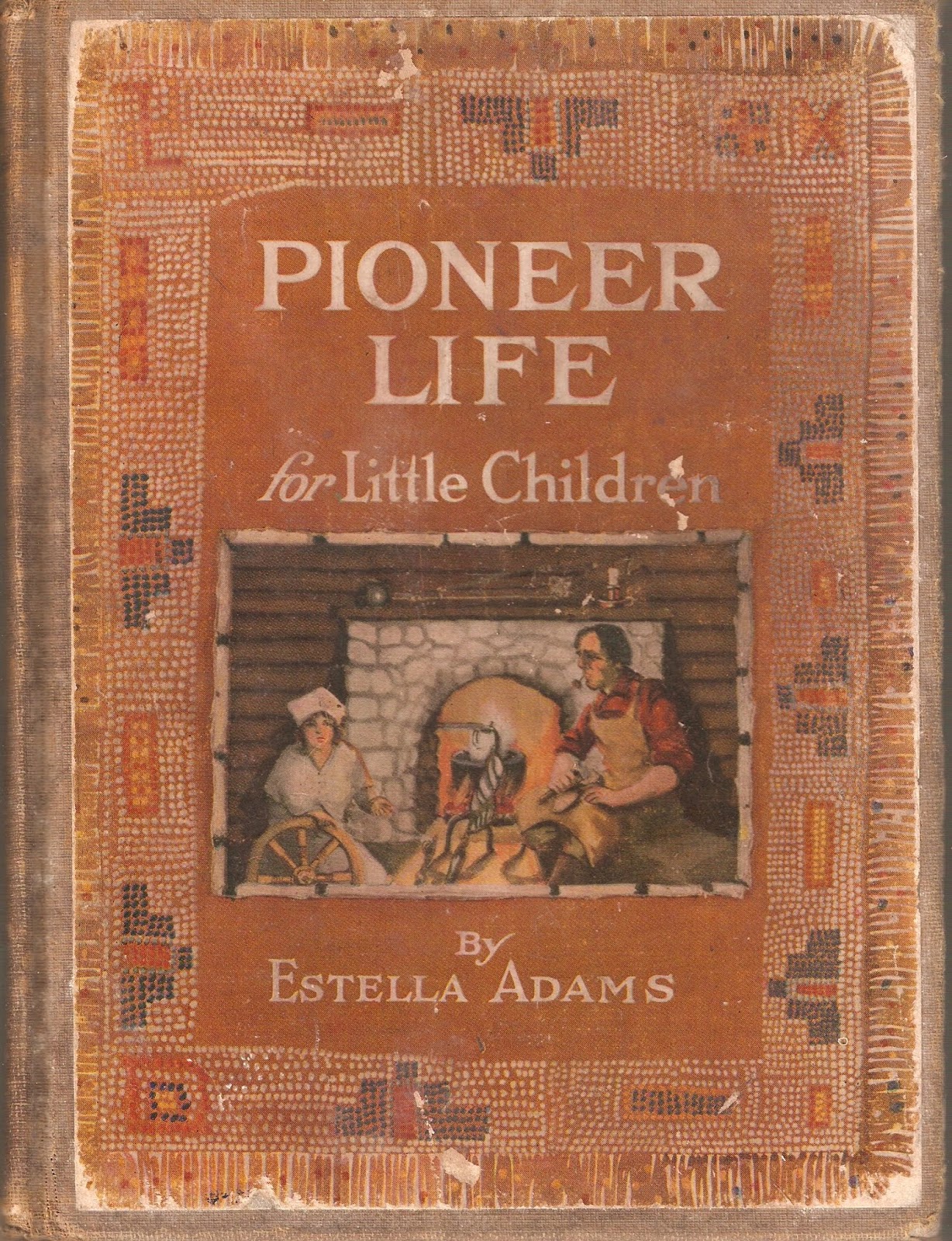
In 1916, Indiana celebrated one hundred years of statehood. Local residents put on pageants, plays, and festivals. Several histories also appeared that year including one by a local Irvington teacher, Estella Adams. The Bobbs-Merrill Company, a local printer, published her work, Pioneer Life for Little Children, and sold the book throughout the United States. Miss Adams taught first grade at School #57 at the time so the smaller children were her primary audience.

She likely wrote the book while living in her beautiful new home at 440 North Irvington Avenue. She resided there with her mother, Margaret, and her brother, George. City records indicate that Miss Adams took out a building permit in 1911 for the property. It is unknown how she was able to afford such a grand home, but the Indianapolis News in 1905 published that she had invested $200 in the Citizens Gas Company so perhaps she had earned a comfortable living with some shrewd investments.

Miss Estella Adams, a teacher at School #57, took out a building permit for 440 North Irvington Avenue in 1911. She lived here with her brother and mother. They sold the home to the Rush Family in 1920. (Photo taken in the summer of 2018)

The Rush family dwelled at 440 North Irvington Avenue throughout most of the 1920s. They put the house on the market in the summer of 1928 as Mr. Rush took a job in the East. (image courtesy of Indianapolis Star, July 15, 1928)

Pioneer Life was illustrated by Harrison Fisher and Marie Stewart. In the first third of the book, Miss Adams wrote about the lives of the Indians who lived in the Midwest. The illustrations in this part of the book are realistic and somewhat romanticized. Her treatment of the native peoples is much more respectful than many narratives of her day. The illustrator of this section chose to draw images of the Plains Indians and not those who actually dwelled in Indiana. In the second third of the work, Miss Adams described life for the white people who moved into the area. Like most children's histories, this section is sanitized. The Indians, according to the author, moved away because the deer and the bison were no longer as plentiful. How does one tell first graders that their ancestors actually forced the native peoples from their land and on to reservations? The illustrations in this section are more like etchings. She does challenge the children to think about the lives of the two groups.

Indian girls carry wood for the fire.
They string red and yellow beads.
They make pretty baskets.
The baskets are made of sweet grasses.
The girls make bowls of clay.
They paint the bowls after they are dry.
They carry water in these bowls.
Can you make a clay bowl?

Pioneer Life for Little Children appeared in print on August 6, 1916, and was used throughout the state of Indiana.

Two different illustrators contributed to the book Pioneer Life for Little Children. In this romanticized image, a young Indian girl, who has Caucasian features, looks hopefully off to the side. Miss Adams portrayal of the native peoples, although not accurate, was more sympathetic than many authors from the time period. 

Estella Adams, who taught at School #57, dedicated the book to the neighborhood children. 

Miss Adams dedicated the book to the children of Irvington. She and her family continued to dwell in their Irvington Avenue home until 1919. For unknown reasons, she took a leave of absence from the Indianapolis Public Schools and eventually moved to California. The Rush family purchased her house.

Miss Adams frequently experimented in her first-grade classroom at School #57 as she was a proponent of both the Montessori Method and the Fresh Air Movement. In the winter of 1916, she placed muslin over the screens in her classroom and did not put in the glass windows. Her room remained warm enough for the children and she noted improved results. (image courtesy of Indianapolis News, February 16, 1916)

Sources:  "Recent Publications," Indianapolis Star, August 6, 1916, 6; "Written Book on Pioneer Life," Indianapolis News, December 7, 1916, 13; Obituary for Margaret Adams, Indianapolis Star, July 8, 1933, 10.


Saturday, January 13, 2018

Mary Pulver Stevenson in the late 1930s

Mary Pulver eloped with Robert Stevenson in 1909. The couple eventually settled in Irvington and dwelled in three separate houses together. In 1915, they adopted Robert's ten-year-old nephew, Edward Lollis. The family dwelled at 275 South Audubon Road, 5698 East Washington Street (demolished), and in their final home together at 56 South Irvington Avenue. Mr. Stevenson died in 1939. We do not know the occasion for this photo, but Mrs. Stevenson posed for the snapshot sometime in the late 1930s. Behind her, you can see Julian Avenue when it was a brick street and also the rear of IPS #57.  If you look closely, you can also see some residences along South Ritter Avenue in the distance.  After her husband's passing, Mrs. Stevenson moved to 112 Johnson Avenue where she remained for many years. She taught Sunday school at the Irvington Presbyterian Church.  You may read more about the Stevenson or Lollis family by clicking on the links below.  

Mary Pulver Stevenson (1884-1969) posed for  this image sometime in the late 1930s in her front yard at 56 South Irvington Avenue. Behind her, you can see School #57 and homes along South Ritter Avenue.  
This photo is courtesy of Ted Lollis.  

Saturday, April 30, 2016

Time for Play and Time for School in the 1920s

Dick Palmer grew up at 333 North Audubon Road as the nation and the neighborhood "roared."  His parents, Walter and Mary Fee Palmer, built a house in the decade as did hundreds of others especially north of Pleasant Run Parkway. Many Irvingtonians purchased cars during the 1920s so toy automobiles became popular gifts for children. Dick Palmer received his special present in 1925. He remained a car enthusiast for the rest of his life. In an image below, you can see him "driving" around in the backyard.  Two years later he received a toy airplane. Behind him in that photo, you can see the double at 338-40 and the dwelling at 344 North Audubon Road. His family had no way of knowing it in 1927, but  later during World War II, Dick flew B-25 Mitchell aircraft and even taught other pilots how to fly.

The 1920s were also important for Dick as he started school in 1927. Children along North Audubon Road attended School #57. Visiting the family in September of 1927 was his Aunt Nell Fee.  The Fees hailed from a prominent farming family near Clarksburg, Indiana in northeastern Decatur County. Nell and Mary Fee's grandfather, John G. Fee, was one of the founders of Berea College in Kentucky. Aunt Nell's timing for her visit could not have been more perfect as Dick was afraid to go to school. She told him that she would escort him to the building and she gave him a dime to put in his pocket. As young Dick walked up the stairs of School #57, he turned back to give his Aunt the dime, but she told him to keep it and he was to show it to her upon his exit later that day. Dick Palmer thrived at school. He later graduated from Arsenal Tech High School and Miami University in Ohio.

Dick Palmer received his toy car gift in 1925. He "drove" it around in the backyard of his home at 333 North Audubon Road. 

Dick Palmer and a friend posed for this photograph in 1927 after receiving his new airplane as a gift. Behind the boys, you can see the double at 338-40 North Audubon Road and the residence at 344 North Audubon Road. The Karns family dwelled on one side of the double and the Johnson family lived at 344.  The 1927 city directory noted that one side of the double was vacant.  

Dick Palmer posed for this photograph in 1927 in his front yard at 333 North Audubon Road on his first day of school.

Dick Palmer posed for his family in 1927 in the backyard of 333 North Audubon Road in 1927. His  supportive Aunt Nell Fee walked  with him to school that day. 

Wednesday, March 16, 2016

Best Friends Posed Near School #57

Barbara Jones and Donna Garland posed for this candid portrait most likely in 1941 or 42 on the lawn of IPS #57. Other photographs from the Jones family collection reveal that the girls had been friends for several years. Miss Jones grew up at 273 South Ritter Avenue and it is not known at this time where Miss Garland dwelled.


Barbara Jones (left) and Donna Garland (right) posed on the grounds of IPS #57 c1941.
The historic photograph is courtesy of the Jones Family Collection.  

Monday, June 8, 2015

Snowfall Along Julian Avenue--1937

In the winter of 1937, Mary Stevenson of 56 South Irvington Avenue peered out her window and noticed a beautiful scene as snow had just fallen. She grabbed her camera and went out onto the front porch and snapped one photo.  Then she ventured out into her yard and took another.  In the top photo, a young boy can be seen in front of 5451 Julian Avenue.  It is possible that it might have been five-year-old Harry Fox, Jr. who dwelled in that house.  His father, Harry Fox, Sr., was Vice President of Fox Optical Company.  His mother Mabel stayed home and raised his other siblings, Mary Ellen, Dorothy,  Anna, Jane, and Joan.   Next door at 5457 Julian Avenue dwelled  his elderly neighbors, Edgar and Harriett Perkins.  Mr. Perkins still served as a judge although he was old enough to retire. You can also see the rear of the homes along South Ritter Avenue.

In the second photo, Mrs. Stevenson aimed her camera at the back of IPS #57.  Were children in session on that day or did she take the photo on a weekend? The home at the far left was a double at 25-27 South Irvington Avenue.  Verner E. Sprouse lived on one side while Bernard and Mary Callon dwelled on the other.

Beautiful Snow:  Mary Stevenson snapped this photo from her home at 56 South Irvington Avenue of the 5400 block of Julian Avenue in the winter of 1937.  

The rear of IPS #57 and part of 25-27 South Irvington Avenue can be seen in this photo snapped by Mary Stevenson (56 South Irvington Avenue) in the winter of 1937.  

The historic images are courtesy of Ted Lollis.  

Wednesday, February 11, 2015

Butler Students Performed Booth Tarkington Play at School #57 in 1926

In March of 1926, nine members of the Pi Epsilon Delta Theater Fraternity performed "Tweedles," a comedic play written by Booth Tarkington.  Butler University lacked many facilities at its Irvington location, including a theater so local productions had to be staged in IPS #57 at 5435 East Washington Street.  Tarkington, most known for his novels, authored several plays.  "Tweedles" centered around the character of Julian Castlebury who visits a tea room.  Hilarity ensues.  The play was directed by Claude Sifritt and was a student production.  The cast performed two shows in mid-March and provided a perfect date night for Butler coeds.  It is not known if Mr. Tarkington attended the production.

"Tweedles" by Booth Tarkington was performed on March 17 and 18, 1926, by Butler University students at School #57.  Pictured left to right: Harold Magee, Volney Hampton,  Helen Pascoe, Rudolph Baker, Horace Storer, Frances Ogle, Fred Sanders, Mary Dirnberger

Sunday, March 16, 2014

School #57--1922

Several proud eighth graders gathered in the spring of 1922 for this photo.  The pupils are all wearing their coats and the boys in the front row are sitting on folded chairs so they won't get dirty. Each graduate has a ribbon pinned to their coat.  Teachers clumped at the edge of the rows.  Some are smiling and some look stern.  I wonder about the lives of so many of these children.  What became of them?  It is likely that every person in this photo is no longer with us. How can this be as the children look so vibrant?  One African-American girl stands in the top row.  What became of her?  Did the other students treat her with respect?  We know of only one name in the photo and that is of Robert Orbison, who dwelled at 51 North Irvington Avenue. If you recognize any of the students or teachers in this photo, then drop me a note at williamfranklingulde@gmail.com.

Eighth Grade Graduation Photo at School IPS #57 in 1922
This historic image is courtesy of Carol Orbison.

Monday, June 10, 2013

IPS #57 Grade Eight School Photo--1934

Although it would be highly unlikely today, teachers of the graduating class of 1934 from IPS #57 directed the students down Johnson Avenue from East Washington and Ritter to the Irvington Presbyterian Church for a class photo.  The church was only six years old in 1934 so perhaps the photographer, W. Frank Jones, thought that the site made for a better setting that the older school.  Most of the students are dressed in their finest despite the fact that the Great Depression likely took a toll on many Irvington households. The girls are wearing dresses and at least two of the boys are wearing ties.  One young man in the top row has his hand over his heart.  Another young man is still donning his beret.  Sadly, most of the names are the lost to the ages now so if you recognize anyone in this photo then drop me a line at sleeth28@rock.com.  This wonderful image is courtesy of Don Rouse.  His mother, Christine Bruckman, is in the front row.

Members of the grade eight class from IPS #57 pose for their graduation photo in front of the Irvington Presbyterian Church in 1934.

Thursday, May 30, 2013

Historic Postcard Scenes of Irvington--1910

Stafford Engraving, managed by Charles Hackleman (34 N. Ritter Avenue), produced several images of Irvington in the early twentieth century.  In this postcard, a photographer--perhaps Mr. Hackleman-- captured three important structures in 1910.  Both the Bona Thompson Library and School #57 had only been standing for about six years.  The Engine House used to sit on the north side of East Washington Street across from School #57 near Whittier Place.  The house visible behind the Engine House along Whittier Place was demolished many years ago.
Three Scenes of Irvington in 1910

Monday, December 17, 2012

Early Twentieth Century Views of School #57

IPS #57 is one of the oldest continuously run school buildings in the city of Indianapolis.  The school has gone through many additions and renovations since it was first constructed on the southwest corner of East Washington Street and Ritter Avenue in 1903.  The school district commissioned local architect, Herbert Foltz, to design the substantial two-story building.  Further additions in 1914 and 1922 provided much needed classroom space as the community continued to grow.  In the early 1930s, the community petitioned that the building be named after George Washington Julian, a former US Congressman and Irvington resident.  The historic photos, courtesy of Larry Muncie, show three views of the school before officials enlarged it.  Further stories about Irvington schools may be found in Irvington Stories by Larry Muncie (1992) and Greater Irvington by Paul Diebold (1997).  Oral histories conducted in the 1980s and 1990s also contain a wealth of information about the teachers and principals who worked here.  You may now access those interviews online by going to the Indianapolis Marion County Public Library's website.

School #57 c.1910

School #57 c.1908

School #57 c.1908


Sunday, June 24, 2012

The Missing Tooth--A House Reemerges From the Grave 36 Years Later

Sometimes when you are a historian, you get sent into directions you never imagined.  For instance, when local Irvington resident, Kent Hankins, presented me with today's historic image, I had to do a double take.  With only one recognizable structure, I had to figure out where this photo was taken.  The photographer intended to take a picture of the procession of children.  In the background, there was clearly a church, but the house looked unfamiliar.


It didn't take long to figure out that the religious institution in the photo was the former St. Matthews Episcopal Church at 23 South Ritter Avenue.  That structure has hosted several denominations over the years including the Seventh Day Adventists and Baptists.  So, what of the house next door?  It is clearly gone today.  Who lived there?  I wanted to know more.

It turns out that the small bungalow at 21 South Ritter Avenue was likely built in 1927 by Harry L. and Grace L. Moore.  The couple would be the only family to ever live in the house and they dwelled in it for decades.  Mr. Moore worked in a variety of jobs.  He was a salesman and insurance agent.  He was probably most known for his appliance shop that he operated at 5420 East Washington Street called Moore's Modern Appliances.  An ad proclaimed that the shop sold everything from juvenile furniture to household "electrical" appliances.  Mrs. Moore continued to live in the house after her husband died.  Eventually, the Seventh Day Adventist Church purchased the property and leveled the house in 1976.  Today, the Moore's family site is a parking lot.


The Mobley family purchased this radio from Moore's Modern Appliance Store at 5420 East Washington Street (photo courtesy of Robert Mobley) 

Moore's Modern Appliance Store operated at 5420 East Washington Street. The Moore family dwelled at 21 South Ritter Avenue.  (photo courtesy of Robert Mobley)

The second mystery surrounding this photo still remains.  First, I am unclear on the date.  It looks to be sometime in the mid-1950s.  I know that the young people are on the grounds of School 57 on the southwest corner of East Washington Street and South Ritter Avenue.  It is obviously a warm day.  Perhaps the graduates of School 57 can help me out with this part of the photo. What are the young people doing?  Is this a practice? A ceremony?  A celebration?  Inquiring minds would like to know more!  Send me an e-mail at williamfranklingulde@gmail.com if you have any ideas.

The historic image is courtesy of Kent Hankins and likely came from the Phelps family, who dwelled at 5317 Lowell Avenue for years.  The contemporary image reveals that the church remains, although now sheathed in vinyl siding instead of stucco.

Saturday, April 21, 2012

Irvington Baby Boomers--1954


Look at all of these toothless, cute, pigtailed, and innocent children. They all attended School #57 (George Washington Julian School) at East Washington Street and South Ritter. Many of them will be retiring soon, and perhaps some are not with us anymore. Several of their fathers and some of their mothers fought in World War II, while most of their moms stayed home and kept the U.S. moving forward by working in factories, shops, government agencies, and schools. Some of these children were drafted or volunteered for the Vietnam War. Much has happened to them and to the country since 1954.

They dared to defy their parents by listening to rock music. They witnessed the Civil Rights movement, and perhaps they turned off their television sets during the Watergate Scandal. They thought they might be killed by an atomic bomb and they viewed the fall of the Berlin Wall on a new cable TV channel called CNN. When this photo was taken, most likely in the autumn of 1954, Dwight Eisenhower was the President of the United States, and George Craig was the Governor of Indiana.

So much has happened to Irvington since 1954 as well. A new mall called Eastgate opened in 1957 and lured many local shops away. Some residents left the neighborhood for greener pastures in the suburbs, where they could build a long ranch house on a large lot. Those who chose to remain in Irvington watched as Washington Street business owners began to struggle and close up their shops in the 1970s and 1980s. In their later years, they have watched a Renaissance transform part of that street by 2012.

For those who moved away never to return to the neighborhood, they take with them their memories of playing in Ellenberger Park; watching a movie at the Irving; or perhaps buying candy at the local soda shops or corner grocery stores. It is possible that as I type this note, the "kids" in this photo are busy telling their grandchildren stories of this place called....Irvington.

This historic image is courtesy of Janet Hunt Wilzbacher. She is the cute little girl located fourth from the left in the fourth row. If you recognize the faces of any other children in this photo, then drop me a note and we shall add them!


Thursday, January 6, 2011

School 57--Historic Postcard


School #57, also known as the George Washington Julian School, is actually the third school building for Irvington. The first two structures used to be located in the 200 block of South Audubon Road across the street from the Irving Circle Park. After two significant fires, leaders in the neighborhood chose to move the school to East Washington Street and Ritter Avenue across from the former Irvington Fire Station! Herbert Foltz designed the school in 1903. It is now on the National Register of Historic Places. This historic postcard was sent by "Maud" to "Miss Nannie Thom" of Massillion, Ohio (c/o Rev. Mathinson of South Lincoln Avenue) on April 28, 1910. She writes: Hello my dear and how are you? We are fine. Haven't seen any of those pictures floating out this way. Hope to hear from you soon. Good Bye. Maud

Saturday, January 1, 2011

Irvington Teachers--1927


Teachers take time out in 1927 to pose for the camera in front of School #57 (East Washington and Ritter Ave). Oral histories conducted by the Irvington Public Library in the 1970s and 1980s reveal that some of these ladies were loved while others feared. You will note that none of them married. In this photo--standing (from left to right) Miss Genevieve Burns, Miss Nessler, Miss Alwes, Miss Early, Miss Vance, and ?--seated (from left to right) Miss Winders, Miss Loeper, principal.

Sunday, November 7, 2010

School 57


Welcome to my new blog dedicated to the history of Irvington, a neighborhood in Indianapolis, Indiana. My goal is to showcase historic photos and sites associated with the community. If you have any interesting photos to share then please contact me! My first post begins with a photo of students at School #57 located at East Washington Street and Ritter Avenue. The photo features eighth graders and was taken in January of 1928. The principal of the school was Eileen Cassell.