Showing posts with label National Road. Show all posts

Wednesday, April 15, 2020

Bittle's Tourist Court East of Irvington Along the National Road


With the advent of the automobile and the paving of state and federal highways, thousands of Americans began to travel across the country. Many of them pulled into roadside cabins on their way through the state of Indiana. A recent Smithsonian magazine article, penned by Andrew Wood, noted that entrepreneurs constructed many of these sites along busy routes with 1964 as the peak year with 61,000 tourist camps or courts in the United States. Travelers merely had to pull into the court and they could park next to their cabin. The demise of the roadside inn came with the construction of the interstate system along with the rise of the corporate hotel chain. Many mom and pop places like Bittle's Court at 7628 East Washington Street did not survive those movements.

Located two miles east of Irvington along the National Road, Bittle's Court opened sometime in the mid or late 1930s. James E. and Cora Bittle built the cabins near a tourist trailer camp along the busy National Road. Mr. Bittle's obituary indicates that he might have opened the court as early as 1935. An ad in a 1938 Indianapolis Star, touted Bittle's Cabin-Trailer Court, Sandwich, candies, soft drinks. 

The tourist camp was a family affair as Mr. Bittle sons, Keith and James, Jr., eventually operated the site. In an obituary, reporter Bess Watson described James E. Bittle, Sr. as an "active man" and a "smart dresser" who had a "dynamic personality." He died in 1955 at the age of 89.

In 1953, Henry Wood, a journalist for the Indianapolis Star Magazine, interviewed Keith Bittle for a story on the roadside attraction. Mr. Bittle told the reporter many stories that had occurred on the site including the birth of a few babies, the desertion of a bride, and of a suicide by a local nurse. He also noted that many young honeymooners paid a visit to Bittle's Court.  In 1939, bandits arrived in the middle of the night and forced the manager at gun point to open the cash register. The thieves fled the scene with twelve more dollars.  In 1961, the FBI tracked down a woman from Erie, Pennsylvania to the court. She had rented a car for the day in that town but kept it for several months and put nearly 8,000 miles on the car!

Th 7500-7800 block of East Washington Street saw a lot of development in the 1940s. Next door to the Bittle Court, at 7712 E. Washington Street, investors opened a bowling alley designed by R.C. Lennox and J. C. Matthews. Across the street, Frank Andrews opened the Golden Pheasant Restaurant in 1946. (see link)

Much of the area changed dramatically when the federal government decided to build a segment of Interstate 465 in eastern Marion County in 1965.  The Bittles sold their property to the federal government. A public notice placed in the Indianapolis Star on December 31, 1964, described each structure to be removed.  Tourist court consisting of brick veneer house, garage, stucco apartment building, frame apartment building, concrete block boiler building, and 22 frame tourist cabins. Formerly known as Bittle's Tourist Court... 


Aerial photo of Bittle's Court at 7628 East Washington Street along with the Pritchett-Hunt-O'Grady Bowling Alley at 7712 East Washington Street c1947. Across the street, you can see the recently constructed Golden Pheasant Restaurant. (postcard courtesy of Don Flick) 

Rear of the postcard for Bittle's Tourist Court at 7628 East Washington Street (Postcard courtesy of Don Flick)

Bittle's Tourist Cabins at 7623 East Washington Street (formerly 7608 East Washington Street) c1940 (postcard courtesy of Evan Finch and the Indiana Album) 

I wish to thank Don Flick for the use of the postcard and for the information for this post.

Sources: Bess Watson, "James Bittle Opened First Motel Here," Indianapolis News, July 8, 1955, 18; "James W. Bittle Dies; Former Owner of Motel," Indianapolis Star, May 18, 1972, 37; Henry Wood, "Anything Can Happen," Indianapolis Star Magazine, February 22, 1953, 6-7; Andrew Wood, "Rise and Fall of the Great American Motel," Smithsonian Magazine, June 30, 2017; "Kidnapped, Robbed By Masked Bandits," Indianapolis Star, November 20, 1939, 13; "Woman Held in Theft," Indianapolis News, September 18, 1961, 1; "Public Notices," Indianapolis Star, December 31, 1964, 28.

Friday, April 10, 2020

Building for Sale East of Irvington--1958

After World War II, many families began to move further east of Irvington and into the rural parts of Warren Township. Entrepreneurs developed housing subdivisions while others built Eastgate Shopping Mall and other commercial endeavors along East Washington Street.

In 1946, Frank E. Adams opened the Golden Pheasant Restaurant at 7803 East Washington Street. Mr. Andrews already owned a restaurant at 1606 North Illinois Street so he might have overextended himself as he soon ran into financial trouble. Although the restaurant was located just a few miles east of Irvington, it was largely still out in the country. Within a year, Mr. Andrews ran into another road block when he applied for a liquor license as he wanted to open the Flamingo Bar in the basement of the new structure, but residents of Warren Township fought him due to the proximity of a school that used to sit along East Washington Street and Franklin Road. By 1948, he was out of business and out of money.

In 1948, Marvin L. Jones purchased the site and opened Jones Restaurant and Drive-In. Local east side organizations frequently rented out rooms in the facility for banquets or meetings. The restaurant remained opened for ten years. Mr. Jones placed the building and grounds on the market in December of 1958. Postcards of 7803 East Washington Street were mailed out to several realtors including Van's Realty Company located at 1333 North College Avenue. Potential buyers just needed to ring up Fleetwood 6-5544 to get information.

In 1959, the site became home to a Rambler automobile dealership which last until the 1970s when the entire property was redeveloped for what would become Service Merchandise. There is a building on the site of the former Art Modern structure, but it is unclear if any of the original structure remains.

In December of 1958, cards advertising the sale of 7803 East Washington Street were sent out to various realtors in the city of Indianapolis. (card courtesy of Glory June Greiff) 

Van's Realty Co. received the card advertising the sale of 7803 East Washington Street in December of 1958. (card courtesy of Glory June Greiff) 

Frank Andrews opened the Golden Pheasant Restaurant at 7803 East Washington Street in December of 1946. (courtesy of Indianapolis Star)

The Golden Pheasant Restaurant at 7803 East Washington Street, operated by Frank Andrews, reflected the racial codes of the day. African-Americans who wanted a job at the restaurant could only apply for certain positions. (courtesy of Indianapolis Star)

In 1948, Marvin Jones opened Jones Restaurant and Drive-In at 7803 East Washington Street and remained in business for ten years. (courtesy of Indianapolis Star)

In 1959, the property became the site of Rambler auto dealership. (courtesy of Indianapolis Star)

Bill Grawemeyer operated the Rambler auto dealership at 7803 East Washington Street in 1959. Mr. Graweyer's map is not quite accurate, but he wanted to show how close the business was to the new Eastgate Mall. (courtesy of Indianapolis Star)

Ramblers were for sale at 7803 East Washington Street in 1959. (courtesy of Indianapolis Star)

A Warren Township School, formerly located at 7935 East Washington Street, can be seen in this newspaper photo from 1959. (courtesy of Indianapolis Star)
Sources: "Club Drops Liquor Plea," Indianapolis Star, November 11, 1947, 10; "Restaurant Owner Broke, Suit Says," November 15, 1947, 15; "Jones Interests Plan Restaurant," Indianapolis Star, April 29, 1948, 4;

Friday, July 5, 2019

Graduation Photo--1950

In the early spring of 1950, eighth graders gathered on the lawn of IPS #57 for their special graduation photo. Most of the kids later attended Thomas Carr Howe High School in the fall. While we do not know the name of every child in the photograph, we do have several of the names. Contact me at williamfranklingulde@gmail.com to add or correct any names. This photograph has been scanned thanks to Bill Sohn, a member of this class.

Graduation Photo, School #57: Front Row (left to right) James Riggs, Mark Mitzner, ?, Bill Sohn, Tom Litteral, ?, ?, Mike Stark, ?,?; Second Row: Joan Stumph, Donna Burris, Julia Wurster, ?,?,?,?, Earlene Terry, Virginia Garrison, ?, Nancy Pflueger, ?, ?; Third Room: Norma Soots, ?,?, Linda Huggins, John Stumph, ?, ? Dick Hildreth, ?,?,?, Margaret Moreland, Barbara Warrick, ? Patricia Lawhorn, Janet Newcomer; Fourth Row:  Pat Murphy, Jerry Coonse, ?, Cynthia Leslie, ?, Carolyn Barnett, Leonard ?, Judy Lawson, ?, Elizabeth Johnson, ? Jim Baker, Donna Funk

Saturday, February 16, 2019

Irvington Tragedy--1953

Not all was right in the formerly fashionable home at 5316 East Washington Street. Dr. Harold Bailey Cox and his third wife, Halene (sometimes spelled Helene) Wilson Cox, had been living in the stuccoed Mission-Revival American Four Square since their marriage in 1937. The couple welcomed Nedra Lucretia Cox into their lives in 1940. The home was perfect for Dr. Cox's family medical practice as patients could meet him downstairs while the family lived upstairs.

By 1953, Dr. Cox was seeing few patients as he was ailing. The sixty-eight-year-old physician was also dealing with another kind of sickness, the mental illness of his forty-year-old wife. Neighbors had noticed that the family had become quite reclusive. Few people ever went to the house and delivery men were asked to place parcels on the front porch. Then, on March 18, 1953, while working in his garage, Dr. Cox suffered a fatal heart attack. Halene Wilson Cox who seldom left her home, found her husband in the garage and dragged his body to the front porch. She then phoned a friend who was a physician, to check on Dr. Cox, but it was too late. While authorities found the scenario odd, no one was charged as he had clearly died of natural causes.

For the next eight months, conditions deteriorated in the Cox household.  Fourteen-year-old Nedra, who was supposed to be attending Arsenal Technical High School, failed to enroll. She remained inside the house although friends did say that over the summer of 1953 she showed up at Ellenberger Park. Few ever saw the mother-daughter team outside again. Over the years, Mrs. Cox had become a hoarder and her home was filled with refuse, boxes, and disorder. No one was ever allowed to come in. Worried about their daughter, Mr. and Mrs. Hal Wilson of 569 Middle Drive Woodruff Place, stopped by on Sunday, November 1, 1953, but Mrs. Cox refused to allow them into the home. Nedra  spoke to her grandparents through a peep hole in the front door.

At 1:05AM the next day, Harold Hunt, of Greenfield, Indiana was driving eastbound on Washington Street when he noticed flames shooting out of a downstairs living room window at 5316 East Washington Street. He then saw Mrs. Cox screaming from a second floor bedroom window. Mr. Hunt phoned the fire department and Irvington firemen rushed to the scene.  While the first floor was engulfed in flames, the second floor was filled with smoke. Fireman, Errol Evans, climbed up a ladder and found Mrs. Cox slumped over the headboard of a bed. He managed to get her down with help from three other firemen named Arthur Lynn, William Gearns, and John Thompson. Then, the fireman found Nedra Cox on a bed and they brought her down as well.

Both women were carried next door and wrapped in blankets and given oxygen; however, it became apparent that both had been shot. Detectives rushed to the scene and found a house in chaos. As the last of the embers burned, detectives in the house noticed trash and even a decaying cat corpse inside the wrecked residence. Dr. Bailey had been a gun enthusiast and had given his daughter a .22 caliber pistol as a present before his death. Nedra apparently used the gun to shoot both her mother and herself.  Mrs. Cox had been shot in the chest and had been burned on her back although strangely her clothes were not burned. She must have changed before the firemen arrived.

Detectives had a hard time sorting through the strange story. Mrs. Cox was coherent and managed to tell investigators that Nedra had accidentally shot her and then killed herself. The next day the story was captured in lurid headlines in newspapers all over the state. Both the Indianapolis Star and Indianapolis News seemed obsessed with Nedra's appearance and behavior. They called her "exotic" and "sultry." Reporters noted that she had worn bikinis in the summer and had grown immensely long fingernails. They seemed to have overlooked the major plot that a fourteen-year-old girl was trapped in a home with a mother who was clearly mentally ill. In the end, the county coroner ruled that Nedra had indeed shot her mother and then killed herself, but why did Mrs. Cox have burn marks on her back when the fire was on the first floor and she was on the second floor? Did she try to escape but then realized that she could not get out? Some aspects of this story will never be known.

Mrs. Cox eventually moved in with her parents in Woodruff Place. Sadly, she killed herself on July 8, 1954. The Cox home was torn down shortly after the fire and in 2019, the site serves as a parking lot for a medical facility.


Dr. Harold B. and Halene Cox along with their daughter, Nedra, resided at 5316 East Washington Street. Fourteen-year-old Nedra shot her mother and then herself. It is not known which of the women set the fire on the first floor. If you look closely, you can see Dr. Bailey's physician sign hanging on the front porch. He died eight months before the fire. (Image courtesy of Patrick Pearsey)

A fireman combs through a messy second-story bedroom. The house at 5316 East Washington Street was in complete disarray when the department arrived on the scene. Mrs. Cox appears to have been a hoarder and suffered from mental illness. (Image courtesy of Patrick Pearsey)

Nedra Lucretia Cox was fourteen years when she fired a shot at her mother and then took her own life. Local newspapers focused on her attire and looks. (Image courtesy of the Indianapolis Star, November 3, 1953)
A special thanks to Patrick Pearsey, who chronicles the history of the Indianapolis Police Department, for the images and links to the stories about the Cox tragedy. 

Sources: "Girl Set Fire to House, Shot to 'Escape?'" Columbus Republic, November 3, 1953, 1; "Exotic Irvington Girl Shot Mom, Committee Suicide, Police Theorize," Indianapolis Star, November 3, 1953, 1;  "Tests Hint Slain Girl Shot Recluse Mother," Indianapolis Star, November 4, 1953, 13; "Widow of Doctor Takes Own Life," Terre Haute Tribune, July 8, 1954, 2. "Dr. Harold B. Cox Found Dead in Garage at Home," Indianapolis Star, March 20, 1953, 9; "Dr Cox Wins Shoot with Perfect Score," Indianapolis Star, June 9, 1940, 38.

Tuesday, November 20, 2018

Dispatch from the Ruhsenberger Family--1937

Ann Hart Stewart was one of the first contributors to this blog. Her grandparents, Charles and Hattie Ruhsenberger, resided at 5930 East Washington Street. Other relatives lived nearby on Burgess Avenue. Ann's photos and stories have chronicled life near the corner of East Washington Street and Arlington Avenue. She contributed a fun story about a famous cat, who lived across street.  You may read more about her family by clicking the "Ruhsenberger" or "Stokesberry" links below. Recently, she found another historic photo of her family members snapped in 1937.

The Ruhsenbergers occasionally took breakfast picnics. Mr. and Mrs. Ruhsenberger had three children, Roger, Henrietta, and Patricia. Sometimes, the families would get up early and drive to Christian Park to enjoy the beauty of nature and each other's company.  They had to reserve a grill ahead of time for cooking. Not everyone loved the experience. A very young Ann Hart noted that she was not so keen to be up so early and away from the warmth of her kitchen at 5930 East Washington Street. The Ruhsenbergers are all now gone from Irvington and even their family home was demolished in 1957. Thankfully, folks like Ann Hart Stewart help us to remember.

Ruhsenberger Family Picnic at Christian Park in 1937: Pictured (top left to right) MaeClaire "Tottie" Whidden Ruhsenberger (1911-1981), Lt. jg. J. Roger Ruhsenberger (1900-1993), Charles  A. Ruhsenberger (1869-1959), Hattie Jones Ruhsenberger (1872-1973), Henrietta Ruhsenberger Hart (1896-1969),  Paul J. Hart (1899-1989) Bottom rows: Roger Henry Ruhsenberger (1932-2004), Ann Hart Stewart, Patricia Patricia Ruhsenberger Dillard (1910-1954) The photo was snapped by Larry J. Dillard (1930-1993)

The Ruhsenbergers resided in a beautiful Dutch Colonial Revival home at 5930 East Washington Street. The grand home was built in 1906. It was later demolished for a filling station on the northwest corner of East Washington Street and Arlington Avenue. 
Photos and stories for this post are courtesy of Ann Hart Stewart.

Saturday, April 28, 2018

Intersection and Accident Scene in 1945 and 2018

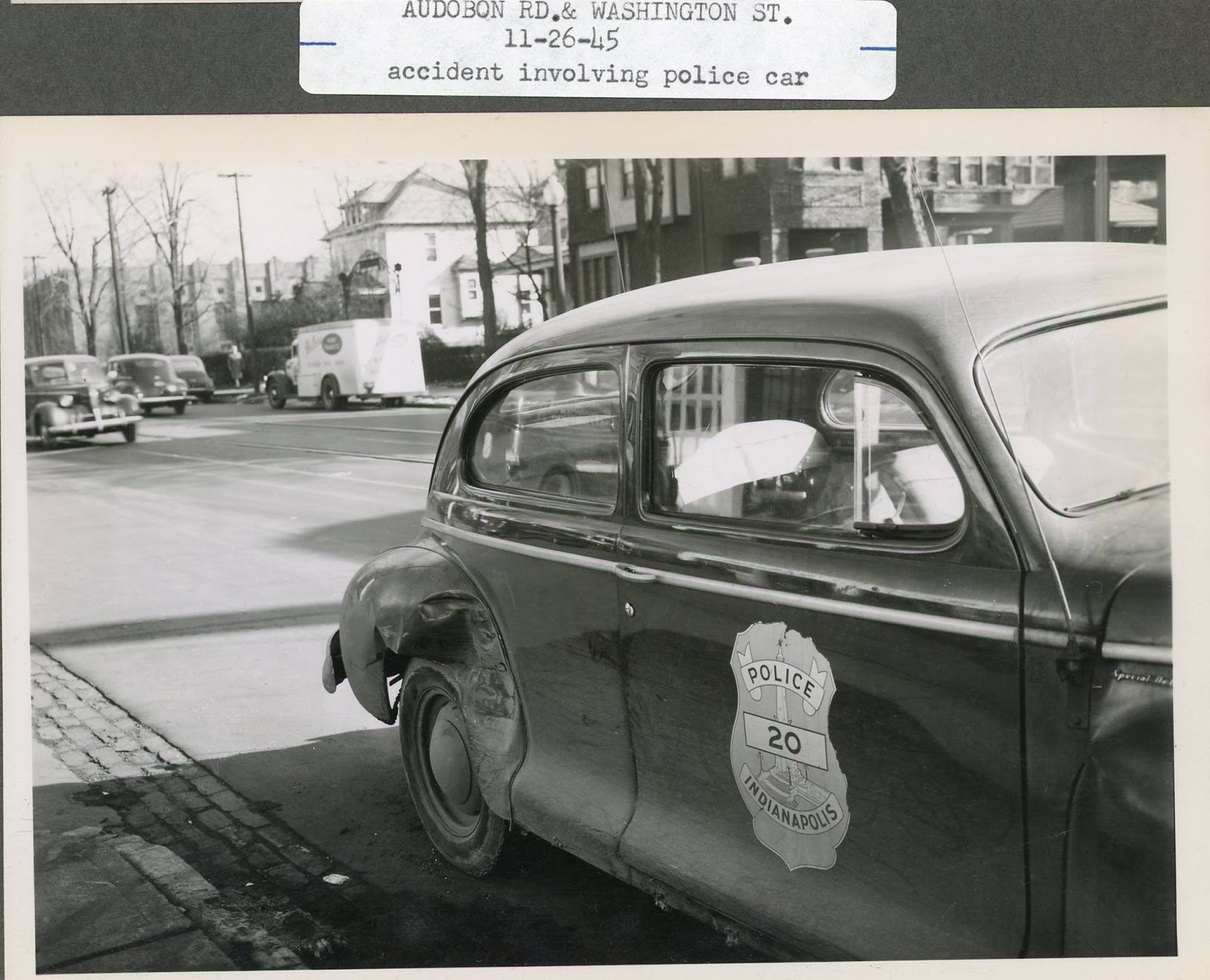
On November 26, 1945, a police officer was involved in an accident at the intersection of East Washington Street and Audubon Road. It was not a terrible crash, but someone from the Indianapolis Police Department documented the scene. While the focus of the photographer is on the damaged vehicle, behind the squad car you can see the Audubon Court Apartments and the two houses that used to stand at 5723 and 5731 East Washington Street. Beyond the two houses, you can view the Indiana Bell Telephone Building.  The historic images are courtesy of Patrick Pearsey and the Indianapolis Long Ago Facebook page.

Damaged Police Car: Parked on the north side of East Washington Street, you can see some of the commercial strip that used to sit on north side of the street in 1945 as well as what is today called the Suites of Irvington Apartments at 5730 East Washington Street.

In this view, you can see the Audubon Court Apartments as well as the homes that used to sit at 5723 and 5731 East Washington Street. The Pinnick and Lawler families dwelled in those homes at the time of the accident in 1945.  

The intersection of East Washington Street and Audubon Road in 2018.  

Sunday, December 17, 2017

Wallace-Bosart Home Predates Irvington

It is impossible not to notice the beautiful brick two-story home at 4704 East Washington Street. Most sources indicate that the large farmhouse was likely built around 1862 for the Wallace family. Little is known at this point about that family other than that they lived in the house until 1881 and that a nearby street is named for them. Ads placed in the Indianapolis News from March until November 1881, listed the house as for sale.

                    Farm of Wm. John Wallace--19 acres, great deal of fruit, outbuildings,
                    and a handsome brick house. Price low, terms easy. (March 31, 1881)

The Wallace-Bosart home in 2017. The two-story brick porch was likely added around 1915.
The Wallace-Bosart home appeared in an Indianapolis Star article on March 5, 1906 (p.3). The house had a one-story wrap around porch at the time and a windmill in the back. 

In early 1882, Timothy and Ruth Bosart along with their five children moved into the lovely estate. The children had plenty of room to play and in the backyard sat a three-story Second Empire structure with a windmill on top of it. Mr. Bosart had earned a comfortable income in the wholesale grocery business and then in the new electric power industry. He actually filed several patents and served as the Vice President and business manager for Jenney Electric Company. Mr. Bosart owned quite a lot of property and helped to develop the area north of his house now known as Bosart-Brown.  The street that bears the family name was also put in sometime in either the late nineteenth-century or early twentieth century. An Indianapolis Star article noted that sidewalks were added along Bosart Avenue north of Washington Street on May 2, 1903.

Two tragedies struck the Bosart family within two years. The first blow came on May 4, 1900, when Mr. Bosart died of a massive heart attack while at work. He was only 55 years old. The second and more horrifying event occurred on June 1, 1902. Mrs. Bosart along with her young son, Russell, and her mother, Lucetta Murray had gone to Crown Hill Cemetery to visit Mr. Bosart's grave. Upon leaving the cemetery, Mrs. Bosart's mother failed to see a streetcar. Lucetta Murray was instantly killed in front of her daughter and grandson.

Timothy Bosart (1844-1900), was a successful businessman. He helped to develop much the area around East Washington Street and Bosart Avenue. His untimely death of a heart attack shocked his family. (Photo courtesy of the Bosart family descendants via Ancestry.com)

Ruth Bosart (1858-1943) did her best to hold the family together after her husband's passing. Some of her adult children lived with her in the large house at 4704 East Washington Street. She died at the age of 84 having been a widow for forty-three years. (Photo courtesy of the Bosart family descendants via Ancestry.com)

Lucetta Murray, the mother of Ruth Bosart, was killed in horrible streetcar accident in 1902 near Crown Hill Cemetery.  (Photo courtesy of the Bosart family descendants via Ancestry.com)

Despite the sadness in her life, Ruth Bosart continued to manage and live in the large home with her children. In March of 1906, a reporter from the Indianapolis Star, profiled the Bosart family and property. He noted the flowing well, the large veranda that wrapped around the house (removed), and the number of fireplaces in the dwelling. At the time, the property was managed by Ruth's son, Oscar Bosart.

Several joyful moments took place on the property including an unusual event, a graduation ceremony. On June 13, 1909, the nearby Emerson School at New York Street and Linwood Avenue held their eighth-grade celebration on the lawn of the property. The students recited poetry by Longfellow including, "The Birds of Killingsworth" and "Tales of a Wayside Inn." They also sang words to Mendelssohn's "Spring Song." The Assistant Superintendent, Nebraska Cropsey, distributed diplomas to the 15 graduates who all held a garland of flowers while the remaining students and families watched.

The windmill on the Bosart property at 4704 East Washington Street as it looked in 1906. An Indianapolis Star article noted that the mansard-roofed structure was also likely used as a smokehouse in the nineteenth century. 

Dora Bosart, the daughter of Timothy and Ruth Bosart, became quite active in the Women's Franchise League, an organization dedicated to getting women the right to vote. The Smith College graduate, campaigned in the years leading up to the passage of the 19th Amendment. At some point, she met and fell in love with a British naval war hero, Alfred Evans. The young man was a veteran of the Boer Wars in South Africa and he had fought in World War One. The couple lived at 4704 East Washington Street along with other Bosarts until 1925 when they moved to Long Beach, California.

The Bosart sibling to have the most important role in the home was Oscar Bosart.  Along with his wife, Mabel, and their children, the next generation of Bosarts transformed the residence into the Green Lantern Tourist Home in 1936. A "Talk of the Town" article from the Indianapolis News in 1937 revealed that Oscar and Mabel had the house painted white with green shutters to reflect the Civil War era. The author pointed out that the house had been painted red, gray, and brown in previous years. A 1944 Indianapolis Star ad touted the inn as having "running water in rooms." Weary travelers along the National Road could stop off and stay with the Bosart family.

The matriarch of the family, Ruth Bosart, moved to Long Beach, California to live with her daughter in 1928 and died there in 1943. Oscar and Mabel Bosart continued to dwell in the family home for the next several decades. Their daughter, Jane, was married in the house and the society page of the Indianapolis Star on April 20, 1941, wrote of the beautiful candlelit service. One of their sons, Oscar, Jr., sadly drowned in an accident near New York City in 1936. Their youngest son, Robert, served the country during World War II as a pilot in the North African and Italian campaigns.

Oscar and Mabel Bosart took over the management of the property. The young couple, photographed in 1914, were likely standing in front of an older porch at 4704 East Washington Street. They later turned the home into an inn in 1936. (Photo courtesy of the Bosart family descendants via Ancestry.com)

By 1917, the Bosarts had removed the older porch and added a two-story brick porch. In this photo, Mabel Bosart posed with her children, Jane and Oscar, Jr. (Photo courtesy of the Bosart family via Ancestry.com)

So, the next time you drive or walk by the large house on the northeast corner of Washington Street and Bosart Avenue, you will know that you are viewing one of the oldest homes still standing on the east side of Indianapolis.

Sources:
Timothy Bosart obituary, Indianapolis Journal, May 5, 1908, 8; Lucetta Murray's Death, Indianapolis News, June 1, 1902, 2; Ruth Murray Bosart obituary, Indianapolis Star, May 1, 1943, 3; Profile of Bosart Family, Indianapolis Star, March 5, 1906, 3; Ads for Wallace Sale, Indianapolis News, March 31, 1881, 1; Dora Bosart and the Women's Franchise League, Indianapolis Star, November 3, 1914, 8; Graduation Ceremony, Indianapolis Star, June 13, 1909, 20; Jane Bosart Wedding, Indianapolis Star, April 20, 1941, 47, Talk of the Town, Indianapolis News, October 19, 1937; Date of Wallace-Bosart home--
  • Bodenhamer, D. J., Barrows, R. G., & Vanderstel, D. G. (1994). The Encyclopedia of Indianapolis. Bloomington: Indiana University Press, 1262.

Monday, October 17, 2016

Our Lady of Lourdes First Communion--1944

The young ladies gathered in front of Our Lady of Lourdes Catholic Church on East Washington Street for their first communion in the spring of 1944. They all wore white dresses and veils. Somewhere in that line of girls stood Barbara Schweiters,  the daughter of Norbert and Dorothy Schweiters, of 6076 Dewey Avenue. Behind the girls, traffic was parked along East Washington Street and a bus had just passed along the intersection with North Hawthorne Lane. Across the street, you can see the sign for the Gulf Filling Station run by Don W. Miller at 5302 East Washington Street. (demolished) The most visible home in the photo was that of Joseph and Josephine Kernel, who dwelled at 5370 East Washington Street in 1944. Dr. Kernel was an optometrist as was one of his daughters. Next door at 5360 East Washington Street, you can see residence of Karl and Agness Kernel. Mr. Kernel was the brother to Joseph. Another brother, Paul, lived just around the corner at 5040 Pleasant Run Parkway North Drive. Beyond the Kernel homes, loomed the Butler apartment building at 5230 East Washington Street. Although it is hard to believe, all of those young girls in the photo would be in their eighties if they are still living in 2016. Sadly, the life of Barbara Schweiters was cut short as she passed away from the effects of polio in 1949.

A procession of young girls with their hands clasped prepared to enter Our Lady of Lourdes Catholic Church on East Washington Street in 1944.  

The historic image is courtesy of Deedee Davis. Information on the Kernel brothers came from the Polk's City Directory and census records. 

Monday, September 19, 2016

Historic Building Collapses

Residents of Irvington awoke to the sad news today that at around 4:30 AM, the former East Side State Bank and now Jack and Jill's Antique Mall at 5501 East Washington Street had collapsed. The top part of the front facade fell onto East Washington Street. The building was constructed during the summer of 1913 and served as a bank well into the 1980s. The future of the building is unclear at this point.

A section of the former East Side State Bank collapsed at 4:30 AM on September 19, 2016 (photo courtesy of Fox59News)

Monday, June 13, 2016

East Washington Street Then and Now

Sometime in the spring of 1941, Barbara Jones who dwelled at 273 South Ritter Avenue, snapped this photo of her friends Louise and Carol.  We do not know their last names so if anyone recognizes these young ladies then drop me a note. Behind the girls, you can see the doubles at 5132-34 and 5136-38 East Washington Street.  Beyond the doubles, you can get a view of the Victoria Apartments located at 5124 East Washington Street. Little has changed with the two doubles seventy-five years after this photo was snapped. Louise and Carol would have no difficulty recognizing their former neighborhood.

Young ladies identified as "Louise" and "Carol" stand in the 5100 block of East Washington Street in 1941.  

The doubles at 5132-34 and 5136-38 East Washington Street in 2016  
The historic image is courtesy of the Jones Family collection.  

Sunday, January 24, 2016

East Washington Street and Audubon Road in 1924

Sometime in the late fall or early winter of 1924 an unidentified Butler University sorority girl who dwelled at 5657 East Washington Street stopped to pose for this photograph. She had been sweeping the walk. Behind her you can see the grand home that used to stand at 5698 East Washington Street. The Stevenson family lived in the large house at the time. In three years, the Stevenson residence would be demolished for a commercial strip that still stands in 2016. The Kappa Kappa Gamma House where the young woman stood was also later razed.

A Kappa Kappa Gamma member posed in front of the chapter home in 1924. Behind her you can see the residence of Robert and Mary Stevenson at 5698 East Washington Street. (Photo: Butler Drift, 1924) 

Robert and Mary Stevenson purchased this home in 1918. To learn more about this history of this former Irvington dwelling click on the Stevenson link below. It was demolished in 1927.

This beautiful home at 5657 East Washington Street briefly served as the Kappa Kappa Gamma Sorority House in the 1920s. It was razed in 1945. (Photo: Butler Drift, 1924)

5600 block of East Washington Street in 2016
The historic image of the Stevenson home is courtesy of Ted Lollis.  

Saturday, November 14, 2015

Irvington Fire House--Station #25

One of the chief reasons for Irvington's annexation to the city of Indianapolis in 1902 was to obtain police and fire protection. Two disastrous school fires and numerous house blazes demonstrated to many folks in the community that Irvington needed city services. In 1903, the community hired architect John Stem to design a beautiful fire station to fit into the "classic" suburb. Mr. Stem was likely recommended by Hilton U. Brown, the publisher of the Indianapolis News, as the architect had designed Brown's large stone mansion at the southwest corner of East Washington Street and Emerson Avenue. (demolished) Stem's design was unlike any other fire station in the city. By 1903, the National Road or East Washington Street had emerged as the main commercial corridor for Irvington so the town planners placed the fire station at 5432 East Washington Street.

The Irvington Fire Station c1905 at 5432 East Washington Street
Stem opted for a European-styled structure with the first floor exterior sheathed in stone and the upper gables clad with wood shake. Since the first fire engines were powered by horses, the station had a stall on the first floor and a hayloft on the second floor. In the early years of the station, firemen, worked 24-hour shifts for six days of the week on a rotating basis and slept on the second floor. They were allowed to eat meals at home, but most dined at the station. Later, their schedules were modified to a more reasonable time frame.

If neighbors needed to report a fire, then they could run to a nearby fire alarm box scattered throughout the neighborhood. In 1910, there were fire alarm boxes located at several intersections including: Downey and Julian; University and Ohmer; 200 block of South Audubon Road; Beechwood and Burgess; Layman and Lowell; Washington and Ritter; Washington and Arlington; and Washington and Bosart. Many residents already had a telephone by 1910 so they merely had to pick up the receiver and call the station.

On February 8, 1929, Fire Station #25 obtained its first motorized vehicles. The horses, who had been lovingly tended to, were sent away to a nearby farm. The station hosted a Dalmatian and "Spot" became a beloved animal in the neighborhood.

Life for the firefighters was fairly routine. Oral histories conducted by the Irvington branch of the Indianapolis Public Library and now found online revealed that fireman had tasks to do each day. Substitutes or the newer recruits were assigned the worst jobs like stoking the coal furnace in the winter or cleaning out the disgusting spittoons. On Mondays, the men stretched out the hoses to dry and clean them. On Tuesdays, the men conducted inspections of nearby schools and institutions. On Wednesdays, the station was cleaned and the floors scrubbed. On Thursdays and Fridays, they cleaned every inch of the firetrucks and did maintenance work. They had some free time where they could play cards, read, or listen to a ballgame on the radio. Each man was given a task for dinner and the subsequent clean up. They also had assigned beds and each man a monthly night watch.

The Irvington Fire Station (#25) c1929 at 5432 East Washington Street
Over the years, dozens of men served their time in the beautiful but aging chalet of a fire station. Bob McDonnell, a veteran of World War II and an employee for the city fire department since 1938, started working at #25 in the early 1950s. Mr. McDonnell reported that by the mid-twentieth century, the station was in such poor shape that the firemen did not jump into the trucks until they were out on the concrete pad because they worried about the sagging floors.


Bob McDonell worked for Station #25 for many years. In 1958, he helped in the from the old station at 5432 East Washington to the new site at 17 South Sheridan Avenue. 


In November of 1958, the city of Indianapolis vacated the unusual fire station for a modern structure located at 17 South Sheridan Avenue. Sadly, the community had no rules in place to protect such structures so it was torn down very quickly as a nearby car dealership needed space for a parking lot. One can only imagine the reuse of this building in 2015 as a restaurant, a coffee shop, a bookstore, or as a boutique.

To learn more about the station and to see additional photographs click on the link below. Much of the information for this post came from an oral history interview with Errol Evans and from Terry Wilgus, the daughter of Bob McDonnell. Ms. Wilgus also provided the wonderful images.

http://www.digitalindy.org/cdm/compoundobject/collection/ioh/id/1483/rec/28


Saturday, August 29, 2015

East Washington Street Double 1949 and 2015

In 1949, Samuel Wheeler posed for this photo next to his Ford Coupe in the driveway of 5115 East Washington Street. This home is no longer standing.  To his left, you can barely see the brick American Four Square at 5117 East Washington Street. It was at that point in its history the Blackwell Funeral Home.  Behind him, you can see the facade of the double at 5118-20 East Washington Street.  The Wilkens and Rahn family dwelled in that double throughout much of the 1950s.  Although a Bradford Pear Tree in the parking lot of the Speedway Gas Station made it impossible to capture the exact view in 2015, I tried to stand close to where Mr. Wheeler stood sixty-six years ago.

Samuel Wheeler posed next to his 1949 Ford Coupe. The white clapboard house to his right  (our left) was located at 5115 East Washington Street and is no longer standing.  

5118-20 East Washington Street in 2015
The historic image is courtesy of the Wheeler family via Ancestry.com.  

Sunday, August 23, 2015

Exciting Times at an East Washington Street Double

For years the Wilkens family dwelled in a small one-bedroom double along Linwood Avenue. In 1950, Harold and Ellen Wilkens along with their daughter Diana moved into a spacious double at 5120 East Washington Street.  The family could see the beautiful Hilton U. Brown mansion across the street and of course in the winter, they watched as hundreds of kids sledded down his steep hill. Next door, motorists stopped by the Flying Red Horse Filling Station on the northeast corner of East Washington Street and Emerson Avenue to fill up their Pontiacs, Buicks, Cadillacs, and other boat-sized vehicles. Mr. Wilkens, a pharmacist, purchased his first car in 1950--a 1949 Chevrolet.

Young Diana enjoyed living in the stucco double as she could walk to Howe High School, a place she loved.  Each morning she dressed up in her cashmere sweater, long dress, hose, and flat shoes and entered Miss Motley's homeroom class. She loved to draw so Mr. Howard, an art instructor, was one of her favorite teachers.  She joined a social club called  "Smiles" and hung out with friends after school. After graduating from Howe in 1952, Diana matriculated to Butler University. She continued to dwell with her parents

Then Diana decided to do something crazy. In 1956, she bid her bid parents "farewell" and headed off to New York City with a few other friends. She landed a job with the Benton and Bowls Ad Agency as an art secretary. While she mainly kept the files organized for the executives and ad men, she occasionally helped out the creative directors by posing for test shots before the models would be brought in for the actual photo shoot.  Diana had to pinch herself as she met famous people like Norman Rockwell, Grandma Moses, and fashion designer John Weitz. She also fell in love, but in 1964 she learned that her mother was ill so she packed up her bags and made the long ride home to Irvington, where a new life awaited her.

Diana Wilkens posed for this shot with her date, Paul Ross, in her home at 5120 East Washington Street in 1954

All Dressed Up: Diana Wilkens on the front steps of 5120 East Washington Street in 1954

Diana Wilkens playfully held up "Ming" to the Christmas wreath hanging on the door at 5120 East Washington Street in 1955.

Mr. Wilkens fed a tame squirrel on the rear stoop of 5120 East Washington Street in 1954

Exciting Times: Diana Wilkens and Alan Pentaleri posed for a test shoot for an ad while working at the Benton and Bowls Ad Agency in New York City in 1958.  

The Wilkens family moved into the double at 5118-20 East Washington Street in 1950 would remain there throughout the decade.  


Monday, May 25, 2015

A Grand Home Along East Washington Street

Some of the most fashionable homes in Irvington sat along Washington Street. The founders of the community never envisioned that great avenue as a commercial corridor. In fact, they put in a small downtown in the 200 block of South Audubon Road. (then called Central Avenue) Over the decades, various entrepreneurs realized that opening businesses along the National Road might yield profitable results so they began buying up the grand old houses and tearing them down.  In 1927,  a local businessman, Robert E. Stevenson, sold his home and large lot at 5698 East Washington for a future Tudor-Revival commercial strip.

Built c1905, the giant home at 5698 East Washington Street had a wrap-around and curved brick porch and an uncovered balcony above.  Smaller balconies jutted out along the side and from the third story.  The Goodwin family is the earliest known family to dwell in the home and they might have built it.  Clarence Goodwin was Vice President of the Indiana Veneer and Lumber Company. He later moved his family to Greensburg, Pennsylvania in 1910.  Other families lived in the house until 1918, when Robert and Mary Stevenson purchased it.  They would remain in the dwelling for the next nine years.

The home was a way for Robert Stevenson to show the world that he had arrived. In the age of "Gatsby" and the Roaring 20s, Mr. Stevenson chased the almighty dollar.  He was always looking for the next big deal. He kept his pretty and younger wife in fur coats and at this time in his life drove fine cars. While the family seemed to enjoy living the American dream, not all was at it seemed with the Stevenson finances. The couple became the guardian of their nephew, Edward Lollis, in 1915. Young Edward noticed that the family would have good times followed by lean times and he vowed later as an adult to avoid such financial volatility.

Sensing yet again another economic opportunity, Mr. Stevenson sold the Washington Street property to developers in 1927.  Little did he know what ominous financial developments awaited Americans. Thousands of people like Robert Stevenson would lose vast sums of money after the Stock Market Crash of 1929.  The Great Depression humbled many people looking for the next big deal.  The days of fur coats and fancy cars were over for many people.

The Stevensons rented a few homes and then purchased another house at 56 South Irvington Avenue in 1932. They tried to continue to live in the same manner as they had at their grand home along East Washington Street, but the money did not come as easily.

Next post:  Life Along Irvington Avenue in the 1930s

Robert and Mary Stevenson and their ward, Edward Lollis, dwelled at 5698 East Washington Street from 1918 to 1927. The home would be torn down in 1927 and replaced with a Tudor-Revival commercial strip.  

Arthur, Robert, and Frank Stevenson stood behind their mother, Kate Stevenson in the front yard at 5698 East Washington Street c1918.  

Edward Lollis was a member of Boy Scout Troop #3. They met in the Irvington Presbyterian Church. It is possible that young Edward was not in a scout uniform, but rather in a uniform of a youth group that drilled during World War One. Edward spent a summer in Fort Knox, Kentucky. Fortunately the war ended before he became of age to serve. In this photo, he stood in front of 5698 East Washington Street in full salute c1918.  

Effie Lenore Johnson Stevenson, wife to Frank Stevenson, stood with her child in front of Robert and Mary Stevenson's home at 5698 East Washington Street c1918.  Note that the flag hanging nearby had only 48 stars on it.

An unidentified man stood in front of 5698 East Washington Street c1918.  You can see the address above his head.  

The large home at 5698 East Washington Street used to sit on the northwest corner of Washington Street and Audubon Road. It was torn down in 1927 to make way for a commercial enterprise.  The Tudor-Revival structure that replaced the home still stands in 2015 and is frequented by thousands each year who flock here for delicious food, unique gifts, and stylish clothing.  

The stories and photos for this post are courtesy of Ted Lollis.