Showing posts with label Wheeler Family. Show all posts

Wednesday, January 1, 2025

In Search of Herbert E. Fouts: Artist, Illustrator, Designer

      Nearly twenty years ago, I purchased a painting called Pool in Irvington (1921) from an online auction site. I knew little about the artist, Herbert E. Fouts, other than he studied at the John Herron Art Institute in Indianapolis. The small impressionistic painting has now traveled with me through three houses and currently hangs in the living room of my modest bungalow. The young artist who created the painting was likely in Irvington for no more than a few hours yet our worlds have intersected a century after his quick study of a beautiful scene. I mistakenly thought that there would be plenty of information on this talented painter, but I was wrong. My search for him metaphorically took me from Indiana to New York, Paris, Vienna, and back home. Who was Herbert E. Fouts? 

Pool in Irvington by Herbert E. Fouts, 1921

On the back of the painting, Fouts recorded exactly when he painted the scene.

Pool in Irvington hung in the 15th Annual Exhibition of Indiana Artists in the spring of 1922.


From New Washington, Indiana to the John Herron Institute (1902-1922)

Herbert E. Fouts rode in the backseat of this car in 1915. The older man in the photo is possibly his father, Isaac Fouts while the young man at the wheel is likely his brother, Arthur Fouts. (photo courtesy of Janae Tsu)

     Herbert E. Fouts started life on a farm in Clark County, Indiana near the village of New Washington in 1902. He was the second son of Isaac and Viola Fouts. Early on, his teachers noted that he possessed artistic talent. Later accounts reported that he used to fill the blackboards at the schoolhouse with "frescoes." Upon graduating from high school, he received the Clark County Scholarship to study at the John Herron Art Institute in Indianapolis beginning in the summer of 1921 and in subsequent terms in 1922. At some point during that first summer, he made his way to Irvington to set up an easel most likely near Pleasant Run. Local artist, William Forsyth, who taught painting and drawing at the Institute, might have been with him on that day. 

     Later that year, he submitted his work, Pool in Irvington, to the Art Association of Indiana for its 15th annual exhibition. Incredibly, he was chosen and appears to have been one of the few students accepted. The committee welcomed 134 painters, four sculptors, and numerous handicraft artists. Over 1300 visitors during the spring of 1922 strolled through the Herron Institute and admired work by talented artists like J. Ottis Adams, Simon Baus, William Forsyth, Marie Goth, Carl Graf, Paul Hadley, John W. Hardrick, Frederick Polley, Myra Reynolds Richards, Otto Stark, T.C. Steele, Clifton Wheeler, Hilah Drake Wheeler and many others. 

     Hanging on the wall that spring with so many of those great artists was Pool in Irvington. Bessie Hendricks, who also exhibited that year, wrote a column for the Indianapolis News. She mentioned numerous people in her review of the exhibition, but singled out young Herbert Fouts. ...Pool in Irvington, an attractive little oil painting in which the pool takes the leading role. There is not even a glimpse of the sky. Visitors were encouraged to buy paintings that day so it is possible that someone locally might have purchased the work; however, the provenance from 1922 until 2006 remains a mystery. 

Catalog of the Fifteenth Annual by Indiana Artists, April 22, 1922 (Image courtesy of Newfields Digital Archives) 

Herbert E. Fouts (middle row, second from right) was a design major while studying at Herron. One of his teachers was Paul Hadley (standing), who designed the state flag of Indiana. (Photo courtesy of the Herron Art Library Slide Collection, IU Indianapolis Library & Archives)

From Louisville to New York City: Herbert E. Fouts as an Illustrator (1923-1937)

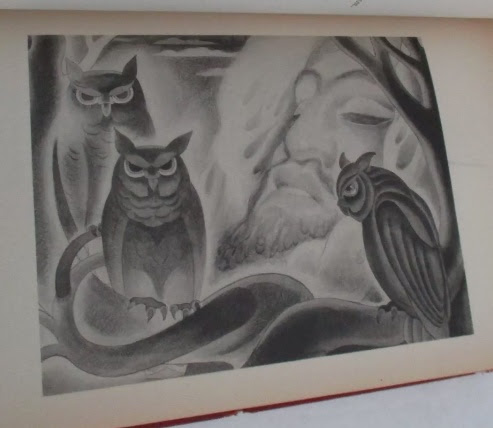
     After studying at Herron, Fouts returned to southern Indiana. In nearby Louisville, he studied under Alexander Van Leshout, a local illustrator and muralist. The Louisville Courier-Journal  published some of Fouts' illustrations. By 1925, he settled in New York City and studied at the Parsons School of Design on scholarship. He earned a living by illustrating for magazines and publishers. He soon fell in with a group of Greenwich Village poets, who hired him to illustrate their books. By this point in his career, he seems to have moved away from Impressionism and into Art Deco. His illustrations for a book of poetry by Ralph Cheyney titled Touch and Go (1926) reflected his new interest in that genre. He quickly garnered other jobs with other poets including Sara Owens and Carolyn Davies. The Greenwich Village Quill, a magazine for that neighborhood, hired him to illustrate a cover in 1927. 

     In the summer of 1927, the young man sailed for Europe to study in both Paris and Vienna. Upon his return to New York City, he resumed his job as an illustrator. The Louisville Courier-Journal noted that his drawings were "ultra modern" and compared his art to the English illustrator, Aubrey Beardsley. 

   Fouts continued to get jobs as an illustrator in the 1930s including one by Jacob Krup who attempted to translate some of the work by the great Russian poet, Alexander Pushkin in 1936. One reviewer for the Fort Worth Telegram brutally panned the book, but praised Fouts. He noted that the illustrations were, "most attractive and more poetic than the printed matter of the book." 

Ralph Cheyney, Touch and Go, 1926

Ralph Cheyney, Touch and Go, 1926

Daggers in a Star, 1930

Jacob Krup, Six Poems from the Russian, (1936)

Herbert E. Fouts, Interior Designer, 1937-1970

     Like many Americans, Herbert Fouts likely struggled during the Great Depression, but those days would soon be in his rear-view mirror as his career soared to new heights. When he attended John Herron, Fouts was in the first cohort of design majors. One has to wonder if the idea of becoming an interior designer first germinated at Herron or did he arrive with that idea in mind? Throughout the 1930s, he decorated the homes of friends. Soon, his reputation as a designer spread and he opened a shop on 62nd Street in New York City in 1937 called Decorative Interiors. For the next thirty years he decorated homes for the wealthy. Band leader, Guy Lombardo, hired him to paint a Chinese screen for his home. Air-conditioning magnate, Willis Carrier, employed him to decorate a drawing room for his mansion in Syracuse, New York. Samuel Blackford, who owned a chain of cafeterias, contracted him to decorate his house. Fouts usually worked with their wives. 

     He was considered a very unique designer because he personally created the wall paper and any textiles for the project. He even occasionally designed the furniture. He painted the murals or added one of his own paintings. By the 1940s, he had become enamored with a new movement originating in New York City called abstract impressionism. He also worked with hotels. He painted a mural in the Park Lane Hotel near Central Park in New York City and decorated a rustic inn located in Westport, Connecticut. 

Donna Frazier was a first cousin, once removed to Herbert Fouts. She received a letter from him in 1956. (courtesy of Janae Tsu)

     Despite his success, he never forgot about his Indiana roots. After the tragic and untimely death of his brother, the responsibility for tending to his aging parents fell to him. He frequently flew home especially after his father died in 1949. He eventually moved his elderly mother into his New York City apartment. He visited both Louisville and Indianapolis and each time he spoke to reporters about design. In 1955, he gifted "October Moon" to his old high school at New Washington. The abstract impressionist work hung in the school for many years but its whereabouts remains unknown at this time. 

"October Moon" can be seen behind the young woman from this 1960s yearbook photo from New Washington High School (photo courtesy of the Greater Clark School Corporation)

"October Moon" is visible behind Gary Weston and Joan Moberly in this 1960s yearbook photo from New Washington High School (photo courtesy of the Greater Clark School Corporation)

     The best description that I found of Herbert Fouts came from Miss Mary Sample, a beloved Clark County, Indiana teacher. At the age of 80 in 1957, she traveled to New York City to visit with the successful native son. In classic Miss Sample form, she penned a letter to the editor to the Charlestown Courier to document what she had uncovered. She noted that his apartment was "beautifully decorated," and that he lovingly referred to his wheel-chair bound mother, Viola Fouts, as "Aunt Vi." Miss Sample toured his shop and revealed that Eleanor Roosevelt lived two doors down. She commented on the beauty of his textiles. They visited museums. They watched the Rockettes at Radio City Music Hall, and saw "Show Boat" on stage. Fouts put Miss Sample up at the Ellerton, a hotel for single women. She could hardly contain herself on all of the great food that they ate. 

     Herbert Fouts died in 1970.  Much of his design work has likely been replaced, but he would have understood that fact. Sometimes, it doesn't take long to be forgotten. There are still so many unknowns about the talented artist and creator. But, here is what we do know...In the summer of 1921, a young man arrived in Irvington and painted a scene.

Herbert E. Fouts, a successful painter, illustrator, muralist, and designer, posed on a New York City rooftop with his dog, Coco. (photo courtesy of Janae Tsu) 

     I wish to thank Art and Design Historian, Kyle Kingen for his assistance with this post. Kyle uncovered many obscure details including the photo of Herbert Fouts at Herron. He even examined Herron Art School records to confirm that Fouts was a design major. I also wish to thank Janae Tsu and her family for the use of the photos. Surprisingly, the only images I could find of Mr. Fouts were grainy newspaper shots. I am grateful for her kindness. Jonathan May and Nate Koets of the Greater Clark School Corporation took time out of their busy schedules to search for "October Moon." While the painting may be gone, I appreciated their help. 

Sources:  Early Years (1902-1922):  1910 and 1920 Federal Census Records, Herron Art School Enrollment Records, 1921-1922; Bessie Hendricks, "Comment on Indiana Art at Herron Institute and the Taos Society of Artists' Exhibition," Indianapolis News, March 11, 1922, p. 9

New York and Europe (1922-1937): "Youth Attracts Attention Here as Rare Artist," Louisville Herald, April 20, 1924, p. 65; "Herbert Fouts to Study in Europe," Louisville Courier-Journal, July 3, 1927, p. 6; "Local Artist Sails for Paris," Jeffersonville Evening News (IN), July 5, 1927, p. 2;  Catherine E. Berry, "Around New York," Louisville Courier-Journal, September 25, 1927, p. 9;  "About Books," Los Angeles Evening Post, July 31, 1929, p. 12;  "Drawings by Herbert Fouts," Louisville Courier-Journal, July 28, 1929, p. 36;  "Concerning Herbert E. Fouts," Louisville Courier-Journal, November 10, 1929, p. 37; Evidence of Inept Translation," Fort Worth Telegram, May 2, 1937, p. 44; 

Interior Design Years (1937-1970): Rhea Talley, "First He Did Over His Own Flat," Louisville Courier-Journal, September 7, 1947, p. 25;  "Fouts' Painting Featured at Art Exhibit," Jeffersonville Evening News (IN), June 25, 1955, p. 10; Mary Sample, Letter to the Editor, Charlestown Courier (IN), September 19, 1957, p. 4; "Art Adds to the Living," Indianapolis News, October 2, 1967, p. 14;   


Saturday, August 29, 2015

East Washington Street Double 1949 and 2015

In 1949, Samuel Wheeler posed for this photo next to his Ford Coupe in the driveway of 5115 East Washington Street. This home is no longer standing.  To his left, you can barely see the brick American Four Square at 5117 East Washington Street. It was at that point in its history the Blackwell Funeral Home.  Behind him, you can see the facade of the double at 5118-20 East Washington Street.  The Wilkens and Rahn family dwelled in that double throughout much of the 1950s.  Although a Bradford Pear Tree in the parking lot of the Speedway Gas Station made it impossible to capture the exact view in 2015, I tried to stand close to where Mr. Wheeler stood sixty-six years ago.

Samuel Wheeler posed next to his 1949 Ford Coupe. The white clapboard house to his right  (our left) was located at 5115 East Washington Street and is no longer standing.  

5118-20 East Washington Street in 2015
The historic image is courtesy of the Wheeler family via Ancestry.com.  

Friday, July 18, 2014

Azbell Distribution Company c1950

Entrepreneur Fred Azbell opened his own business in the mid-twentieth century selling Bowes Auto Parts.  Eventually, he secured a commercial building at 5021 East Michigan Street and operated at this site from 1950 through the mid-1960s until his untimely passing. The building was first constructed for Harry Asche in 1918 to service east side automobile owners.  Many others operated out of this garage including Charles P. Culley in the 1920s, John L. Manson in the 1930s, and a business called Wheeler and Gossett Auto Repairs in the 1940s. Mr. Azbell enclosed the central garage bay and turned the structure into an auto parts distribution center.  Spark plugs, wheelcaps, and just about any other Bowes parts were available to Irvington residents. The top image revealed the exterior of the structure in the 1950s.  In the second photo, Mr. Azbell on the right met with a client possibly in a filling station at 5135 East 10th Street.  In the third historic photo, Mr. Azbell proudly posed next to the Bowes Auto trucks c1945. The contemporary photo shows the early twentieth-century structure in 2014.

The Azbell Distributing Company at 5021 East Michigan Street (formerly 5019) c1950

Fred Azbell, on the right, visited one of his customers--possibly in a filling station 5135  East 10th Street run by Joe Himmel

Fred Azbell next to Bowes Auto Parts company car c1945

5021 East Michigan Street in 2014.  Harry Asche built the garage in 1918.  
The historic images are courtesy of Barbara Sanders.  

Friday, June 22, 2012

The Phelps Family Moves into the Wheeler Home--1954

For the past week, we have been celebrating the centennial of the Wheeler Home (5317 Lowell Avenue).  Clifton and Hilah Drake Wheeler saw to the construction of the home in 1912 and dwelled in the house until 1954.

The Phelps family moved into the Wheeler Home in 1954


In 1954, Robert E. Phelps (1919-2004) and his wife Eva Mae Chaille Phelps (1921-2002) became the next long-term residents.  Mrs. Phelps grew up in Irvington.  Her father's family operated Chaille's Shoes, a business that began at 9 North Ritter Avenue in the 1920s and eventually moved to 5622 E. Washington Street.  Mr. Phelps took over the family business and ran it until the early 1990s.  Chaille's Shoes became an institution in the neighborhood as generations of Irvingtonians purchased shoes there.  (A future post will be dedicated to this business.)  Mrs. Phelps, as she was called by her students, taught at Schools 58 and 85 for twenty-eight years.


The Phelps family ran Chaille Shoes at 5622 East Washington Street in the second half of the 20th century. Louis Saba, a clerk for Chaille's Shoes stands next to the shoe rack.  He later moved to Las Vegas where he bought a gas station.  


The couple collected antiques and raised their children in the beautifully-sited home.  Mrs. Phelps liked bright colors and painted some of the rooms in the house, including the gallery, in yellows and reds.  They had the reputation of being kind neighbors and were very much interested in the home's history. The family maintained ownership of the property until 2004.

The Wheeler-Phelps Home in an undated photo.  


You may learn more about the history of this home by clicking on the Wheeler Family link below.  The  historic images are courtesy of Michele and Bruce Oertel and Kent Hankins.

Monday, June 18, 2012

Clifton Wheeler--Noted Artist, Muralist, Teacher

For the past several days, we have been celebrating the centennial anniversary of 5317 Lowell Avenue.  Clifton and Hilah Drake Wheeler built their dream home in 1912.  For decades the couple, created inspiring art pieces in the gallery room designed into the plan of the house.  Newspaper accounts from the early twentieth century describe the room bulging with art from floor to ceiling.

Spring by Clifton Wheeler


Clifton Wheeler (1883-1953) grew up in Mooresville, Indiana.  His father had planned for him to take over the family flour mill business, but he had other dreams.  An inspirational aunt invited him to live with her in Indianapolis on the weekends during his teen years so that he could take classes from noted artist and Irvingtonian, William Forsyth.  The young man generally sat for lessons on Saturdays.  Eventually, he made his way to New York City to study under Robert Henri and Kenneth Hayes Miller, and finally to Europe where he painted under the direction of William Merritt Chase.  While in Europe, he observed, critiqued, and recreated the classics.  He also developed his own style.  In 1910, William Merritt Chase gave young Wheeler the award for being his best student.  In that same year, while touring Europe, he met fellow art student Hilah Drake.  He would earn his second prize when she said yes to his proposal of marriage.

Mural at Shortridge High School, Indianapolis, c.1914

Clifton Wheeler murals restored in 2006 at School Number 54 (3150 East 10th, Indianapolis), 1921


Once settled in Indiana, the couple moved to Irvington in 1912 to be near other artists and to enjoy the beauty of Pleasant Run stream and Ellenberger Woods.  Many of Mr. Wheeler's works feature Indiana scenes.  He was frequently called upon to paint murals around the state.  Several of his works are still in existence including those in several schools, universities, hospitals, and at the Circle Theater.

He earned a living by teaching in his private studio on Lowell Avenue; at the John Herron Art Institute; and at Shortridge High School.  The Wheelers traveled the country for inspiration and spent time painting in the Catskills and Rockies.  Mr. Wheeler exhibited all over the state and country as well.  He was renown during his lifetime.  Hundreds of his paintings and sketches remain in private and public collections all over the United States.

Young Leaves by Clifton Wheeler

Winter Woodland by Clifton Wheeler

Up Fall Creek by Clifton Wheeler


It appears that the Wheelers remained close throughout their lifetime.  They had one child named Hilah Mary.  Mr. Wheeler continued to paint until his cancer would not allow him to do so.  He died at the age of 69 in 1953.  His companion, wife, and fellow artist, Hilah Drake Wheeler, outlived him by several years.  She passed away at the age of 92 in 1970.

Clifton and Hilah Drake Wheeler Home, May, 1913


One hundred years later, the home has been proudly restored.  The Wheelers would be happy to know that their shady lot and stuccoed home looks much as it did in 1912.  To learn more about the Wheelers click on the link below.   The historic images are courtesy of Michele and Bruce Oertel.

Sunday, June 17, 2012

The Talented Wheeler Women of Lowell Avenue

I ask you to remember the ladies...
               Abigail Adams to her husband, John Adams

Two very talented ladies dwelled at 5317 Lowell Avenue along with their very accomplished husband and father.

Hilah Drake (1878-1970) met her future husband, Clifton Wheeler, while studying art in Europe.  The daughter of Alexander Drake, an art critic for The Century magazine, the young woman was a talented watercolorist.  In 1910, the couple married and briefly lived in his hometown of Mooresville, Indiana.  She gave birth to Hilah Mary Wheeler in 1911.

Hilah Drake Wheeler and daughter, Hilah Mary--1912


By 1912, they were building their dream home at 5317 Lowell Avenue in Irvington.  The Wheelers had their architect, George Hoagland, design a beautiful studio with a tall ceiling and a fireplace as part of the home.  Both of the Wheelers tended to paint landscapes and portraits although Mrs. Wheeler also specialized in still lifes and silhouettes.

Clifton and Hilah Drake Wheeler Home--1913

Flower Stall, Indianapolis City Market by Hilah Drake Wheeler 1925, Courtesy of Indianapolis Museum of Art

Hibben Home, Pleasant Run Parkway by Hilah Drake Wheeler

Still Life by Hilah Drake Wheeler


Their daughter, Hilah Mary Wheeler (1911-2002) was also a talented artist in her own right.  She married George Remaily (1912-2004) and moved to Hammondsport, New York.  Mr. Remaily became renown as a viticulturist.  His grapes were used in wines throughout the US.

Hilah Mary Wheeler Remaily with her daughter, Hilah Katrina Remaily--1939 at 5317 Lowell Ave

Portrait by Hilah Mary Remaily


The elder Mrs. Wheeler remained at Lowell Avenue for much of her life.  Upon Clifton Wheeler's passing in 1953, she painted this scene in 1954 to capture what the room looked like upon his sad death at the age 69.  She later moved from the home to be near her daughter.  The historic images are courtesy of Bruce and Michele Oertel.  The scene below is only a partial view of the painting. You may learn more about the Wheelers by clicking on the link below.

Wheeler Studio by Hilah Drake Wheeler, 1954, courtesy of Bruce and Michele Oertel


Friday, June 15, 2012

The Wheeler Home Celebrates 100 Years!

One hundred years ago this summer, builders broke ground for a beautiful home at 5317 Lowell Avenue in 1912.   George E. Hoagland (1872-1959) designed the house for Clifton and Hilah Drake Wheeler, both renown local artists.  The Wheelers actually purchased the large lot from Fred O. Ritter on July 29, 1911.  The couple, both in their late twenties in 1912, just welcomed a child into this world.  Mr. Wheeler (1883-1953) at the time taught at the John Herron Institute of Art under the direction of another Irvingtonian, William Forsyth (15 South Emerson Avenue.)

Both Mr. and Mrs. Wheeler studied in Europe under some of the most eminent artists of their day.  They actually met and fell in love in Europe while taking a class instructed by William Merritt Chase.  Mrs. Wheeler (1878-1970) came from the prominent Drake family, who were also artists and art critics living in New York City.  Mr. Wheeler worried about his new wife's reaction of moving to Indiana, but the couple sited their new home on a hill overlooking nearby Pleasant Run stream and Ellenberger Woods.  Both used the bucolic settings for their art.  The following photo, taken in May of 1913,  is the oldest known of the dwelling.

Wheeler Home, May 1913

Architectural plans for the home--May, 1912


In early September 1913, Lucille Morehouse, a local art critic for the Indianapolis Star, visited the Wheeler home and spent time in the gallery room.  The Wheelers asked their architect to design a large space to serve as a studio and classroom.  Mr. Hoagland placed a tall door on the westside of the house so that large canvases could be easily moved in or out.  He also placed four tall windows facing Lowell Avenue so that the artists could receive light from the north.   Ms. Morehouse wrote of the gallery on September 7 (page 36):

     One could spend a week there taking barely enough time to eat and sleep and still not be able to see everything in it.  

Side gallery door


     She also reported  that there are color studies and paintings large and small.  The journalist noted and gushed about the large collection of Japanese prints, the small sketchbooks filled with ideas, and the plethora of paintbrushes and tubes of oils.  Ms. Morehouse seemed completely enchanted by not only the studio, but also of Mr. Wheeler.  He is not yet 30 years old!  Mrs. Wheeler gets little mention in the lengthy biopic.

     The Wheelers would have no trouble recognizing their former home.  The house has been lovingly and superbly restored to its former grandeur.  The historic photos, architectural plans, and historical information are courtesy of Bruce and Michele Oertel.  More information will be forthcoming on this interesting dwelling and of the families who have called it home.  Stay tuned!

Wheeler Home in Summer of 2012