Showing posts with label Forsyth. Show all posts

Monday, August 17, 2026

Irvington Intersection Then and Now

     Renowned artist, William Forsyth, and his family used to live on the southeast corner of East Washington Street and Emerson Avenue with an address of 15 South Emerson Avenue. Over the many decades that the family lived there, they created a beautiful oasis with tall trees and gorgeous flower gardens. Mr. Forsyth often painted in his studio at the house. A few months after his death in 1935, Frank Hohenberger, a highly respected photographer, visited Alice Forsyth, the widow of Mr. Forsyth. He or perhaps the family likely wanted to document the place just as the great artist would have known it. He snapped at least twelve images soon after an early summer rain. In the top photo, you can see puddles on the shimmering sun-lit bricks. You can also see the streetcar line. Members of the Forsyth family continued to live on in the rambling house for over 30 years. After Dorothy Forsyth, a retired English teacher died, the two living sisters, Constance and Evelyn, who had made lives elsewhere, held an auction of the remaining paintings and sold the property. In a decision that still shocks, a developer snapped up the property along with the neighboring house at 5115 East Washington and razed both residences to put in a filling station. In 1967, ads appeared in Indianapolis newspapers that a new service station was open on the corner of East Washington Street and Emerson Avenue. A beautiful corner of Irvington was gone. 

Intersection of East Washington Street and South Emerson Avenue showing the Forsyth family property at 15 South Emerson Avenue in 1935. Photo by Frank Hohenberger (courtesy of Susan Selby Sklar)

The Speedway Gas Station located at 5103 East Washington Street on August 17, 2026; This service station replaced the Forsyth home and a nearby house in 1967.

Other Hohenberger Images of the Forsyth Property--1935

Photographer by Frank Hohenberger captured a path leading to the East Washington Street front porch at the Forsyth home on the southeast corner of East Washington Street and South Emerson Avenue, 1935 (courtesy of Susan Selby Sklar)

Lush gardens in the backyard of the Forsyth property as documented by photographer Frank Hohenberger in the early summer of 1935. (courtesy of Susan Selby Sklar)

Studio and house of William Forsyth snapped by Frank Hohenberger in the early summer of 1935 (courtesy of Susan Selby Sklar)

Small porch facing South Emerson Avenue at the William and Alice Forsyth home on the southeast corner of East Washington Street and South Emerson Avenue. Photo by Frank Hohenberger, 1935 (courtesy of Susan Selby Sklar)

Side yard respite complete with an arbor and many flowers at the Forsyth home at 15 South Emerson Avenue, 1935. Photo by Frank Hohenberger (courtesy of Susan Selby Sklar) 

Earlier Images of the Forsyth Home and Studio

The multi-gabled Forsyth family home c1910 at 15 South Emerson Avenue; The girls in the photo are Dorothy, Constance, and Evelyn Forsyth. (courtesy of Susan Selby Sklar)


William Forsyth often painted at home in his studio attached to the house located at 15 South Emerson Avenue. (courtesy of Susan Selby Sklar)

The House Lost Next Door--5115 East Washington Street

The neighboring house at 5115 East Washington Street was also razed by a developer to put in a gas station on the southeast corner of East Washington Street and Emerson Avenue. 

     I wish to thank Susan Selby Sklar, the granddaughter of William and Alice Forsyth, who donated these photos to the Irvington Historical Society. For more information on the great artist be sure to read a biography written by Rachel Berenson Perry called William J. Forsyth: The Life and Work of an Indiana Artist (Indiana University Press, 2014)

Wednesday, January 1, 2025

In Search of Herbert E. Fouts: Artist, Illustrator, Designer

      Nearly twenty years ago, I purchased a painting called Pool in Irvington (1921) from an online auction site. I knew little about the artist, Herbert E. Fouts, other than he studied at the John Herron Art Institute in Indianapolis. The small impressionistic painting has now traveled with me through three houses and currently hangs in the living room of my modest bungalow. The young artist who created the painting was likely in Irvington for no more than a few hours yet our worlds have intersected a century after his quick study of a beautiful scene. I mistakenly thought that there would be plenty of information on this talented painter, but I was wrong. My search for him metaphorically took me from Indiana to New York, Paris, Vienna, and back home. Who was Herbert E. Fouts? 

Pool in Irvington by Herbert E. Fouts, 1921

On the back of the painting, Fouts recorded exactly when he painted the scene.

Pool in Irvington hung in the 15th Annual Exhibition of Indiana Artists in the spring of 1922.


From New Washington, Indiana to the John Herron Institute (1902-1922)

Herbert E. Fouts rode in the backseat of this car in 1915. The older man in the photo is possibly his father, Isaac Fouts while the young man at the wheel is likely his brother, Arthur Fouts. (photo courtesy of Janae Tsu)

     Herbert E. Fouts started life on a farm in Clark County, Indiana near the village of New Washington in 1902. He was the second son of Isaac and Viola Fouts. Early on, his teachers noted that he possessed artistic talent. Later accounts reported that he used to fill the blackboards at the schoolhouse with "frescoes." Upon graduating from high school, he received the Clark County Scholarship to study at the John Herron Art Institute in Indianapolis beginning in the summer of 1921 and in subsequent terms in 1922. At some point during that first summer, he made his way to Irvington to set up an easel most likely near Pleasant Run. Local artist, William Forsyth, who taught painting and drawing at the Institute, might have been with him on that day. 

     Later that year, he submitted his work, Pool in Irvington, to the Art Association of Indiana for its 15th annual exhibition. Incredibly, he was chosen and appears to have been one of the few students accepted. The committee welcomed 134 painters, four sculptors, and numerous handicraft artists. Over 1300 visitors during the spring of 1922 strolled through the Herron Institute and admired work by talented artists like J. Ottis Adams, Simon Baus, William Forsyth, Marie Goth, Carl Graf, Paul Hadley, John W. Hardrick, Frederick Polley, Myra Reynolds Richards, Otto Stark, T.C. Steele, Clifton Wheeler, Hilah Drake Wheeler and many others. 

     Hanging on the wall that spring with so many of those great artists was Pool in Irvington. Bessie Hendricks, who also exhibited that year, wrote a column for the Indianapolis News. She mentioned numerous people in her review of the exhibition, but singled out young Herbert Fouts. ...Pool in Irvington, an attractive little oil painting in which the pool takes the leading role. There is not even a glimpse of the sky. Visitors were encouraged to buy paintings that day so it is possible that someone locally might have purchased the work; however, the provenance from 1922 until 2006 remains a mystery. 

Catalog of the Fifteenth Annual by Indiana Artists, April 22, 1922 (Image courtesy of Newfields Digital Archives) 

Herbert E. Fouts (middle row, second from right) was a design major while studying at Herron. One of his teachers was Paul Hadley (standing), who designed the state flag of Indiana. (Photo courtesy of the Herron Art Library Slide Collection, IU Indianapolis Library & Archives)

From Louisville to New York City: Herbert E. Fouts as an Illustrator (1923-1937)

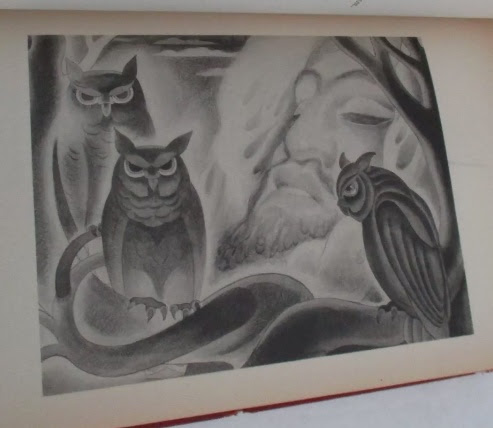
     After studying at Herron, Fouts returned to southern Indiana. In nearby Louisville, he studied under Alexander Van Leshout, a local illustrator and muralist. The Louisville Courier-Journal  published some of Fouts' illustrations. By 1925, he settled in New York City and studied at the Parsons School of Design on scholarship. He earned a living by illustrating for magazines and publishers. He soon fell in with a group of Greenwich Village poets, who hired him to illustrate their books. By this point in his career, he seems to have moved away from Impressionism and into Art Deco. His illustrations for a book of poetry by Ralph Cheyney titled Touch and Go (1926) reflected his new interest in that genre. He quickly garnered other jobs with other poets including Sara Owens and Carolyn Davies. The Greenwich Village Quill, a magazine for that neighborhood, hired him to illustrate a cover in 1927. 

     In the summer of 1927, the young man sailed for Europe to study in both Paris and Vienna. Upon his return to New York City, he resumed his job as an illustrator. The Louisville Courier-Journal noted that his drawings were "ultra modern" and compared his art to the English illustrator, Aubrey Beardsley. 

   Fouts continued to get jobs as an illustrator in the 1930s including one by Jacob Krup who attempted to translate some of the work by the great Russian poet, Alexander Pushkin in 1936. One reviewer for the Fort Worth Telegram brutally panned the book, but praised Fouts. He noted that the illustrations were, "most attractive and more poetic than the printed matter of the book." 

Ralph Cheyney, Touch and Go, 1926

Ralph Cheyney, Touch and Go, 1926

Daggers in a Star, 1930

Jacob Krup, Six Poems from the Russian, (1936)

Herbert E. Fouts, Interior Designer, 1937-1970

     Like many Americans, Herbert Fouts likely struggled during the Great Depression, but those days would soon be in his rear-view mirror as his career soared to new heights. When he attended John Herron, Fouts was in the first cohort of design majors. One has to wonder if the idea of becoming an interior designer first germinated at Herron or did he arrive with that idea in mind? Throughout the 1930s, he decorated the homes of friends. Soon, his reputation as a designer spread and he opened a shop on 62nd Street in New York City in 1937 called Decorative Interiors. For the next thirty years he decorated homes for the wealthy. Band leader, Guy Lombardo, hired him to paint a Chinese screen for his home. Air-conditioning magnate, Willis Carrier, employed him to decorate a drawing room for his mansion in Syracuse, New York. Samuel Blackford, who owned a chain of cafeterias, contracted him to decorate his house. Fouts usually worked with their wives. 

     He was considered a very unique designer because he personally created the wall paper and any textiles for the project. He even occasionally designed the furniture. He painted the murals or added one of his own paintings. By the 1940s, he had become enamored with a new movement originating in New York City called abstract impressionism. He also worked with hotels. He painted a mural in the Park Lane Hotel near Central Park in New York City and decorated a rustic inn located in Westport, Connecticut. 

Donna Frazier was a first cousin, once removed to Herbert Fouts. She received a letter from him in 1956. (courtesy of Janae Tsu)

     Despite his success, he never forgot about his Indiana roots. After the tragic and untimely death of his brother, the responsibility for tending to his aging parents fell to him. He frequently flew home especially after his father died in 1949. He eventually moved his elderly mother into his New York City apartment. He visited both Louisville and Indianapolis and each time he spoke to reporters about design. In 1955, he gifted "October Moon" to his old high school at New Washington. The abstract impressionist work hung in the school for many years but its whereabouts remains unknown at this time. 

"October Moon" can be seen behind the young woman from this 1960s yearbook photo from New Washington High School (photo courtesy of the Greater Clark School Corporation)

"October Moon" is visible behind Gary Weston and Joan Moberly in this 1960s yearbook photo from New Washington High School (photo courtesy of the Greater Clark School Corporation)

     The best description that I found of Herbert Fouts came from Miss Mary Sample, a beloved Clark County, Indiana teacher. At the age of 80 in 1957, she traveled to New York City to visit with the successful native son. In classic Miss Sample form, she penned a letter to the editor to the Charlestown Courier to document what she had uncovered. She noted that his apartment was "beautifully decorated," and that he lovingly referred to his wheel-chair bound mother, Viola Fouts, as "Aunt Vi." Miss Sample toured his shop and revealed that Eleanor Roosevelt lived two doors down. She commented on the beauty of his textiles. They visited museums. They watched the Rockettes at Radio City Music Hall, and saw "Show Boat" on stage. Fouts put Miss Sample up at the Ellerton, a hotel for single women. She could hardly contain herself on all of the great food that they ate. 

     Herbert Fouts died in 1970.  Much of his design work has likely been replaced, but he would have understood that fact. Sometimes, it doesn't take long to be forgotten. There are still so many unknowns about the talented artist and creator. But, here is what we do know...In the summer of 1921, a young man arrived in Irvington and painted a scene.

Herbert E. Fouts, a successful painter, illustrator, muralist, and designer, posed on a New York City rooftop with his dog, Coco. (photo courtesy of Janae Tsu) 

     I wish to thank Art and Design Historian, Kyle Kingen for his assistance with this post. Kyle uncovered many obscure details including the photo of Herbert Fouts at Herron. He even examined Herron Art School records to confirm that Fouts was a design major. I also wish to thank Janae Tsu and her family for the use of the photos. Surprisingly, the only images I could find of Mr. Fouts were grainy newspaper shots. I am grateful for her kindness. Jonathan May and Nate Koets of the Greater Clark School Corporation took time out of their busy schedules to search for "October Moon." While the painting may be gone, I appreciated their help. 

Sources:  Early Years (1902-1922):  1910 and 1920 Federal Census Records, Herron Art School Enrollment Records, 1921-1922; Bessie Hendricks, "Comment on Indiana Art at Herron Institute and the Taos Society of Artists' Exhibition," Indianapolis News, March 11, 1922, p. 9

New York and Europe (1922-1937): "Youth Attracts Attention Here as Rare Artist," Louisville Herald, April 20, 1924, p. 65; "Herbert Fouts to Study in Europe," Louisville Courier-Journal, July 3, 1927, p. 6; "Local Artist Sails for Paris," Jeffersonville Evening News (IN), July 5, 1927, p. 2;  Catherine E. Berry, "Around New York," Louisville Courier-Journal, September 25, 1927, p. 9;  "About Books," Los Angeles Evening Post, July 31, 1929, p. 12;  "Drawings by Herbert Fouts," Louisville Courier-Journal, July 28, 1929, p. 36;  "Concerning Herbert E. Fouts," Louisville Courier-Journal, November 10, 1929, p. 37; Evidence of Inept Translation," Fort Worth Telegram, May 2, 1937, p. 44; 

Interior Design Years (1937-1970): Rhea Talley, "First He Did Over His Own Flat," Louisville Courier-Journal, September 7, 1947, p. 25;  "Fouts' Painting Featured at Art Exhibit," Jeffersonville Evening News (IN), June 25, 1955, p. 10; Mary Sample, Letter to the Editor, Charlestown Courier (IN), September 19, 1957, p. 4; "Art Adds to the Living," Indianapolis News, October 2, 1967, p. 14;   


Wednesday, June 28, 2023

Local Artist and His Wife Moved to Maine

      Recently, while perusing some historic postcards in a local antique mall, I came across a brief note on stationery postmarked on May 26, 1948, from Eastport, Maine. The card depicted a beautiful lighthouse print by Robert Craig. I was drawn to the card because it was sent to an Irvington address. Soon, I fell into several rabbit holes while researching the people who sent the note and the "folks" who received it. I was even more intrigued when I realized that the card was actually sent by Robert and Winifred Craig. There were clues in the text as well.

Robert Craig sketched the East Quoddy Lighthouse located on Campobello Island, New Brunswick most likely from a boat. 

The Craigs mailed this note in 1948 to the Winslows at Maplewood Court in Irvington.


Both the Craigs and the Winslows lived in the Maplewood Apartments at 37 and 47 Johnson Avenue shown here in winter of 2017.


     Dear Folks,

     School is almost out and soon you will be starting Maineward. Wonderful new road from Portsmouth north to Portland done. Come to see us when you can--our latch string is always out.  Craigs

     Robert Craig taught at Arsenal Technical High School for many years. In fact, he headed the fine-arts department. Born in Spencer, Indiana, Mr. Craig later learned his craft at the Pratt Institute and at Columbia University. He also studied under William Forsyth. He and his wife Winifred moved to Irvington and lived at 37 South Johnson Avenue at Maplewood Court. When he retired from Arsenal Tech in 1941, the school named a gallery for him on the third floor of Stuart Hall. During his summer breaks the couple began to go to Maine where he found many beautiful scenes to paint. He preferred painting or sketching outdoors rather than in a studio. He often exhibited his works with other Irvington artists or in one-man shows. 

     In 1945, art critic and Irvington resident, Lucille Morehouse, featured Mr. Craig's one-man show at Lieber's Art Emporium in downtown Indianapolis in her column during the winter of 1945. He displayed many pieces for sale including 29 watercolors, six oils, two lithographs, and one etching. Most of the subjects were of Maine although he did include a few Indiana scenes. In 1947, he exhibited more work at Herron Art School including nine pieces of coastal Maine. Lucille Morehouse noted that besides Forsyth, he also studied under George Ennis in Maine. He reached his peak much later in life in 1964 when the Lynn Kottler Galleries in New York City featured his oil paintings and watercolors. A critic in the Manhattan East wrote of Mr. Craig that, "here is a realist who sees with clear vision and an unerring sense of color." 

Robert Craig was head of the Art Department at Arsenal Technical High School for many years. He is standing in the center of the bottom row. Flanking him were Thelma Adams and Ruth Kothe. In the middle row: Chelsea Stewart, Ione Hirsch, Sara Bard, Edmund Schildknecht; Top Row--Oakley Richey, Elizabeth Jasper, and John Simpson (Arsenal Canon, 1937)


     With that background, one can now begin to understand the text of the note. Harold and Harriett (Hattie) Winslow received the letter from the Craigs just as school neared an end in Indianapolis. Mr. Winslow taught music at both Manual Training High School and at Arsenal Technical High School, which is where Mr. Craig and Mr. Winslow might have met. Mrs. Winslow taught history at both Shortridge and Howe High Schools. They also lived at Maplewood Court in Irvington. The Craigs lived at #16 while the Winslows resided at #7. Mr. Craig had already retired by 1948, but the Winslows were wrapping up the school year.  School is almost out.  

     The Winslows, like the Craigs, had no children and traveled extensively on summer breaks. They had been to Europe and the Middle East. They also drove across the United States so it was not surprising to learn that one of those sojourns might be to Maine to visit their friends, the Craigs, who had made Eastport their permanent home by 1945. For Mr. Winslow it also might have been like coming home since he had been born in Maine. 

Harriett or Hattie Winslow taught Social Studies at Howe High School for many years. She can be seen at the far right in profile. Others in the image include (l to r): Lewis Gilroy, Wade Fuller, Russell Curtis, Dorthea Kirk, Hartwell Kayler, and Mary Diaz (Hilltopper,  1946)

Harold Winslow taught music for many years for the Indianapolis Public Schools and with many church choirs. (Ellen Manual, Find-a-Grave)

     Two years after the Craigs mailed their note to the Winslows of Maplewood Court, Mr. Winslow died in 1950. Did Mrs. Winslow ever see her friends again? We do not know as of this writing. Both Mrs. Winslow and Mrs. Craig died in 1968. Robert Craig died in 1971 at the age of 87. 

     Before purchasing the simple note on the lovely stationery, I had never heard of these interesting and talented Irvington couples. Come see us when you can--the latch string is always out. 

The subject of Mr. Craig's wonderful sketch still stands on Campobello Island, New Brunswick (Britannica) 

Sources:  Craigs--Lucille Morehouse, "Water Colors Feature One-Man Show," Indianapolis Star, February 25, 1945, 21; Lucille Morehouse, "Art of Mattison and Craig Exhibited at Herron Museum," Indianapolis Star, March 2, 1947, 70; "Eastport Artist Has 1-Man Show," Bangor Daily News, January 6, 1964, 26; "Robert Craig, Noted Painter Dies in Eastport," Bangor Daily News, May 11, 1971, 15; Federal Census and City Directories; Winslows--Obituary for Harold Winslow, Indianapolis Star, December 26, 1950, 16; Obituary for Harriet Winslow, Indianapolis News, September 18, 1968, 44. 
     Thank you to Paula Schmidt at the Irvington Historical Society.


Thursday, December 16, 2021

Brown's Hill Was a Popular Sledding Site

     Newspaper publisher Hilton U. Brown and his wife Jennie Hannah Brown purchased five acres of land on the southwest corner of East Washington Street and Emerson Avenue in 1891 for $3500. Mr. Brown first heard about the opportunity from an Irvington realtor named Charles W. Brouse. The property came complete with a pioneer farmhouse previously owned by the Weesner and White families. Mr. Brown demolished that residence but used the hewn walnut and oak timbers for a barn that an Englishman named Hector Fuller constructed on the site. The Browns erected a large home on the site using boulders from the nearby Pleasant Run stream. The couple raised their ten children on the expansive grounds complete with an orchard and an ice house built into the hill near the stream. 
     Soon after the home was finished, the Browns allowed local children to sled down the hill. Mr. Brown did have rules for the children. They were not to quarrel nor to throw snowballs. Over the decades thousands of local children flocked to the site. Jean Brown Wagoner, a daughter of Mr. and Mrs. Brown and an author, noted in one of her newspaper columns that, "It made a fellow suck in his breath and then let out a yell as he started down." With the arrival of spring, the Browns frequently had to reseed the hill to keep it from being a muddy mess. 
    Over time, the Brown children moved out. Mrs. Brown died first, but Mr. Brown lived on until the age of 99. He passed away on September 20, 1958. His family sold the property to the Washington and Emerson Corporation shortly after his death. Several people in the neighborhood wondered what would become of the grand old place. Grace Booth Bay, in an Indianapolis News newspaper article, called for the home to be a senior home. She had grown up near the residence and remembered the boulders being put into place. Others hoped it would be turned into a museum. Some thought it might become a funeral home. On May 15, 1959, vandals broke into the empty house and broke windows, tore off a fireplace mantel, and littered the house with material they snatched from desk drawers. 
     Without public input, the community likely reacted with shock on June 24, 1959, as a crew began to demolish the beautiful home. The hill, however, remained for another ten years. Sledders continued to fly down the slope. Then, despite public opposition, including from Mayor Richard Lugar, the Indianapolis Board of Zoning Appeals (Division 2) allowed Howard Fieber, the President of Washington and Emerson Corporation, to flatten Brown's Hill for a filling station.  Today, the laughter and thrills from that incline linger on in memories and in photographs like those below. 

The Widner brothers, who lived on Farrington Avenue, enjoyed a slide down Brown's Hill c1962. Across the street, you can see the Forsyth family home at 15 South Emerson Avenue. William Forsyth was a renown-impressionistic artist. He purchased the house in 1908 from the Parker family, who predated the foundation of Irvington. Developers razed that home in 1966 or 1967 for a filling station. You can also see the double located at 25-27 South Emerson Avenue and the cottage next door at 29 South Emerson Avenue. (photo courtesy of Estate of Frank N. Widner)

This view of Brown's Hill was snapped in 1962 from the Forsyth property at 15 South Emerson Avenue. The Brown mansion had already been torn down, but the hill still existed on the southwest corner of East Washington Street and Emerson Avenue. It was later flattened for a filling station. (photo courtesy of Susan Forsyth Selby Sklar Collection at the Irvington Historical Society)

Hilton U. and Jennie Hannah Brown built their stunning home at 5087 East Washington Street on a hill in 1892 at the southwest corner of Washington and Emerson Avenue. It was demolished in 1959 and the hill was removed in 1969 for a filling station. This photo shows the home in a publication celebrating the fortieth anniversary of the neighborhood in 1912. (image courtesy of the Irvington Historical Society)

Robert Selby, the son-in-law of William and Alice Forsyth, painted this image of Brown's Hill. You can also see the Brown home in the painting. (photo courtesy of Irvington Historical Society) 


     I would like to thank members of the Widner family and Susan Forsyth Selby Sklar for their incredible photographs and Paula Schmidt, the archivist at the Irvington Historical Society. 

Sources:  Information about the construction of the Brown home and the rules for sledding on Brown's Hill--Hilton U. Brown, A Book of Memories, Old Swimmin' Hole Press, Greenfield, IN, pp 278-288; Jean Brown Wagoner, "Downhill All the Way," Indianapolis News, December 23, 1975, 13; Last years of the Brown home and hill--"Hilton U. Brown Home Sold, Indianapolis News, March 31, 1959, 15; Wayne Guthrie, "When Mary's Marry, It's a Grand Mix-up," Indianapolis News, April 15, 1959, 13; "Hilton U. Brown Home Entered by Vandals," Indianapolis Star, May 16, 1959, 4; "Landmark Passes," Indianapolis News, June 24, 1959, 23; Art Harris, "Brown's Snowy Hill May Lose its Slide," Indianapolis News, October 12, 1968, 1;  Wayne Guthrie, "Efforts to Save the Hill Laudable," Indianapolis News, February 6, 1969; "Saving Brown's Hill," Indianapolis News, April 21, 1969, 6; Letter to Editor, Mary Elizabeth Ramier, "Disenfranchised," Indianapolis News, June 9, 1969, 9; Information William Forsyth family--Rachel Berenson Perry, William J. Forsyth: The Life and Work of an Indiana Artist, Bloomington and Indianapolis: Indiana University Press, 2014. 

Monday, June 18, 2012

Clifton Wheeler--Noted Artist, Muralist, Teacher

For the past several days, we have been celebrating the centennial anniversary of 5317 Lowell Avenue.  Clifton and Hilah Drake Wheeler built their dream home in 1912.  For decades the couple, created inspiring art pieces in the gallery room designed into the plan of the house.  Newspaper accounts from the early twentieth century describe the room bulging with art from floor to ceiling.

Spring by Clifton Wheeler


Clifton Wheeler (1883-1953) grew up in Mooresville, Indiana.  His father had planned for him to take over the family flour mill business, but he had other dreams.  An inspirational aunt invited him to live with her in Indianapolis on the weekends during his teen years so that he could take classes from noted artist and Irvingtonian, William Forsyth.  The young man generally sat for lessons on Saturdays.  Eventually, he made his way to New York City to study under Robert Henri and Kenneth Hayes Miller, and finally to Europe where he painted under the direction of William Merritt Chase.  While in Europe, he observed, critiqued, and recreated the classics.  He also developed his own style.  In 1910, William Merritt Chase gave young Wheeler the award for being his best student.  In that same year, while touring Europe, he met fellow art student Hilah Drake.  He would earn his second prize when she said yes to his proposal of marriage.

Mural at Shortridge High School, Indianapolis, c.1914

Clifton Wheeler murals restored in 2006 at School Number 54 (3150 East 10th, Indianapolis), 1921


Once settled in Indiana, the couple moved to Irvington in 1912 to be near other artists and to enjoy the beauty of Pleasant Run stream and Ellenberger Woods.  Many of Mr. Wheeler's works feature Indiana scenes.  He was frequently called upon to paint murals around the state.  Several of his works are still in existence including those in several schools, universities, hospitals, and at the Circle Theater.

He earned a living by teaching in his private studio on Lowell Avenue; at the John Herron Art Institute; and at Shortridge High School.  The Wheelers traveled the country for inspiration and spent time painting in the Catskills and Rockies.  Mr. Wheeler exhibited all over the state and country as well.  He was renown during his lifetime.  Hundreds of his paintings and sketches remain in private and public collections all over the United States.

Young Leaves by Clifton Wheeler

Winter Woodland by Clifton Wheeler

Up Fall Creek by Clifton Wheeler


It appears that the Wheelers remained close throughout their lifetime.  They had one child named Hilah Mary.  Mr. Wheeler continued to paint until his cancer would not allow him to do so.  He died at the age of 69 in 1953.  His companion, wife, and fellow artist, Hilah Drake Wheeler, outlived him by several years.  She passed away at the age of 92 in 1970.

Clifton and Hilah Drake Wheeler Home, May, 1913


One hundred years later, the home has been proudly restored.  The Wheelers would be happy to know that their shady lot and stuccoed home looks much as it did in 1912.  To learn more about the Wheelers click on the link below.   The historic images are courtesy of Michele and Bruce Oertel.

Friday, June 15, 2012

The Wheeler Home Celebrates 100 Years!

One hundred years ago this summer, builders broke ground for a beautiful home at 5317 Lowell Avenue in 1912.   George E. Hoagland (1872-1959) designed the house for Clifton and Hilah Drake Wheeler, both renown local artists.  The Wheelers actually purchased the large lot from Fred O. Ritter on July 29, 1911.  The couple, both in their late twenties in 1912, just welcomed a child into this world.  Mr. Wheeler (1883-1953) at the time taught at the John Herron Institute of Art under the direction of another Irvingtonian, William Forsyth (15 South Emerson Avenue.)

Both Mr. and Mrs. Wheeler studied in Europe under some of the most eminent artists of their day.  They actually met and fell in love in Europe while taking a class instructed by William Merritt Chase.  Mrs. Wheeler (1878-1970) came from the prominent Drake family, who were also artists and art critics living in New York City.  Mr. Wheeler worried about his new wife's reaction of moving to Indiana, but the couple sited their new home on a hill overlooking nearby Pleasant Run stream and Ellenberger Woods.  Both used the bucolic settings for their art.  The following photo, taken in May of 1913,  is the oldest known of the dwelling.

Wheeler Home, May 1913

Architectural plans for the home--May, 1912


In early September 1913, Lucille Morehouse, a local art critic for the Indianapolis Star, visited the Wheeler home and spent time in the gallery room.  The Wheelers asked their architect to design a large space to serve as a studio and classroom.  Mr. Hoagland placed a tall door on the westside of the house so that large canvases could be easily moved in or out.  He also placed four tall windows facing Lowell Avenue so that the artists could receive light from the north.   Ms. Morehouse wrote of the gallery on September 7 (page 36):

     One could spend a week there taking barely enough time to eat and sleep and still not be able to see everything in it.  

Side gallery door


     She also reported  that there are color studies and paintings large and small.  The journalist noted and gushed about the large collection of Japanese prints, the small sketchbooks filled with ideas, and the plethora of paintbrushes and tubes of oils.  Ms. Morehouse seemed completely enchanted by not only the studio, but also of Mr. Wheeler.  He is not yet 30 years old!  Mrs. Wheeler gets little mention in the lengthy biopic.

     The Wheelers would have no trouble recognizing their former home.  The house has been lovingly and superbly restored to its former grandeur.  The historic photos, architectural plans, and historical information are courtesy of Bruce and Michele Oertel.  More information will be forthcoming on this interesting dwelling and of the families who have called it home.  Stay tuned!

Wheeler Home in Summer of 2012


Sunday, February 13, 2011

William Forsyth--Irvington artist


William Forsyth (1854-1935) was one of Irvington's most talented residents. A prominent local artist, Forsyth and his family dwelled at 15 South Emerson Avenue in a rambling Queen Anne style home. He won numerous prizes over the years for his impressionistic work and he taught at the Herron Art Institute for twenty-seven years. The top photo captures Forsyth in his younger years perhaps after he returned after having studied in Munich, Germany. In the bottom photo, Evelyn Forsyth, a daughter, poses with several of her friends in 1925. You can see a similar photo in a previous post. The girls are standing along Emerson Avenue in front of the Forsyth Home. (demolished) The girls featured are: bottom row--Margaret Cook, Margaret Elrod; middle row--Dotty Canfield, Evelyn Forsyth; top row--Isabelle Layman. This image is courtesy of Isabelle Layman Troyer.

Monday, November 8, 2010

Girlfriends at Forsyth Home


Artist and director of the Herron Art School, William Forsyth (1854-1935), lived at 15 South Emerson Avenue. He maintained a studio at his home at the southeast corner of East Washington Street and South Emerson Avenue. Constance Forsyth, a daughter, went on to become a prominent artist as well. Shown here are a group of Irvington girls gathered in front of the Forsyth home in 1925. They are from left to right: Margaret Cook, Margaret Elrod, Dotty Canfield, Evelyn Forsyth, and Isabelle Layman. This photo is courtesy of Isabelle Layman. The home was demolished in the mid-twentieth century for a gas station.