Irvington street names have a complicated history. Many of the avenues have been called by numerous names. In this second part of the series, you will note that some of the meandering paths in the neighborhood were named after local farm families, famous American writers, and investors. We do not know the origin of all of the names, but thanks to the hard work of a local historian, Larry Muncie, we do have precise dates for their naming. Feel free to contact us if you have more information!
Edmondson Avenue: Little is known about the origin of this street. It first appears in the Indianapolis City Directory in 1928. When Warren Park incorporated in the late 1920s, Edmondson Avenue became an eastern boundary for that neighborhood. More research is needed on this street.
Ellenberger Parkway: In the mid-1920s, city officials began construction on Ellenberger Parkway; however, they did not pave nor link it with Tenth Street, which upset a few local residents. (Indianapolis Star, May 19. 1925) With the availability of federal funds during the Great Depression and working with the WPA, the parkway was completed by the mid-1930s. (Indianapolis Star, December 20, 1935, 18) The avenue was named for the prominent Ellenberger family who also sold the land for the nearby park.
 |
| Members of the Ellenberger family gathered for a reunion at the family home at 5602 East 10th Street in 1914. Both a park and a nearby street are named for the Ellenbergers. |
Elizabeth Street: Although the name of the street is unknown at this time, we do know that many of the homes built along that stretch were developed by the Vogel Company in Wagner's Addition in 1941. The investors invited the public to tour twelve new residences on September 7, 1941. Two months later, the United States entered World War II.
 |
| Indianapolis Star, September 7, 1941, 31 |
Emerson Avenue: Now a busy thoroughfare, Emerson Avenue began as a quiet street called National Avenue until 1898. The Irvington Town Board changed the name to Emerson after the essayist Ralph Waldo Emerson (1802-1882). Mr. Emerson would have likely been pleased that two of his good friends, George Bancroft and Nathaniel Hawthorne, also had streets named for them in the new college town, but he died before the renaming.
 |
| Ralph Waldo Emerson (1802-1882) never knew that the little town of Irvington named a street for him. (public domain) |
 |
| William Hayden English, a capitalist and politician, built an opera house and hotel on Monument Circle in Indianapolis. (public domain) |
Farrington Avenue: After World War II, developers scrambled to build houses for the returning veterans who were starting their families. With assistance from the FHA and the GI Bill, families could apply for loans and purchase brand new two or three-bedroom residences along Farrington Avenue in the late 1940s and early 1950s. E. G. Bauer & Son built many of the houses along the new street.
Fletcher Avenue: While Fletcher Avenue is most often associated with a near south side Indianapolis neighborhood, the street has a short stretch through southwestern Irvington. The street is named after Calvin Fletcher, an early resident of Indianapolis who went on to become a banker, farmer, and a politician.
 |
| Calvin Fletcher (1796-1866) was an early leader in Indianapolis. His multi-volume diary captured life in the young capital and was later published by the Indiana Historical Society (public domain) |
Good Avenue: Walter and Ada Good joined Jacob Julian, Sylvester Johnson, and Lycurgus Rawles in platting most of southern Irvington in January of 1873. As a thank you for his investment, a small street north of Dewey (then East) and south of Bonna (then Railroad) was named Good Avenue. Later in 1903, the city of Indianapolis renamed South Street in between University Avenue and Rawles as Good Avenue as well.
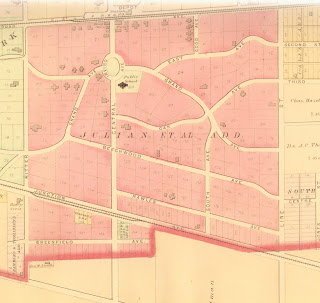
Graham Avenue: While it is unconfirmed at this moment, it is believed that Graham Avenue was named for William Henry Harrison Graham, a local resident and investor. Mr. Graham and his wife Ellen built a beautiful home on University Avenue. In 1897, he became the American consul at Winnipeg, Canada. He also went into business with Charles Brouse, who helped to develop several sections of Irvington. His widow, Ellen Graham, entered the history books when she sold their beautiful home to D.C. Stephenson, the Grand Dragon of the KKK in Indiana and the Midwest.
Grand Avenue: The street used to be longer as it stretched from Audubon Road to Brookville Road, but the town board realized that it was a confusing route so the section from Audubon Road to Ritter Avenue was changed to Burgess Avenue. Only a small section of the street remains today. The name appears to be generic.
Greenfield Avenue: Perhaps when Jacob Julian and Sylvester Johnson named a small stretch as Greenfield Avenue, they had hoped that one day the path might connect to the nearby Hancock County city. Both men were from Centerville, Indiana and would have passed through Greenfield along the National Road on their way to and from Irvington. Greenfield Avenue, however, never managed to make it out Irvington.
Hawthorne Lane: In 1898, the Irvington Town Board chose to name both Commercial and Blount Streets after Nathaniel Hawthorne, the popular writer. Mr. Hawthorne died before the founding of the town, but his works like Scarlet Letter and Twice Told Tales would have rested on many bookshelves throughout the neighborhood.
 |
| Nathaniel Hawthorne (1804-1864) was much admired by many in Irvington. |
Hibben Avenue: In December of 1913, the Irvington Improvement Association announced the exciting news that lots on a new street called Hibben Avenue would now be for sale. (Indianapolis Star, December 4, 1913, 4) The small street stretched from Downey to Ritter Avenue. The Association named the street for the wealthy Hibben family who dwelled in a villa at 5433 University Avenue. Thomas Hibben earned his fortune in the wholesale trade. His children were equally as talented. Paxton Hibben, a brilliant student, went on to become an author and a diplomat. Thomas Hibben, Jr. was an architect who designed buildings on Butler's Fairview campus while James Hibben taught chemistry at Princeton University. His daughter, Helene Hibben, was a prominent sculptor who opened an early kindergarten where the children spoke French. Her sister Hazen assisted her. The house where they lived on University was the previous home to the Downey and Thompson families; thus, three street names came from one house: Downey, Bonna, and Hibben.
 |
| Courtesy of Hibben family descendants via Ancestry.com |
 |
| Courtesy of the Hibben family descendants via Ancestry.com |
 |
| Courtesy of Hibben family descendants via Ancestry.com |
Hill Street: It appears that the small street located in Ritter's Lowell Subdivision was laid out in 1911. Curbs and sidewalks were not added until 1913. (Indianapolis Star, October 4, 1913, 3) Since there is a slight hill on the avenue, it appears that the name is geographical in nature.
Howe Drive: Named for the nearby high school and a former president of Butler University, the narrow street has served as a conduit for thousands of teenagers over the decades. The residents of Irvington had long wanted a high school so when they finally received one in 1938 they decided to name it after Thomas Carr Howe (1867-1934). Mr. Howe served Butler University as a professor, dean, and as president. His untimely death, after being struck by an auto, shocked the community.
 |
| Thomas Carr Howe, a former president of Butler University (public domain) |
Sources: Larry Muncie, Three Windows on Irvington History, 1989; "Changes in Street Names," Indianapolis Journal, January 18, 1903, 3; "Irvington's New Names," Indianapolis News, November 3, 1898, 7; "Would Change Names of 149 Streets in City," Indianapolis News, December 18, 1916, 8; Interviews with Steve Barnett and Larry Muncie, 2020.


