Showing posts with label Kile Oak. Show all posts

Wednesday, April 10, 2019

An Oak Avenue Home--1911

Dawson C. and Ida Belle Kile moved into their brand new home at 5921 Oak Avenue in 1911. Mr. Kile, who was 34 years old at the time, had lived part of his life in a house with his parents, Oliver and Sarah Kile, under the giant oak tree (now called the Kile Oak) on Beechwood Avenue. The younger couple were able to purchase the triangular lots on Oak Avenue because they belonged to the Frys, who were related to the Kiles. The house, fashioned in the American Four Square design, was a very popular style in the U.S. in 1911.  On the back of the photo, a realtor or family member described the interior of the home. Downstairs, the Kiles could enjoy a brick fireplace in the living the room with a coal grate.  The first floor also included a library, a dining room, the kitchen, and a pantry. The lower level had beautiful hardwood floors. Four bedrooms with "large" closets and a bathroom occupied the second floor. The builder attached city water and included a coal furnace that pumped warm air into the home on cold days.

The price of the home in 1911 or perhaps in 1913 was $5000 although the seller was willing to go down to $4500.  The Kiles moved from Irvington in 1913 so it is possible that this photo was used to try to sell the house at that time. It must have worked as the Evans family moved in and remained until 1918.

Dawson C. Kile worked as a railway mail clerk for the Pennsylvania Railroad for 37 years. He serviced various parts of the line from Pittsburg to St. Louis during his long tenure with the company. The couple had one biological son who survived into adulthood, John Albert Kile,  but he died at age 20 from malaria after they had moved to Ohio. The couple also adopted many foster children over the years. The Kiles left Irvington for Zanesville, Ohio after only living in this home for two years. The beautiful photo of their home shows the house before some of the later alterations occurred including a sizable rear addition. Mr. Kile's sister, Mae, continued to reside in the family home two blocks south on Beechwood until the early 1970s.  Ida Belle Kile passed away in 1948 while Dawson Kile lived until 1967.


Dawson and Ida Kile moved into this American Four Square at 5921 Oak Avenue in 1911. By 1913, they had moved to Zanesville, Ohio. Other families to reside here over the years included the Evans, Whiteman, Shirey, Kramer, Fee, Collins,  Pedigo, and Thomas families. (Photo courtesy of the Irvington Historical Society)

Most likely in 1913 when the Kiles were putting the home on the market, someone wrote all of these details about the residence on the back of the photograph.  (Photo courtesy of the Irvington Historical Society)
I wish to thank Paula Schmidt of the Irvington Historical Society for loaning me this wonderful image. 

Sources:  Information about the purchase of the lots came from the Indianapolis Star, May 23, 1905 and the Indianapolis News, March 19, 1907, 8) Other useful information came from the obituaries of Dawson, Ida Belle, and John Albert Kile.

Saturday, October 13, 2018

Patareka Korbly Crawford--An Irvington Artist

Several years ago, I acquired a beautiful painting of the Kile Oak and home by Patareka Korbly. The magnificent tree still stands although the Kile home is long gone. I had wondered about the artist for years. Who was she? I knew from cursory research that she dwelled at 425 North Audubon Road and that she had been a member of the Hoosier Salon, but I knew little else. Then, through a mutual friend, I was able to contact Pat Korbly Dwyer and Carole Korbly Scott, the daughter and niece of the talented artist.

The Kile Oak and Kile Home by Patareka Korbly (undated) hangs in the author's dining room

From these kind ladies, I began to learn the story of Patareka Korbly Crawford. Born to Henry and Hazel Elfner, Patareka was one of three daughters. She spent part of her childhood at 5845 East Michigan Street. Her father, Henry, was an engineer for the International Harvester plant on Brookville Road just south of Irvington. He actually patented a "black-out" light that companies could use during World War II. Hazel stayed home and raised the kids.

Patareka Elfner attended Howe High School. This shot was likely taken in 1941 or 1942. (photo courtesy of Pat Dwyer)

Patareka attended Howe High School and was a member of a sorority referred to as the "Subdebs." At some point, the seventeen-year-old met Bernard Korbly, a newly-practicing attorney. He was 23 years old. They surprised their friends and family by getting married at city hall by Mayor Reginald Sullivan on July 31, 1942. The couple immediately set up housekeeping in the Korbly home at 425 North Audubon Road. They would have two children, Patareka (Pat) and Bernard, Jr. (Bernie).

While she had no formal training other than a sculpture course in St. Louis, Patareka was drawn to her creative side. She loved to decorate; she held elegant dinner parties; and eventually turned to painting. Her favorite subjects included nature, portraits, birds, flowers, boats, and everyday life. In the early years, she painted with oils. Later, she worked almost exclusively with water colors. She would also paint on any surface. Today, her work can be found on canvasses, T-shirts, milk jugs, birdhouses, and even the backs of historic clocks. She loved to go "junking" with friends and family. She would take ordinary items found in thrift shops and turn these pieces into works of art. Later, she jumped in an orange van and drove around the country to paint in plein air settings. Her daughter, Pat, reports that she would sell her art at various festivals. She painted covered bridges, waterfalls, and farm scenes from her portable easel.

Patareka, Pat, and Bernard Korbly posed for this photo most likely in 1947 (courtesy of Pat Dwyer)

Patareka Korbly c1945 (courtesy of Pat Dwyer)

Patareka Korbly frequently painted in the plein air. In these two photographs, you can see her with her easel near a covered bridge in Parke County, Indiana (courtesy of Pat Dwyer)

"The Lighthouse" by Patareka Korbly (courtesy of Pat Dwyer)

Patareka Korbly painted this winter scene on the back of a clock. (photo courtesy of Chris Dwyer)

Market scene by Patareka Korbly (courtesy of Chris Dwyer)

Both the painting and the lamp shade were painted by Patareka Korbly. The subject of the painting was of the author herself as a young girl. (courtesy of Pat Dwyer)

The Korblys later divorced and both remarried. Patareka Crawford, her name after 1980, eventually moved to Florida where she continued to paint for the remainder of her life. She passed away in 2003. Her work still hangs in homes throughout the Midwest and in Florida. The beautiful scene that hangs in my dining room has more meaning now that I know story of this creative woman. I envision her orange van parked along Beechwood Avenue on a sunny day while she stood on the Kile property painting the majestic beauty that still shades a part of southern Irvington.

Artist, Patareka Elfner Korbly Crawford, painting outside. (photo courtesy of Pat Dwyer)


Wednesday, August 28, 2013

Lost Irvington--The Kile Home

Most Irvingtonians of the early twenty-first century are familiar with the Kile Oak, a grand tree now protected along Beechwood Avenue.  For most of the twentieth century, a member of the Kile family literally dwelled under the giant spans of the majestic tree. Reverend Oliver and Sarah Kile moved into their new Irvington home at 5939 Beechwood Avenue in 1901 along with their eight children.  Historian Paul Diebold notes in his book, Greater Irvington, that the family relocated to the community from Ohio for better educational opportunities for their large family.  Reverend Kile died in 1924 and his funeral was held under the tree.  Many of his Civil War veteran friends attended the memorial service.

Mae Kile, a daughter to the elder Kiles, continued to dwell in the home until the 1970s. Miss Kile was fiercely protective of the ancient tree. She allowed school children from IPS #85 to walk onto her property with their teachers and collect acorns and leaves. Larry Muncie, a nearby neighbor remembered that they then walked back to the school and wrote poems and stories about the tree.  While Miss Kile allowed supervised visits of the property, children who wandered unaccompanied onto the property faced her wrath and threats of phone calls to the police.

Chuck McCleery, the next door neighbor to Miss Kile, recalled that she seldom allowed people into the home and that the tree had actually begun to grow into the house.  She was warned to cut back the branches but she refused.  Instead, she had a handyman place rubber tires under the branches so that they would not do further damage into her already compromised roof.

Still living on her own in her early 90s, the home and the property became too much for Miss Kile to manage. With her place falling into ruin and her health beginning to fail, she moved to California to stay with relatives.  Larry Muncie reports that even while she was in California, she called long distance to her former neighbors along Beechwood Avenue to check on the tree.  She had tried unsuccessfully to get the city to buy the lot and turn the area into a park.  Upon her death, Irvington Landmarks and the Irvington Historical Society purchased the land with a grant to save the tree for as long as it remains on this planet.  Miss Kile's Victorian home was demolished in the 1970s and today wildflowers and native plants grow on the site of the Kile home.

In these historic images, provided by Chuck McCleery, you can see the Kile home shortly before its demolition in the early1970s. Once a beautiful home, now a sad wreck, the structure still had many of its Queen Anne elements including the wrap-around porch.  In the next photo, likely taken in 1967, the Kile home appears behind the construction of a small ranch home at 5945 Beechwood Avenue.  In the third photo, likely taken in 1977, the lot has been cleared and the Oak towers above the newer brick home.  The final photo shows the site of the Kile home in 2013.

The Kile home at 5939 Beechwood Avenue c1973. Shadows of the giant oak formed patterns on the lawn.

The Kile home at 5939 Beechwood Avenue looms above the newly built-McCleery home at 5945 Beechwood. You can also see the Kile Oak in this photo taken c1967.

The Kile Oak, a Burr Oak, c.1977

Wild flowers grow on the site of the former Kile Home in 2013.
Thanks to both Chuck McCleery and Larry Muncie for their contributions to this post.

Thursday, August 15, 2013

Mid-Century Photos Show Beechwood Avenue Home

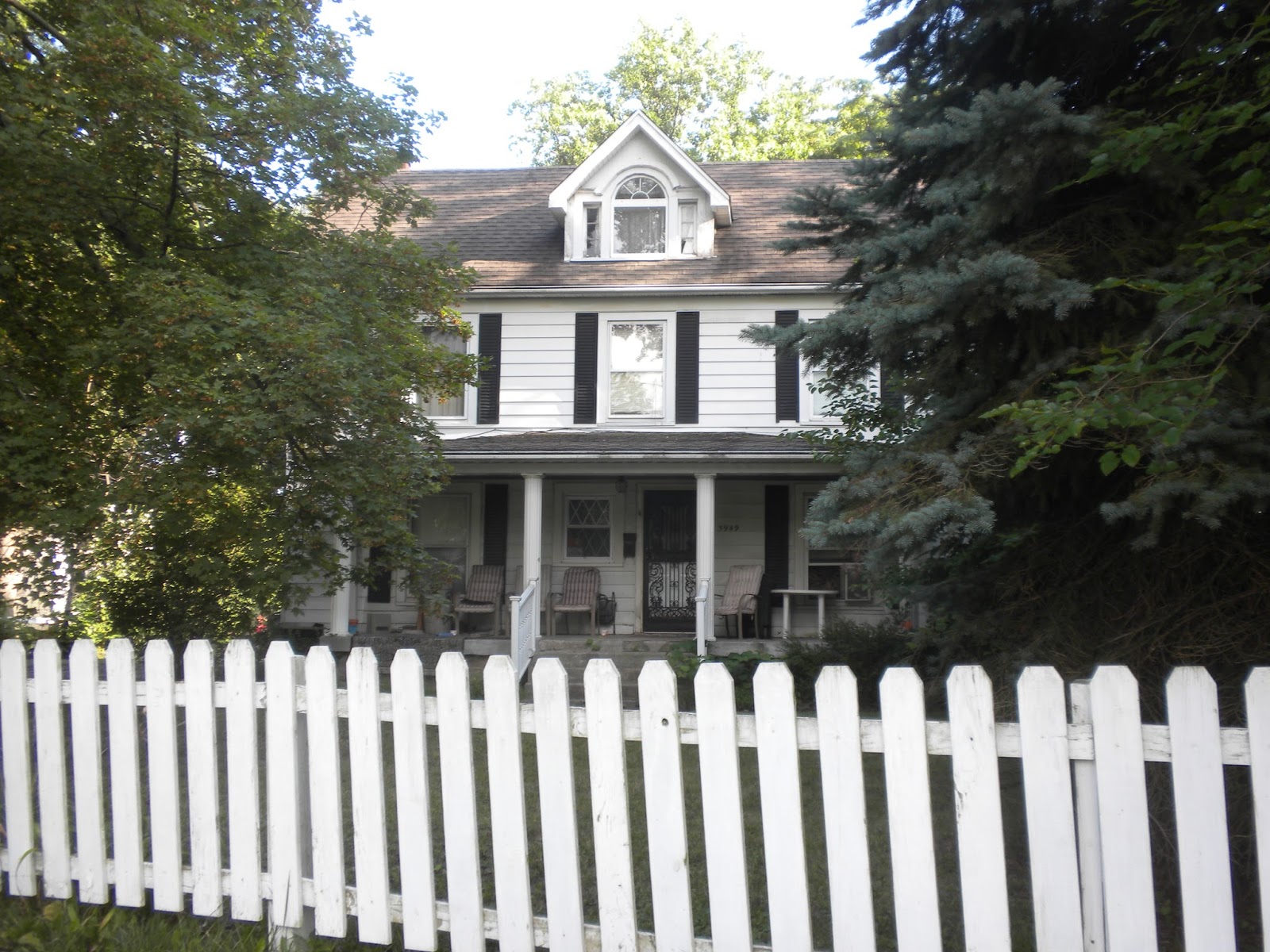
The early twentieth-century home at 5949 Beechwood Avenue has been occupied by many Irvington families over the decades.  One of the earliest families to dwell in the large two-story home was Elmer E. and Alice Holloway, who set up housekeeping here in 1907.  Mr. Holloway was a piano tuner by trade, but may have been connected with the Holloway family who developed land along Arlington, Beechwood, Webster, and Catherwood Avenues.  Lots sold in that area in 1910 were built in "Holloway's Addition."  Mrs. Holloway stayed home and raised their two children Edward and Dorothy.

Further research is needed on the Holloways and other families who set up housekeeping here.  By 1957, the McCleery family moved in and would remain for ten years before building a brick ranch home next door at 5945 Beechwood Avenue.  After living at 317 South Arlington Avenue since the 1940s,  Lee and Jane McCleery decided that it was time to move from that busy street.  Mr. McCleery worked for the International Harvester Corporation.  Many households along Beechwood hosted Harvester employees in the mid-twentieth century.

In the winter of 1957, someone from the McCleery family documented their property on Beechwood after a snowstorm.  These beautiful photos show the home on a large wooded lot.  Many of the trees still stand in 2013.  The third photo, reveals the home on a spring day c1960.  Mr. McCleery would later partition the lot so that he and his wife could live in a brand new one-story home next door.  The final photo shows the home in the summer of 2013.  

Beautiful snowfall:  5949 Beechwood Avenue in the winter of 1957

The McCleery home at 5949 Beechwood Avenue in 1957.  Beyond the home you can see a glimpse of the Kile home, which used to stand under the Kile Oak.

The McCleery home at 5949 c1960

5949 Beechwood Avenue in 2013
The historic images are courtesy of Chuck McCleery. 

Sunday, September 18, 2011

The Kile Oak as Art


Irvington is extraordinarily proud of the Kile Oak, one of the oldest trees in the state of Indiana. Located on Beechwood Avenue near Arlington Avenue, the majestic white oak has towered over the area for nearly 400 years. Irvington has only been part of that story for about 140 years. I have often wondered about the native peoples who might have seen it prior to the arrival of the nineteenth-century white settlers. Who were they? Did they notice it? Perhaps the tree was part of a forest.

Named for an Irvington family, the Kiles lived in a nineteenth-century home just east of the tree at 5939 Beechwood Avenue. The home is no longer standing. The Reverend Oliver Kile was a Civil War veteran and he requested that his funeral service be conducted under the beautiful tree. In May of 1924, dozens of members of the Grand Army of the Republic (GAR), came from all over the state to assist with his funeral. Most of the soldiers who attended his funeral were themselves elderly Civil War veterans. Mae L. and Lois Kile also dwelled in the large home next to the tree.

Today the home is gone, but the lot and the tree are protected by the Irvington Landmarks Foundation. The site has been declared a natural habitat so nature has begun to reclaim parts of the parcel. Several artists over the years have been inspired by the towering tree.

In the first image, Frederick Polley (1875-1957) sketched the tree for the Indianapolis Star on August 1, 1926 (p.8). He worked in the Graphic Arts Department for Arsenal Technical High School from 1917 to 1941. Mr. Polley, who also happened to dwell at 371 South Emerson Avenue, sketched Indiana landmarks and his work and stories appeared in the Indianapolis Star from 1924 to 1947. This talented artist deserves more recognition. In his sketch, you can also see the Kile Home.

In the second work, Patareka Korbly has painted a beautiful oil color of the Kile home and tree. Little is know of this artist so any help from the general public would be most appreciated. The Korbly family dwelled at 425 N. Audubon Road and at 5814 East Pleasant Run Parkway North Drive in the 1940s and 1950s.

Contemporary artist Wayne Kimmell, who sadly just passed away, painted a wonderful rendition of the tree shortly before his untimely death.

The photos show the tree as it appears in September of 2011.