Saturday, March 18, 2023

The Young of Young Avenue

      They gathered under a beautiful shade tree at the intersection of South Drexel and Young Avenues each race-day weekend for the unofficial Christian Park Heights bicycle race. Any kid who had a bike could participate. You might be aware that Johnnie Parsons won the Indianapolis 500 in 1950, but did you know who crossed the finish line on South Drexel in that year? The boys awaited the official start from Wayne Bruness. Then, they sped south on Drexel to Brookville Road.  They hoped that no oncoming car would slow them down. They raced east on Brookville Road and north on Bosart Avenue. In their imaginations they could hear the crowds cheering.  They skidded around the corner onto Young Avenue, a gently sloping down-hill street. And then, the moment of truth arrived. Ron Huggler, of 4613 Young Avenue, passed under the shade tree before the others. Another race was in the history books.

Bike race in May, 1950: Wayne Bruness held the flag. The racers left to right: Johnnie Robeson, Dale May, Bob Butler, and Ron Huggler. Their starting and ending line was on South Drexel Avenue under a shade tree in the yard at 4601 Young Avenue. Behind the kids you can see the houses located at 4572 and 4602 Young Avenue. (photo courtesy of Ron Huggler) 

On race day, many boys would gather at the Huggler house at 4613 Young Avenue and play a board game called "Huggin' the Rail." It was a simple game of chance whereby kids rolled the dice to move their race car along an oval track. (image courtesy of boardgeek.com) 

     If you walked down Young Avenue in the 1940s and 1950s on a beautiful day, you would hear the sounds of children. Nearly every other home along the block had a child in it. For young Ron Huggler, it was a "paradise." The newer neighborhood with its affordable housing attracted many young couples just starting out in life. Some remained in the area for years while others moved into larger homes in other neighborhoods. After World War II ended, another influx of newer families moved in as the veterans took advantage of the GI Bill to buy a home. 

     Ron Huggler recalled that on Saturday mornings he and his family shopped in Irvington. He fondly remembered patronizing the F. W. Woolworth Co. and Danner Brothers. He loved stopping by Taylor's Ice Cream and Candy Store.  Sometimes, he would join his friends for a double matinee at the Irving Theater. They also patronized the Tuxedo, Arlington, Sheridan, and Emerson Theaters as well. During his teenage years, he loved to lunch at Wolman's Drugs on the corner of East Washington Street and Ritter Avenue where he dined on the delicious chili, a sandwich, and a flavored drink. He also enjoyed riding his bike to Bob Steele's Hobby Shop as they had numerous board games, models, train sets, and all kinds of toys. 

     During the summer months, the kids played baseball in a field near Pleasant Run. They also enjoyed hanging around the nearby railroad tracks to flatten pennies or other objects. On one occasion, Ron found a rail-line lantern along the tracks. Several decades later he donated that artifact to the Irvington Historical Society. Another fun adventure for the kids was a bike ride or walk to Bob's Market on Orion Avenue just west of Emerson Avenue. Here, the kids could purchase an array of candy including bubblegum, licorice whips, Red Hots, Jaw Breakers, and even candy cigarettes. (Yikes!) The store had a huge collection of large chocolate bars, most of which cost five cents. 

     There were so many kids living in the area that years later as adults they gathered for reunions in places like Christian Park and the Huggler home. Most of the kids in the photos below are in their 80s now if they are still with us. Enjoy this trip down Memory Lane also known as Young Avenue. 

Several kids in the neighborhood gathered at the Huggler home at 4613 Young Avenue c1945. Behind the kids you can see the homes at 4609 and 4605 Young Avenue. Top Row: Unknown child holding flag, Unknown blond-haired boy, Ron Huggler: Middle Row: Unknown girl, Linda Teeguarden, Bethany Teeguarden, possibly Bonnie Dove; Cathy Dudley with flag. 

Many kids posed on the front yard of 4613 Young Avenue c1946. Top row: Ron Huggler, Sandra Clift; Middle Row: Dale Male, possibly  Wally or Johnny Paul, Alan Miller, Cathy Dudley; Front row:  Johnnie Robeson, Ronnie Riebe, Randy Toler, Linda Riebe, and Bob Butler. 

Bob Butler and Cathy Dudley posed in their western gear in the front yard of 4613 Young Avenue. Behind the kids you can see the north side of the 4600 block of Young Avenue c1947. 

Barbara Reed and her pet chihuahua visited the Hugglers at 4613 Young Avenue c1946. 

Billy, Connie, and Patty Harrell posed in their front yard at 4571 Young Avenue c1950. Behind the kids you can see 4568 and 4572 Young Avenue. 

Cowgirls, Cathy Dudley and Barbara Reed c1945 in front of the Reed home at 4572 Brookville Road.

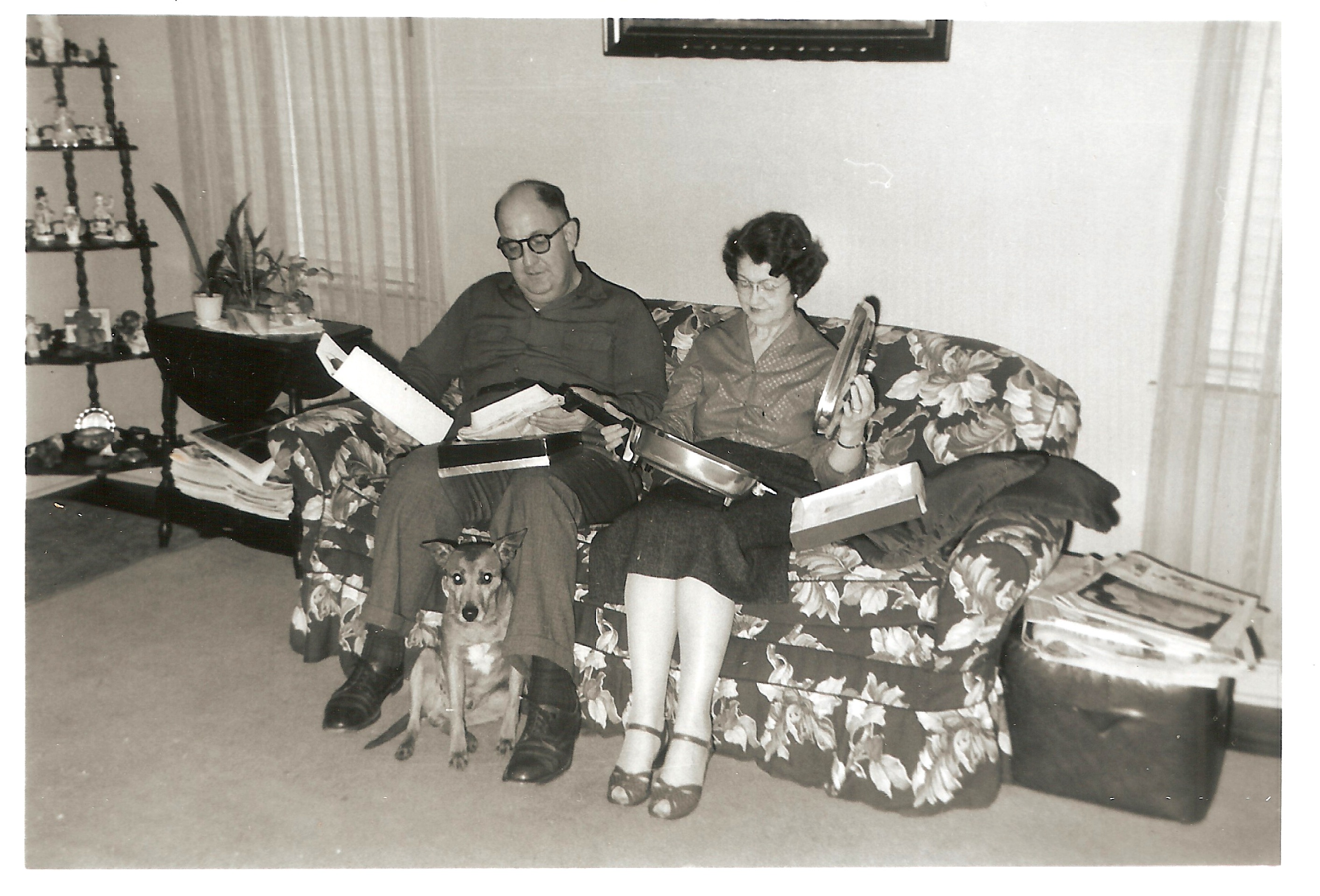
Wayne Bruness and Ron Huggler posed in the Huggler living room at 4613 Young Avenue on Christmas Day c1947. 
g
Ron Huggler and Patrick c 1952 at the Huggler home at 4613 Young Avenue.

Ron Huggler stood at his patrol post in the winter of 1951, Behind him you can see 4658 Brookville Road.

Meanwhile on nearby Farrington Avenue in 1949!! (Hoosier Chronicles)


Sources:  Ron Huggler, "The Best of Times: Random Thoughts on My Journey to Now," Unpublished memories of life on Young Avenue, 2006; Interview with Ron Huggler, January 23, 26, February 1, 2023. I also wish to thank Mike Widner. 

Saturday, March 11, 2023

Neighbors Along Young Avenue

     Many families moved into the newly-constructed houses in the Christian Park Heights subdivision in the 1940s. John and Helen Huggler found their forever home at 4613 Young Avenue in 1942. They raised their son, Ron, in the modest two-bedroom bungalow. Mr. Huggler documented many of the neighbors along Young Avenue. They socialized together and their children grew up together.  As World War II raged, many family members sent spouses and children off to war. Mr. Huggler served as the air-raid warden for the community. Families planted victory gardens. Children participated in paper and scrap drives. 

     Most of the kids from the neighborhood attended IPS #82  adjacent to Christian Park. Teenagers enrolled at nearby Howe High School or Arsenal Technical High School. Ron Huggler, who grew up in Christian Park Heights, noted that the neighborhood was close-knit. 

Ron Huggler grew up at 4613 Young Avenue. His father, John Huggler, photographed several families who resided along Young Avenue. In this image, young Ron posed with his dog Patrick. The photo was snapped in 1947. Behind Ron, you can see several of the residences in the 4600 block of Young Avenue.

The Dudley Family, 4605 Young Avenue

    Art and Faustina Dudley along with their daughter, Cathy, moved into the Christian Park Heights neighborhood in the early 1940s. Mr. Dudley was a plumber for several companies. He occasionally received calls from his neighbors, and according to Ron Huggler, Mr. Dudley always made time to help unclog a drain or fix a leaky faucet. The house became a gathering spot for many neighborhood kids especially on hot summer days as the Dudleys filled an inner tube with water and let the kids cool off. Art Dudley and John Huggler remained friends throughout their lives. 

Faustina and Art Dudley stood in front of their home at 4605 Young Avenue c1943 (photo courtesy of Ron Huggler)

Art Dudley hosed down Cathy Dudley, Johnnie Robeson, Karen Moore, Alan Miller, and Bob Butler in the front yard at 4605 Young Avenue on a hot summer day c1945. Behind the kids, you can see 4610, 4614, 4618, and 4622 Young Avenue. (photo courtesy of Ron Huggler)

Ron Huggler, who lived at 4613 Young Avenue, posed with Cathy Dudley in her front yard at 4605 Young Avenue. Both kids were only-children and grew up as brother and sister. The photo was likely snapped in 1943 in the front yard of 4605 Young Avenue. Behind the kids, you can see 4610 and 4614 Young Avenue. (photo courtesy of Ron Huggler)

   The McKinney Family, 4609 Young Avenue

     Raymond and Mary (Mae) McKinney moved into their bungalow at 4609 Young Avenue in 1943. Mr. McKinney worked for the E.C. Atkins Company for years and later as a representative for the American Saw & Manufacturing Company. Their only son, Raymond McKinney, Jr. served during World War II so there were likely many anxious nights in the home. Thankfully, Raymond, Jr. returned home after the war. The couple did not live in the residence for very long as they moved to 1104 North Leland Avenue by the end of the decade. 

Raymond and Mae McKinney (4609 Young Avenue) visited with the Dudley family at 4605 Young Avenue c1943.  (photo courtesy of Ron Huggler)

Raymond and Mae McKinney relaxed in their backyard at 4609 Young Avenue c1945. Mr. McKinney planted the Lombardy Poplar trees seen in the photo. They were one of the first families to fence in their backyard along the block. They also had one of the earliest television sets. (photo courtesy of Ron Huggler)

Raymond P. McKinney, Sr. landscaped his yard at 4609 Young Avenue c1943 (photo courtesy of Ron Huggler) 

The Mauzys, 4617 Young Avenue

      Merritt and Evangeline Collins Mauzy briefly lived in Christian Park Heights following their marriage in 1943. Mr. Mauzy served the country during World War II and attended the IU School of Medicine. He eventually became a plastic surgeon. Mrs. Mauzy was an accomplished soloist and a graduate of the IU School of Music. She is not pictured in the photographs below. We are still trying to identify the woman in the photos but she is possibly Merritt's mother, Verlie Mauzy. The children in the photos belong to the Teeguarden family of 4621 Young Avenue. Dr. Mauzy and Mrs. Mauzy relocated to West Virginia and  divorced in the early 1950s. Evangeline, who went by the stage name of Jenny Collins, went on to a highly successful singing career in Paris and on Broadway in New York. She married a French athlete and painter named Jacque Maloubier. All of that was far into the future from the photos below. On this date sometime in either 1942 or 1943, John Huggler, who resided at 4613 Young Avenue grabbed his camera and snapped some photos of his new neighbors. 

An unidentified woman posed with Merritt Mauzy and Linda and Bethany Teeguarden c1943 in front of 4617 Young Avenue. The woman might be Verlie Mauzy, the mother of Merritt Mauzy. The Teeguarden children resided at 4621 Young Avenue. (photo courtesy of Ron Huggler)

An unidentified woman posed with Merritt Mauzy in front of 4617 Young Avenue c1943. The woman might be Verlie Mauzy, the mother of Merritt Mauzy.  (photo courtesy of Ron Huggler)

Ron Huggler, Linda Teeguarden, Wayne Bruness, and Bethany Teeguarden stood in front of the Huggler home at 4613 Young Avenue c1942. Behind the kids you can see part or all of 4618, 4622, 4626, 4630, and 4634 Young Avenue. (photo courtesy of Ron Huggler) 

Stodgill Family, 4614 Young Avenue

     Robert (Bob) and Bernadette Stodgill were the second residents of 4614 Young Avenue. Donald and Jane Smith were the first to dwell in the home. The Stodgills were best friends with the Hugglers at 4613 Young Avenue. Ron Huggler reported that his parents frequently hosted card parties or board games with their neighbors. The Stodgills later moved to Texas but returned in the summer of 1984 to visit their good friends along Young Avenue. 

Bernadette and Bob Stodgill returned to their old neighborhood to visit John and Helen Huggler at 4613 Young Avenue in August of 1984. They had moved to Texas. (photo courtesy of Ron Huggler)


Next Up:  The Young of Young Avenue

Sources:  Interviews with Ron Huggler, the son of John and Helen Huggler, January 23, 26, February 1, 2023; Obituaries--"Arthur Dudley," Indianapolis News, December 4, 1986, 1947; "Faustina Dudley," Indianapolis Star, September 25, 1961, 18; "Raymond McKinney," Indianapolis Star, April 30, 1962, 6; "Mary McKinney," Indianapolis Star, January 26, 1994, 14. Evangeline Collins Maloubier--J. Dorsey Callaghan, "She's About as French as New Paris (Ind.)" Detroit Free Press, May 12, 1956, 11.  


Tuesday, February 28, 2023

Christian Park Heights Developer Resumed Construction as Great Depression Ebbed

      Developers first began construction for housing in the Christian Park Heights subdivision on the former Moore-Christian farm in 1924.  After the stock market crash of 1929 development in the area ceased.  The huge venture encompassed several blocks. Boundaries for the subdivision included the Baltimore & Ohio Railroad to the north,  English Avenue on the south, Worcester Avenue on the east, and Denny Street on the west. Other streets included Young, Farrington, Stratford, Bosart, Drexel, Gladstone, and Grant Avenues, along with Chester Street, and Brookville Road. The crown jewel of the neighborhood was the beautiful Margaret Christian Park. Eventually, the city added IPS #82 at the corner of Worcester and English Avenues to accommodate all of the new families who had moved into the area. 

Grinslade Co. constructed several homes along Young Avenue in late 1941. This view shows the 4600 block in the winter of 1942. (photo courtesy of Ron Huggler)

Faustina and Art Dudley stood in their backyard at 4605 Young Avenue in 1942. The photographer is facing west. (photo courtesy of Ron Huggler)

A Baist map shows the Christian Park Heights subdivision to the city of Indianapolis. Construction halted during the Great Depression and resumed in the early 1940s. (IUPUI Digital Collections)

     In the early 1940s, the Grinslade Company began construction on smaller two and three-bedroom homes in Christian Park Heights. Buyers had about five options for floor plans. In 1941, two-bedroom homes cost $3500 and three bedrooms started at $4400. The new construction represented the future of housing developments in its conformity, mass production, and speculation. Those who could afford a house in Christian Park Heights had an opportunity to obtain the American dream. Although there appeared to be no racist covenants in the charter, the first residents of the community were overwhelmingly white. A previous Grinslade development, Millerdale, just east of Christian Park Heights did have a racist covenant. Diversity among the population would not come until much later. 

     In the winter of 1942, the Grinslade Company placed ads in the local newspapers announcing the newest homes available for purchase. One of those residences included a modest two-bedroom house complete with a living room, dinette (smaller than a dining room), kitchen, bathroom, basement, and a one-car garage at 4613 Young Avenue. None of the houses had front porches, but some had covered stoops. All of the houses, including 4613, had been whitewashed. Some had shutters. John H. and Helen Huggler toured the house shortly after it was advertised and placed an offer. They moved into the pretty bungalow in March of 1942 with their young son, Ron. 

The Huggler home at 4613 Young Avenue in 1942. (photo courtesy of Ron Huggler)

An ad for 4613 Young Avenue appeared in the Indianapolis Star, January 25, 1942. 

John and Helen Huggler lived the rest of their lives at 4613 Young Avenue. They posed for this photograph on Christmas Day c1950. (photo courtesy of Ron Huggler)

John and Helen Huggler in their home at 4613 Young Avenue, Christmas Day, c1950. (photo courtesy of Ron Huggler)

Linda and Bethany Teeguarden posed with Ron Huggler along the front walk of the Huggler home at 4613 Young Avenue. The Teeguardens resided at 4621 Young Avenue c1942. Behind the kids, you can see 4610, 4614, and 4618 Young Avenue. (photo courtesy of Ron Huggler)

     The Hugglers had been renting since their marriage. Like most new residents, they took out a mortgage in order to be able to pay for the house. Their son Ron reports that at first they were worried about the monthly mortgage payment at $19.46. Mr. Huggler earned a living first as a truck driver and later as an employee of what would become US Naval Avionics on North Arlington Avenue and East 21st Street. Mrs. Huggler, a talented musician, stayed at home and raised their son. The family inherited a 1929 Hupmobile, which they used for years as the family car. 

John Huggler stood next to the front door of his home in the living room of 4613 Young Avenue in 1943. The Hugglers later painted the woodwork and removed the wallpaper. (photo courtesy of Ron Huggler)

Patrick, the beloved family pet, posed in front of Helen Huggler c1950 in the living room at 4613 Young Avenue. (photo courtesy of Ron Huggler) 

Cathy Dudley of 4605 Young Avenue posed for a photo with Ron Huggler along the entry sidewalk at 4613 Young Avenue in 1942. Behind the kids you can see 4622, 4626, 4630, and 4634 Young Avenue. (photo courtesy of Ron Huggler)

Ron Huggler (left) played Monopoly with his buddies Wayne Bruness and Dale May in the living room at 4613 Young Avenue c1953. (photo courtesy of Ron Huggler)

Ron Huggler placed a pole in the ground for a badminton tournament in his front yard at 4613 Young Avenue along with his friends, Alan Miller and Wayne Bruness c1951. Behind the boys you can see 4614 and 4618 Young Avenue. (photo courtesy of Ron Huggler) 

John Huggler proudly posed with his son, Ron, who was preparing to leave for basic training for the National Guard, in the front yard of 4613 Young Avenue in 1963.  (photo courtesy of Ron Huggler)

Helen Huggler, a devoted Mom, posed next to her son, Ron Huggler in the front yard of 4613 Young Avenue in 1963 for the same occasion as in the photo above. (photo courtesy of Ron Huggler)

In late 1942, John Huggler inherited a 1929 Hupmobile from his Aunt Dessie Ault. The huge automobile became the Huggler family car for years. In this photo, snapped in 1950 on a road trip to Florida, Ron and Helen Huggler posed next to the car at a roadside motor court in Georgia. The car had window blinds and a foot rest in the backseat. (photo courtesy of Ron Huggler) 


    For young "Ronnie" Huggler, the new neighborhood seemed like paradise as there were many young families with children living in most of the houses. 

Next:  Neighbors Along Young Avenue

     This post would not have been possible without Ron Huggler, the historian for Christian Park Heights. He has been documenting the history of the area for years. Every neighborhood needs someone like him! 

Sources: Interviews with Ron Huggler, January 23 and 26, 2023; McCords-Dirks Mortgage Company document, 1942, courtesy of Ron Huggler; "Christian Park Heights 'Where the Boulevards Meet," Indianapolis News, May 17, 1924, 36: Abstract for Lot 41 in Millerdale Addition courtesy of Mike Widner. 

Tuesday, January 31, 2023

Rufus Hammons First Black Politician in Irvington

      Editor's Note: After a hiatus of several months, I have returned to Vintage Irvington. I hope to add many more stories and historic photographs in the coming year. 


     William and Delphia Hammons along with their six children would be among the very first residents of Irvington when they moved into a cottage near the Pennsylvania Railroad in the early 1870s. The path for the couple had not been an easy one as they had both been born into slavery in North Carolina. Less than a decade after the Civil War, they moved north to Indiana and into the new community of Irvington. Mr. Hammons found work in a variety of laboring jobs. Journalist Elizabeth Carlyle noted in an Indianapolis Star article in 1929, that he helped to build some of the structures on Butler's Irvington campus in the mid-1870s. Grace Julian Clarke, a prominent white resident and suffragist, noted in one of her columns in the Indianapolis Star in 1938 that the name of William Hammons appeared in the ledger of Shank's Store in 1877. The Hammons family would have been known by most of the earliest people to settle in the area. 

     The 1880 Federal Census and city directories indicate that William and "Delphey" Hammons lived in a small house located at 240 Good Avenue. Today, Mr. Hammons would be noted as biracial, but in 1880 the census taker noted that he was "mulatto."  His occupation was simply listed as a laborer and that he could read and write. He was 47. Others noted in the 1880 enumeration included his thirty-four-year-old wife, Delphey; his sons, Rufus, age 12; William Wade, age 1, and a daughter, Vandora, age 6. The census taker marked out the name of Judge, who was less than a year old. This action indicated that he had recently died. His homemade tombstone along with numerous other members of the family rests in the Anderson Cemetery on East 10th Street. They would later have two additional children, Elmer and Carrie.

In 1929, journalist Elizabeth Carlyle interviewed Rufus Hammons, the son of William and Hammons, for the Indianapolis Star. 


The Hammons' plots are located north of East Tenth Street in the Anderson Cemetery. The tombstones have been recently cleaned. Many of the stones were hand carved. (photo snapped on January 24, 2023)

Judge or "Judgy" died before his first birthday. Someone hand-carved his name into the tombstone.

The census taker marked out Judge's name to indicate that he was deceased. I had never encountered this before but it was a common practice used at the time. 


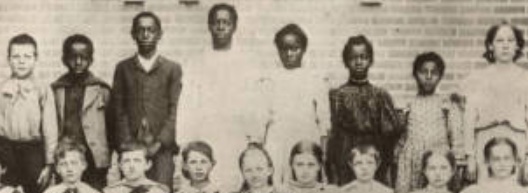
Carrie Hammons, the youngest child of William and Delphia Hammons, can be seen this 1896 Irvington School photograph. Top row: L to R: Bill Judkins, Levi Brock, Dady Compton, Unknown, Cora Rehm, Pansy Brock, Carrie Hammons, Tillie Whistler (Cropped from a much larger photograph belonging to the Irvington Historical Society)

     Rufus Hammons (1862-1945), the oldest son of William and Delphey Hammons, lived all but ten years of his life on Good Avenue in Irvington. At the age of 34 years old in 1896, he made history when he became the first African-American to run for political office from the neighborhood. In the mid to late 1890s, a group of Irvington men tried to purge "party politics" from the town offices. Irvington had not yet been annexed by the city of Indianapolis so the community still elected trustee, clerk, and marshal positions. Not everyone in the neighborhood went along with the plan including many in the Republican Party. Mr. Hammons won the nomination to serve as the Republican candidate for Town Marshal against Samuel Smith, who aligned with the non-party faction. In the late 1890s, the Republican party was still known as the party of Lincoln and most African-American men in the nation supported Republicans on the ballot. For Rufus Hammons it must have been an incredible milestone in his life as he had been born into slavery. 

     When the votes were counted, Samuel Smith soundly defeated Rufus Hammons 178 to 90. Even though Mr. Hammons lost the election, numerous white people in the community still voted for him. He made history on that day. He went on to remain active in organizations throughout his life. He was a leader in the Frederick Douglas Lodge No. 7 of the Knights of Pythias. The black-owned Indianapolis Recorder noted meetings and celebrations held at his Good Avenue home. On August 20, 1903, he hosted a lawn fete complete with a brass band. Admission to the event was free. He and his wife, Susie, raised their children in Irvington and attended the nearby First Baptist Church. His father and mother lived next door at 240 Good Avenue for many years. He earned his living working at the Layman & Carey Hardware Store. Some of his children went on to remain actively involved in Irvington as well. 

     In 1929 and the age of 57, Rufus Hammons told the journalist Elizabeth Carlyle, as he stood next to his bicycle, "I can turn a summersault backwards today." He had been a gifted athlete and acrobat in his younger days. He even auditioned for the P.T. Barnum Circus as a young man. When she inquired why he preferred riding his bike he told her, "I've walked, rode stage coaches, mule cars, dummies, battery storage cars, trollies and automobiles, but people are traveling too fast today to suit me."  He lived until he was 82 years and died at his home on Good Avenue in 1945. 

A Baist map shows Good Avenue north of Dewey Avenue and south of Bonna Avenue in 1908. You will note that the First Baptist Church had not yet built their new structure on the block yet. That happened in 1910. (IUPUI Digital Collections) 


Willliam and Delphia Hammons lived at 240 Good Avenue shown above. Next door, Rufus and Susie Hammons resided at 234 Good Avenue. (demolished) Other descendants also lived on the block. They attended church across the street at First Baptist. (photo Google Streetview, July 2011) 


     I wish to thank James Robinson, Anne Hardwick, and Steve Barnett for their help with this post. We would love to know more about this talented family. If you are a descendant, drop me an email at williamfranklingulde@gmail.com. 

Sources:  William Hammons--Grace Julian Clarke, "Geometrical Flower Beds of Olden Times Recalled," Indianapolis Star, November 1, 1925, 65; 1880 Federal Census; William and Rufus Hammons--Elizabeth Carlyle, "Son of Slaves, Resident Here 57 Years, Still Good Acrobat," Indianapolis Star, June 21, 1929, 72; Rufus Hammons--Election of 1896-"At Irvington," Indianapolis Journal, May 5, 1896, 8; Knights of Pythias--"Notice," Indianapolis Recorder, August 15, 1903; Obituary--"Hammons Burial Friday," Indianapolis News, January 14, 1945, 34.


Friday, September 23, 2022

IPS #77 Dedication, November 14, 1951


     Last year the Irvington Historical Society acquired a recording of the dedication of I.P.S. #77 and then had it digitally converted so that voices from 71 years ago could now be heard again. 

Indianapolis Public School #77 c1951 (courtesy of the Indianapolis Marion County Public Library)

Indianapolis Public School #77 c1951 (courtesy of Indianapolis Marion County Public Library)


     On Wednesday evening, November 14, 1951, hundreds of families gathered for the dedication of School #77 at 6040 East Pleasant Run Parkway South Drive. Designed by Wilbur Shook, the beautiful mid-century building had not been open for very long. Residents assembled in the Delker Auditorium for the formal ceremony at 8:00PM.

The Delker Family

   Christian and Barbara Kuhner Delker lived for decades in a farmhouse that faced Pleasant Run Parkway South Drive (formerly known as Shelley Street) near Arlington Avenue. For years, the school children who attended the portable classrooms at School #77 could see the Delker home and the large red barn. The Delkers were kindly neighbors to the school and often gave the students refreshments and treats. They didn't mind if the children walked on their property. Eventually, they sold the land to the Indianapolis Public Schools, but they asked to live out the remainder of their lives in the old farmhouse. Mr. Delker passed away first in 1942. After Mrs. Delker's death in 1949, the house and barn were leveled to make room for a new school building. To honor the family, the school built an impressive auditorium that could also be used by the public. They named it the Delker Auditorium.

Cathryn Boggy Assumes the Role of Principal


Cathryn Kuemmick Boggy (Indianapolis Marion County Public Library)

     Northern Irvington residents grew weary of the four-classroom building located on Arlington Avenue north of Pleasant Run Parkway. Their children had to attend other nearby schools for fifth through the eighth grade. After some intense lobbying by local residents, the district agreed to build a new school to replace the small building and house children up to the eighth grade. The school was to be named for a beloved teacher, Miss Anna Pearl Hamilton, who passed away in 1948.  Construction started in 1950, but delays occurred over post-war shortages. 

     To lead the new school, the district appointed Cathryn Boggy (1907-1987). Mrs. Boggy had been a teacher for many years at I.P.S. and would serve as the principal for the School #77 for twenty years beginning in the 1947-48 school year.  

      Mrs. Boggy noted in an oral history, conducted in 1981, that the children in the older school became very interested in the construction of the new building. The superintendent of construction frequently informed the children on what would be happening daily on the site. Mrs. Boggy recalled that on the day that the old red barn was pulled down by tractors, the entire structure fell into a pile of dust. She thought that the children might cheer upon seeing the demolition but they stared in silence. She never forgot that moment. On another day, the contractor brought in one of the blond bricks used to clad the new structure. The teachers designed lessons around the events happening outside their windows. 

The red lines show where the new school was to be built. In the upper left hand corner, you can see the outline of the portable classroom building that faced Arlington Avenue. Below you can see the Delker house and outbuildings, including a large red barn. The house faced Pleasant Run Parkway and was torn down along with all of the other farm buildings to make way for the new school. (Courtesy of Indianapolis Marion County Public Library) 


A New School is Dedicated

     On September 12, 1951, Dr. Herman L. Shibler, the Superintendent for the Indianapolis Public Schools, informed Mrs. Boggy via a memo that she was to prepare the dedication program. He was very specific with his instructions in that students were to be part of the program and that the event would take place on Wednesday evening, November 14, 1951.  Thankfully, someone recorded the event.

     We do not know the names of the children who participated, but their voices can be heard throughout the recording so perhaps someone listening will recognize either themselves or a loved one. Parents and community members filed into the new auditorium while students who were not in the ceremony reported to their classrooms with their teachers. They would listen to the skits and speeches over the new public address system funded by the Irvington Lions Club.

     At 8:00PM an older student can be heard welcoming the guests. Another student asked the question, "What does it mean to dedicate a building?" A third student introduced the first skit which attempted to answer the question while another pupil performed the school song on the accordion. Then, a small group sang the school song a cappella. It sounds like members of the audience also joined in. In a second skit, additional kids discussed the importance of Anna Pearl Hamilton, for whom the school was named and of the kindly Delker family. 

     In the early 1950s, the United States was fighting a war in Korea and an imaginary war against communists at home. There was also very little separation of church and state in that era. After the students wrapped up their well-rehearsed skits, another child led the community into a dedication prayer culminating with an "amen." The junior high choir sang two Christian hymns, "Holy, Holy, Holy," and "Bless This House."

     Mrs. Boggy then had the task to introduce the many dignitaries on the stage and there were many! Not all of the adult speakers were as interesting as the children. Wilbur Shook, the architect of the school, presented the key to Mrs. Louis Bruck, the school board representative for Irvington. Mrs. Bruck spoke next and she reminded Mr. Shook that this was the second school key she had received from him as she had been pivotal in lobbying for Thomas Carr Howe High School, which opened in 1938.  Dr. Herman Shibler, the school superintendent, used a sports analogy in his speech. (Lean into the ball and you will have a higher batting average.) He also spoke of moral and spiritual values and good citizenship. Mrs. Robert Platte, the local P.T.A. president, had the task of introducing members of the Delker family and of the Hamilton family along with the "Survey Committee." The tape suddenly ends during her speech. To listen to these voices from the past click on the Sound Cloud link below.

Letter from Dr. Shibler to Cathryn Boggy,  September 12, 1951 (courtesy of Indianapolis Marion County Public Library)

Dedication Program for IPS #77 (courtesy of Indianapolis Marion County Public Library)


To listen to the dedication, click on the link below.

IPS #77 Dedication

To listen to the interview with Cathryn Boggy, click on the link below.

Interview with Cathryn Boggy, 1981


Sources: Delker Family--1900, 1910, 1920, 1930, and 1940 Federal Census, Find-a-Grave, Delker obituaries in Indianapolis newspapers, 1942, 1949; Cathryn Kuemmick Boggy--Oral History conducted by Rosemary Dilley with the Brown branch of the Indianapolis-Marion County Public Library; "Cathryn Boggy Funeral Saturday," Indianapolis News, May 27, 1987, 46; Dedication of school--"Dedication of Three New Elementary School Buildings to Mark Education Week," Indianapolis Star, , November 11, 1951.